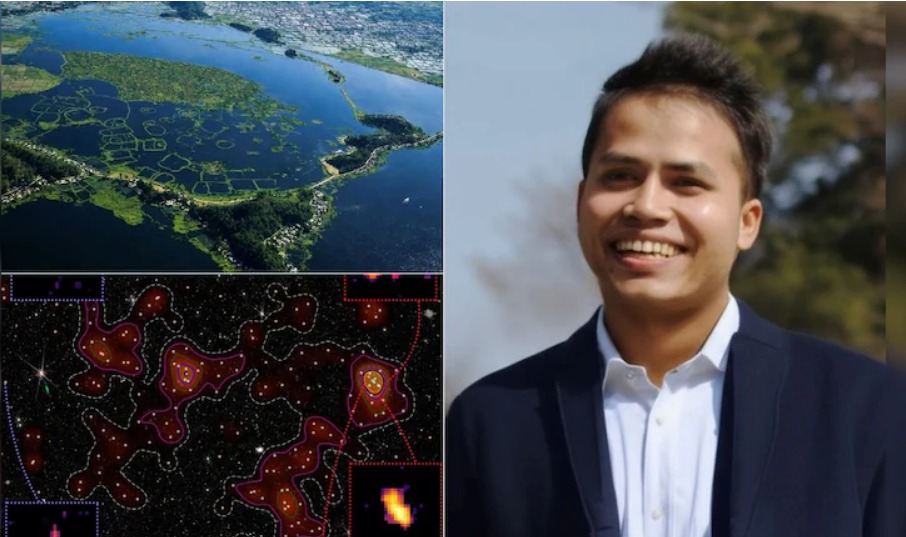
An Indian astrophysicist has led a global team to discover a gigantic structure of young galaxies from the early universe, dating back 12.6 billion years, and named it the Loktak Protocluster after Manipur’s famous Loktak Lake. Described as a sprawling “city of galaxies,” the protocluster offers a rare window into how today’s massive galaxy clusters first began to take shape when the cosmos was still very young.
The discovery, driven by Dr Ronaldo Laishram of Manipur, now at Japan’s National Astronomical Observatory, uses data from powerful telescopes to trace four dense concentrations of galaxies bound together in one evolving structure. The find is being hailed as both a scientific milestone and a proud moment for India’s growing footprint in frontline astrophysics.
Peering Into The Early Universe
The Loktak Protocluster is seen as it existed roughly 12.6 billion years ago, when the universe was only about 1.2 billion years old. That means astronomers are effectively looking back to a time when some of the earliest large scale cosmic structures were still assembling under gravity, long before galaxy clusters took on their present form.
Why The Name Loktak Matters
Laishram chose the name to mirror the way four separate galaxy concentrations are connected inside one vast system, much like the floating pyramids of Loktak Lake forming a linked landscape within a single body of water. The choice ties cutting edge cosmology to cultural roots in Manipur, turning the lake into a metaphor for how the universe itself knits structures together over time.
What Scientists Hope To Learn Next
Researchers will now use the Loktak Protocluster as a natural laboratory to study how dense cosmic environments influenced galaxy growth, star formation and black hole activity in the universe’s first billion years. Comparing galaxies inside this packed region with those in quieter surroundings at the same epoch could sharpen theories on why some clusters evolve into today’s giant cosmic cities while others remain relatively sparse.
Key Highlights
- Discovery of the Loktak Protocluster, a 12.6-billion-year-old “city of galaxies” in the early universe
- Structure named after Manipur’s Loktak Lake by lead scientist Dr Ronaldo Laishram
- Protocluster comprises four connected galaxy concentrations seen when the universe was only about 1.2 billion years old
- Find offers a new laboratory to study how dense environments shaped early galaxy and cluster evolution
Sources: NDTV Science explainer, Moneycontrol science report, India Today NE coverage and regional press on the Loktak Protocluster discovery and Dr Ronaldo Laishram’s work