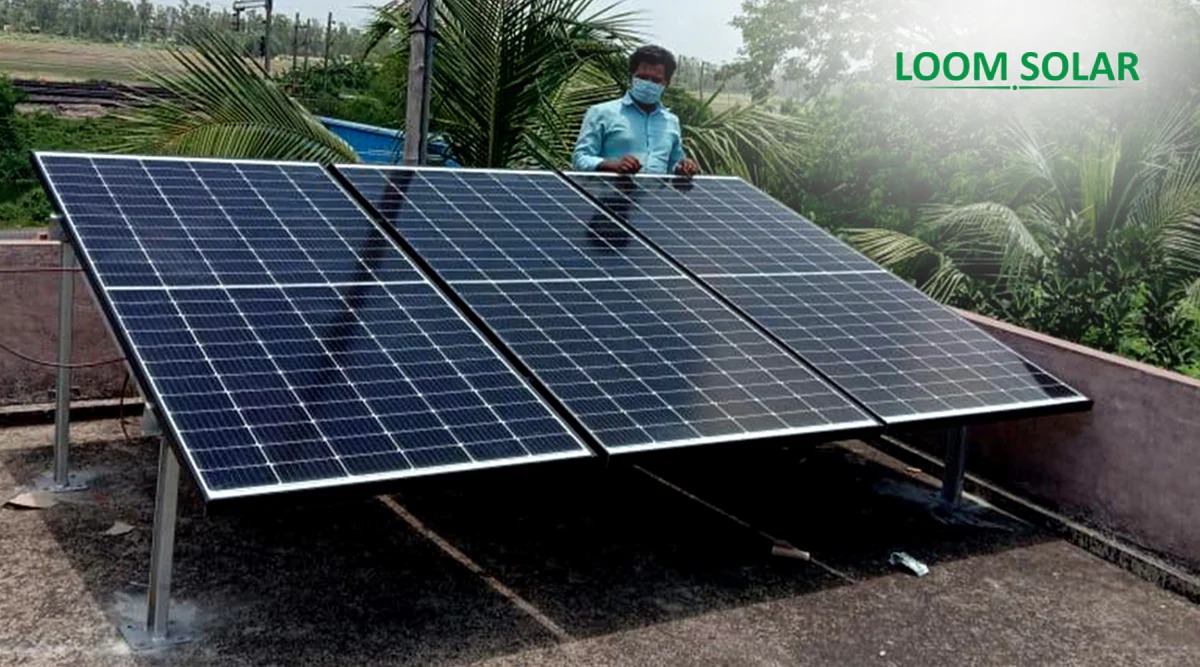
Loom Solar has achieved a historic ₹1,000 crore annual revenue milestone in FY26, driven by a rapid scale-up in indigenous manufacturing of solar modules and battery storage solutions. The Faridabad-based company continues to expand its production capacity across Uttar Pradesh and Haryana to meet surging domestic renewable energy demand.
Loom Solar, one of India’s fastest-growing solar technology manufacturers, has officially crossed the ₹1,000 crore annual turnover milestone for the 2026 fiscal year. This achievement marks a significant point in the company's journey, which began eight years ago as a bootstrapped startup focused on bringing solar energy to rural and Tier-3 markets.
The company’s growth has accelerated significantly over the past three years, with revenue climbing from ₹151.46 crore in FY24 to ₹396.52 crore in FY25. According to financial data, the momentum continued into the current year, with the firm reporting a top-line figure of ₹581.52 crore in just the first nine months of FY26.
Scaling Manufacturing and Innovation
The company’s transition from a trade-focused business to a full-stack integrated manufacturer has been central to its success. Loom Solar now operates in the rooftop, commercial, and utility-scale solar segments, with a portfolio spanning high-efficiency modules—including SHARK Bifacial, TOPCon, and HJT technologies—as well as Battery Energy Storage Systems (BESS) and hybrid inverters.
To support this demand, Loom Solar is currently executing a massive expansion of its manufacturing footprint:
Capacity Expansion: The firm is scaling its Palwal facility from 50 MW to 300 MW.
Greenfield Projects: A new 300 MW integrated manufacturing facility is under development in Kosi, Uttar Pradesh.
Storage Hub: Planning is underway for a 1 GWh battery storage hub in Meerut, Uttar Pradesh, to capitalize on the growing demand for grid-stabilizing energy storage.
Strategic Government Alignment
Loom Solar has become a key player in supporting national clean energy objectives, including the PM Surya Ghar: Muft Bijli Yojana. By aligning its distribution and product capabilities with government-backed rooftop solar schemes, the company has managed to scale its network to over 10,000 dealers across India.
“When we founded Loom nearly eight years ago, solar energy in India was largely confined to select urban pockets,” said Amod Anand, Co-Founder and Director of Loom Solar. “Today, crossing ₹1,000 crore in turnover is not just a business milestone; it is proof that the vision of democratizing solar energy in India is becoming a reality.”
Official Sources
The company’s financial performance and expansion plans have been verified through recent credit rating rationales and public project announcements. Loom Solar recently secured a second land allotment from the Uttar Pradesh government for its manufacturing expansion, a move formalized in Lucknow in the presence of Chief Minister Yogi Adityanath.
Why It Matters
For India’s renewable energy sector, Loom Solar's growth demonstrates the scalability of indigenous manufacturing in the face of global supply chain volatility. By integrating both solar power generation and battery storage solutions (BESS), the company is addressing the "system readiness" challenge that often hampers large-scale solar adoption. This success story offers a roadmap for other startups aiming to bridge the gap between rural energy poverty and the national transition toward sustainable, fossil-free power.
Key Facts at a Glance
Revenue Milestone: Crossed ₹1,000 crore in annual turnover for FY26.
Rapid Growth: Revenue grew from ₹151.46 crore in FY24 to nearly ₹400 crore in FY25, with further acceleration in FY26.
Product Portfolio: Specializes in TOPCon/HJT modules, BESS (Battery Energy Storage Systems), and hybrid inverters.
Manufacturing Expansion: Developing multi-GW capacity across Palwal, Kosi, and a new 1 GWh battery hub in Meerut.
Market Reach: Operates a network of over 10,000 dealers across the country.
FAQ
How has Loom Solar managed to scale so quickly?
The company credits its growth to a shift from trading to in-house manufacturing, combined with a strong B2B strategy and deep penetration into the rural/Tier-3 rooftop solar market via government-supported schemes.
What is the significance of the new Meerut facility?
The Meerut site is designed to integrate energy storage manufacturing (BESS) into the company’s roadmap, which is essential for stabilizing grid power and supporting large-scale solar projects.
Is Loom Solar involved in the PM Surya Ghar scheme?
Yes, Loom Solar is one of the leading vendors registered under the [suspicious link removed], providing high-efficiency rooftop solar systems to households across India.
Source: Loom Solar Official Press Room, Saur Energy International, Brickwork Ratings Rationale 2026, Ministry of New and Renewable Energy (MNRE)