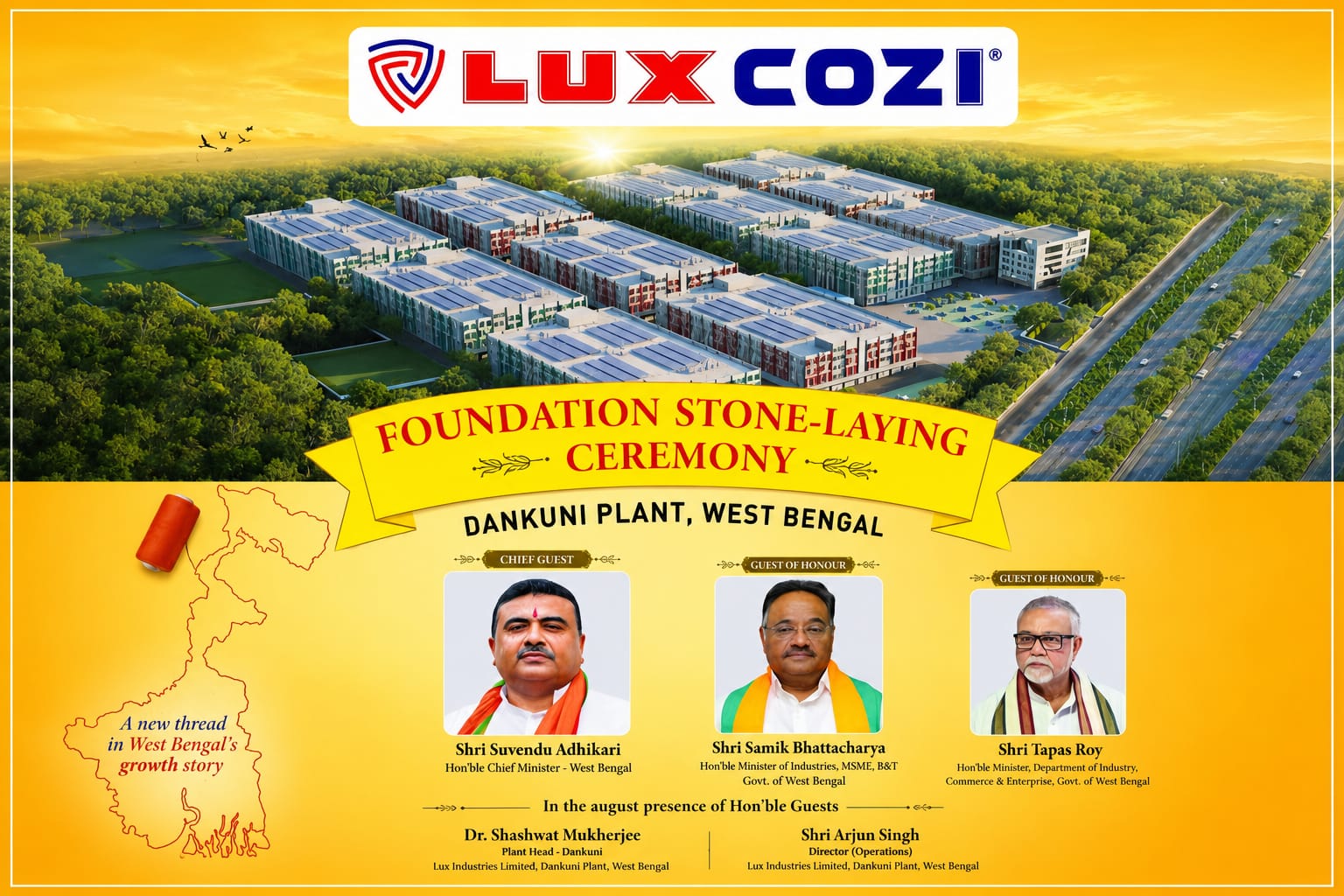
Lux Industries has broken ground on a ₹600-crore automated expansion of its Dankuni hosiery manufacturing unit in West Bengal. The expansion scales the site to 20 lakh square feet, tripling its annual production capacity to 32 crore pieces. The project will generate 9,000 jobs and target ₹1,000 crore in incremental revenue.
DANKUNI, INDIA — In a major boost to eastern India's textile sector, apparel manufacturer Lux Industries Limited officially broke ground on a massive ₹600-crore manufacturing expansion at its Dankuni facility in the Hooghly district of West Bengal. Announced on July 11, 2026, the milestone infrastructure project will add 12 lakh square feet of highly automated production space to the existing 8-lakh-square-foot unit. Upon its completion over a phased six-year timeline, the integrated 20-lakh-square-foot campus will rank as one of Asia's largest garment manufacturing plants, signaling strong industrial green shoots for the regional economy.
The expansion is strategically designed to address rising consumer demand across domestic and international markets, while positioning West Bengal as a centralized powerhouse for premium hosiery and outerwear production.
Driving Scale, Jobs, and Economic Growth
The financial blueprint of the expansion targets a massive output scale. The new infrastructure will introduce an additional annual capacity of 20 crore garment pieces to the existing plant's 12 crore capacity, lifting the Dankuni plant's output ceiling significantly. This development elevates the nationwide annual production capacity of the Lux Cozi group from nearly 20 crore pieces to approximately 36 crore pieces.
According to financial projections submitted by the company, the expansion is expected to generate an incremental annual revenue of ₹900 crore to ₹1,000 crore upon reaching optimum capacity utilization. The project will be financed through a balanced mix of internal accruals and external borrowings, with an estimated payback period of five years.
For local communities, the primary impact lies in massive employment generation. The automated facility is projected to create approximately 3,000 direct jobs and 6,000 indirect employment opportunities, offering a critical livelihood boost to Hooghly and its surrounding districts.
Realigning the Supply Chain with Modern Automation
Beyond pure volume, the Dankuni expansion serves as the operational anchor for the company's long-term business restructuring. By integrating spinning, advanced knitting, cutting, and storage systems under a unified "Vertical A" corporate structure, the brand aims to eliminate regional processing bottlenecks, slash material wastage, and offset rising manual labor costs.
The modern facility comes on the heels of a major domestic licensing agreement with global athletic brand Reebok to manufacture and sell premium innerwear and thermal wear, highlighting a pivot toward high-margin, value-added segments. Financially, the company aims to sustain and build upon its healthy EBITDA margins of 10–12% and a compounded annual growth rate (CAGR) exceeding 25% recorded over the past eight quarters.
Official Sources Section
The operational, logistical, and financial details of this industrial footprint were confirmed through official corporate statements issued by Lux Industries Limited, alongside statutory regulatory filings detailing capital expenditure allocations, capacities, and the group's ongoing corporate demerger strategy. West Bengal state executives and industrial regulatory bodies provided background context regarding fast-tracked single-window land acquisition policies.
Quote Section
Commenting on the strategic expansion, Ashok Todi, Chairman of Lux Industries, stated:
"The Dankuni facility will not only strengthen our production capabilities but will also create meaningful employment, accelerate regional industrial development and contribute to India's emergence as a global textile and apparel manufacturing powerhouse."
Saket Todi, Executive Director of Lux Industries, added:
"The new Dankuni facility represents the next chapter in Lux Cozi Group's manufacturing journey. Built with future-ready infrastructure and significantly enhanced production capabilities, this facility will enable us to respond faster to evolving consumer demand, improve operational efficiencies and reinforce our leadership across the innerwear and apparel industry."
Why It Matters
For investors, the ₹600-crore commitment signals corporate resilience and aggressive market-share consolidation despite broader macroeconomic margin compressions across consumer discretionary segments. For consumers, the automated facility ensures high-quality consistency and speed-to-market for premium innerwear lines. Locally, the project serves as a regulatory bellwether, proving that the state’s streamlined industrial single-window clearance mechanisms can successfully support high-value, large-footprint manufacturing setups without prolonged bureaucratic delays.
Key Facts at a Glance
Total Investment: ₹600 crore total project cost, featuring roughly ₹450 crore in fresh capital expenditure.
Footprint Expansion: Adding 12 lakh sq. ft. to establish a comprehensive 20-lakh-sq.-ft. automated campus.
Production Boost: Triples the Dankuni vertical output from 12 crore to 32 crore garments annually.
Job Creation: Generates 9,000 total jobs (3,000 direct, 6,000 indirect) within the state.
Fiscal Target: Projects up to ₹1,000 crore in incremental annual revenue with a 5-year capital payback target.
FAQ Section
Q1: Where exactly is the new Lux Industries garment facility located?
The expansion is located at the company's core manufacturing ecosystem in Dankuni, situated within the Hooghly district of West Bengal, India.
Q2: How will the project affect the company’s total manufacturing capacity?
The expansion adds 20 crore garment pieces per year, expanding the group’s total nationwide manufacturing capability to approximately 36 crore pieces annually.
Q3: What types of jobs will this facility create for the regional economy?
The unit will generate technical manufacturing, logistics, textile cutting, packing, and quality control roles, supporting 3,000 direct plant workers and 6,000 supply-chain and distribution partners.
Q4: How long will it take for the Dankuni plant expansion to be fully operational?
The industrial project is designed with a phased implementation cycle estimated to take approximately six years to reach maximum operational capacity.
Source: Lux Industries Limited Official Site, Lux Industries Investor Relations Portal