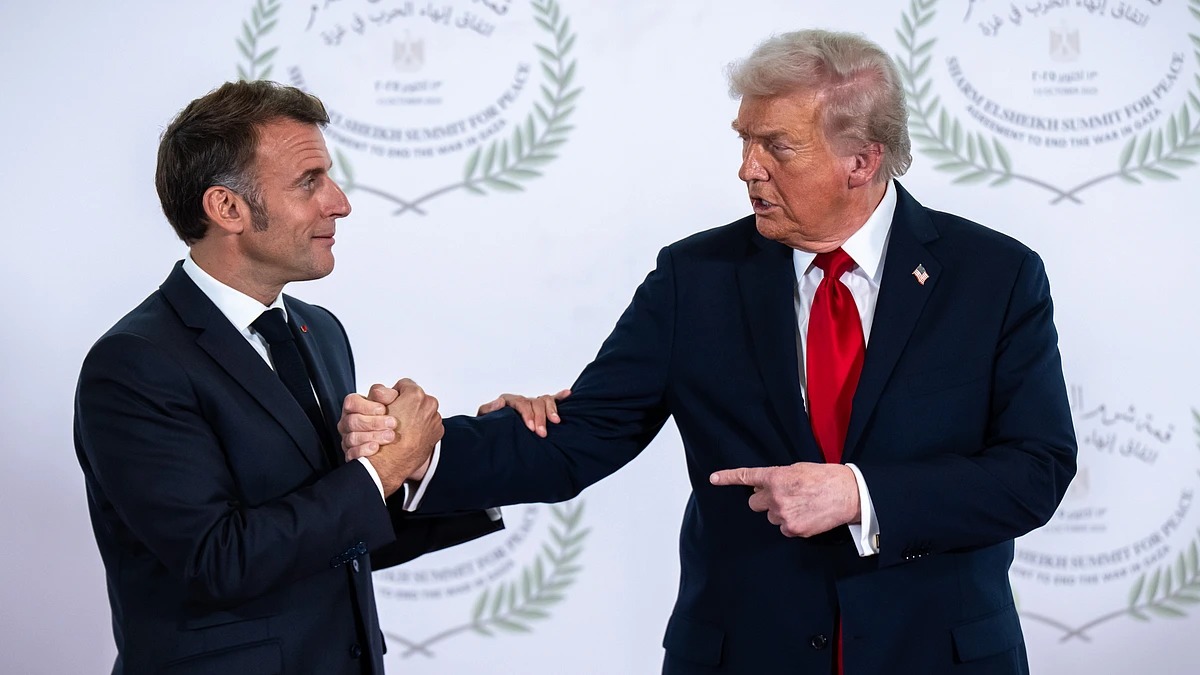
French President Emmanuel Macron hailed the tentative US-Iran peace deal as a vital development for reopening the Strait of Hormuz. Macron announced that a joint Anglo-French naval task force stands ready to deploy to secure the shipping lanes, while firmly rejecting any proposed transit tolls by Tehran.
EVIAN-LES-BAINS — French President Emmanuel Macron has formally welcomed the preliminary peace agreement between the United States and Iran, calling it a "very important step" toward defusing months of intense global economic and military anxiety. Speaking on Monday, June 15, 2026, as world leaders arrived for the 52nd G7 Summit, Macron declared that the Group of Seven nations will mobilize all available diplomatic and strategic resources to ensure the framework deal is implemented and the vital Strait of Hormuz is permanently reopened.
The announcement on French television broadcaster TF1 marks a pivotal opening for the three-day international summit in the alpine resort town of Evian-les-Bains. Macron revealed that France and the United Kingdom have already co-engineered a specialized naval stabilization mission, backed by several European allies, to rapidly clear maritime lanes and secure transit through the Persian Gulf the moment all regional stakeholders finalize the accord.
Anglo-French Naval Mission Stands Ready for Rapid Deployment
To transition the tentative diplomatic breakthrough into a concrete reality, President Macron confirmed that European militaries are prepared to act with immediate effect. The planned maritime deployment is structured to safeguard commercial container ships and oil tankers moving through the narrow waterway, which historically carries roughly 20% of the world's total petroleum supply.
According to the operational details outlined by the French presidency, the multinational deployment framework includes:
Taskforce Composition: A combined naval coalition featuring active operational commitments from the United Kingdom, Italy, the Netherlands, and France.
Carrier Deployment: The French navy's flagship aircraft carrier, Charles de Gaulle, has been placed on high alert and can be stationed in the zone within two to three days.
Specialized Capabilities: The mission will immediately deploy advanced airborne assets, naval frigates, and specialized mine-clearance teams to counter any residual maritime hazards.
Regional Logistics Coordination: The Sultanate of Oman has officially given its administrative consent to cooperate with the international escort vessels.
France Rejects Proposed Shipping Tolls on Sovereign Straits
While welcoming the de-escalation, President Macron drew a firm line regarding international maritime law, issuing a stern warning against any attempts by Tehran to impose unilateral transit fees or tolls on vessels utilizing the Strait of Hormuz. Reports out of regional state media had suggested that Iranian lawmakers were considering charging commercial shipping companies a statutory security fee to offset local defense expenditures.
Defending the High Seas: "This is something we will also discuss," Macron stated during his interview. "It is not in line with international law. We defend international law, and we will do everything to ensure that there is no toll."
The French leader warned that allowing a sovereign country to charge tolls in international straits would establish a dangerous global precedent, threatening traffic across other critical maritime chokepoints like the Malacca Strait or the Bab-el-Mandeb and driving up global consumer prices. Simultaneously, Macron noted that G7 partners will continue long-term strategic plans to diversify supply lines and reduce their systemic dependence on the Persian Gulf corridor.
Neutralization of Enriched Uranium Capital Mandated
A secondary critical condition highlighted by the French head of state centers on the complete degradation of Iran’s nuclear capabilities under the upcoming 60-day negotiation window. Macron asserted that European compliance with any sanctions-relief clauses is strictly contingent upon the total neutralization of Iran's accumulated highly enriched uranium stocks.
The G7 framework demands that these sensitive atomic stockpiles either be physically extracted from Iranian territory or diluted back to non-weapons-grade thresholds. Once neutralized, the underlying storage infrastructure must be placed under the permanent, unhindered verification of the International Atomic Energy Agency (IAEA).
Official Sources Section
The executive policy positions and military deployment metrics detailed in this dispatch correspond directly with the live televised address delivered by President Emmanuel Macron on the French national network TF1. Supplementary strategic coordinates and summit parameters are synchronized with data logs provided by the French Ministry for Europe and Foreign Affairs and the Group of Seven Evian Secretariat.
Quote Section
"According to officials presenting the opening G7 briefs in Haute-Savoie, the sudden announcement of the Washington-Tehran memorandum has completely realigned the focus of the arriving delegations. Host organizers stated that while significant verification challenges remain regarding nuclear dilution timelines, the immediate focus is to project unified Western naval power to keep global shipping open and prevent market volatility."
Why It Matters
President Macron's aggressive push to enforce the US-Iran deal brings clear practical implications for international commercial markets, multinational corporate logistics managers, and retail consumers. The active assembly of a joint European mine-sweeping and escort fleet provides international shipping conglomerates with the concrete insurance guarantees required to resume standard operations through the Persian Gulf without paying exorbitant war-risk surcharges.
By actively opposing any Iranian shipping tolls, the G7 is shielding the global supply chain from a permanent cost increase on crude oil and manufactured goods, ensuring that the tentative ceasefire translates directly into lower fuel prices and reduced inflation for consumers worldwide.
Key Facts at a Glance
Macron Endorsement: The French President formally hailed the new US-Iran framework as a vital step toward regional peace.
Naval Fleet Readied: France and the United Kingdom have organized a joint naval task force to secure the peaceful reopening of the Strait of Hormuz.
Carrier on Standby: The aircraft carrier Charles de Gaulle can deploy to the Persian Gulf within 48 to 72 hours of final political clearance.
Tolls Explicitly Rejected: The G7 has vowed to legally block any unilateral transit fees on shipping, citing international maritime law.
Nuclear Mandate: European leaders demand that Iran’s enriched uranium be completely removed or diluted under direct IAEA supervision.
FAQ Section
What is the primary purpose of the joint Anglo-French naval mission in the Strait of Hormuz?
The mission is designed to ensure the immediate, peaceful, and unhindered restoration of international commercial maritime traffic. The fleet will provide security escorts and carry out specialized mine-clearance operations to safely reopen the waterway.
Why is the G7 firmly opposed to Iran charging tolls in the strait?
Under international maritime law, the Strait of Hormuz is classified as an international highway for commerce. Allowing a state to charge tolls would violate treaties on free navigation, establish a dangerous precedent for other strategic waterways, and drive up prices for global consumers.
What will happen to Iran's enriched uranium under the new agreement?
According to President Macron, the G7 will insist that Iran’s remaining stocks of highly enriched uranium be completely neutralized. This requires the material to either be physically removed from the country or diluted to lower levels under the strict eye of the UN's IAEA.
Source: French Élysée Palace Press Registry, TF1 Television Interview Archives, International Atomic Energy Agency (IAEA) Bulletins.