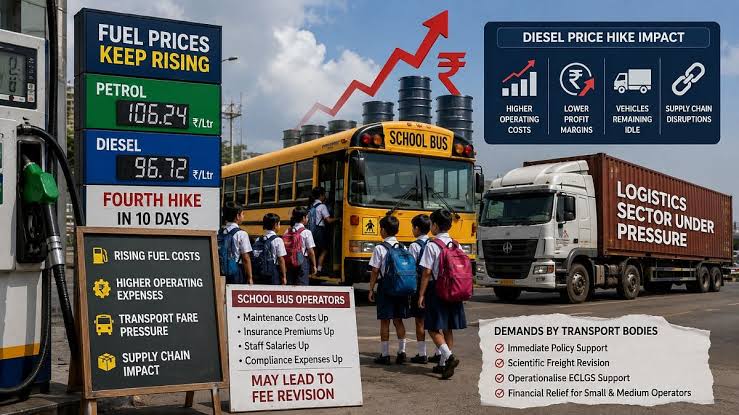
The School Bus Owners Association of Maharashtra has instituted a 15% fare hike for the 2026–27 academic year. Transporters cite a sharp ₹7.50–₹10/L diesel price increase, West Asian supply disruptions for BS6 emission fluids, and steep infrastructure compliance costs as key factors behind passing the financial strain onto parents.
MUMBAI — The School Bus Owners Association of Maharashtra (SBOA) announced a mandatory 15% hike in school student transportation fees across the state starting June 2026. The decision, coming right as schools prepare to reopen for the 2026–27 academic year, follows a series of sharp increases in local fuel costs alongside strict regional transport compliance mandates.
According to official declarations from multiple state-level transport bodies, fleet operators have been absorbing significant overhead increases for over a year. The sudden enforcement of a 15% hike reflects a failure to secure direct fuel subsidies or regulatory tax relief from regional transport offices, effectively shifting the economic weight onto family household budgets.
Fuel and Supply Pressures Drive Fleet Rate Hikes
The primary driver behind the rate revision is a sharp spike in local retail diesel and alternative fuel pricing. Over a two-week window leading up to June, fuel retail centers reported an increase of approximately ₹7.50 to ₹10 per liter across central distribution points.
Furthermore, operators utilizing modern Bharat Stage 6 (BS6) compliant diesel fleets face a critical supply crunch of mandatory Diesel Exhaust Fluid (DEF/Urea). Global logistical disruptions stem directly from heightened tensions in West Asia following recent military escalations involving regional actors, which have constrained chemical supply chains and heavily inflated operation costs for modern mass transit infrastructure.
"The financial burden on vehicles transporting school students has advanced beyond sustainable operational thresholds," noted Rajan Junavane, President of the Pune Bus and Car Owners Association, which oversees a combined fleet of approximately 4,500 transport vehicles. "Our clear expectation is simply to balance out the extra costs incurred due to diesel spikes and broader inflationary indexes. Transporters are not executing this to expand profit margins, but merely to sustain essential route commitments without defaulting."
Compliance Costs and Safety Infrastructure Overheads
Beyond fluctuating fuel expenditures, transport groups attribute the price adjustment to strict safety guidelines enforced by state regulators. Operators must finance localized student safety mechanisms, including closed-circuit television (CCTV) cameras, radio-frequency identification (RFID) scanning systems, automated speed governors, fire-suppression systems, specialized safety doors, and ongoing professional training courses for drivers and female bus attendants (maushis).
Industry experts indicate that localized maintenance variables—ranging from commercial tires and heavy-duty batteries to routine spare part replacements—surged by 25% to 30% over a 12-month period. When combined with increased statutory commercial vehicle insurance premiums, permit processing expenses, and mounting administrative e-challan enforcement fines, private fleet companies assert that a fare freeze would risk widespread operational insolvency.
Household Budgets Strained Ahead of Term Openings
The timing of the announcement has drawn sharp criticism from local parent-teacher collectives. Families are already managing a standard seasonal increase in institutional tuition fees, physical textbooks, stationery supplies, and mandatory uniforms.
A monthly student commute costing ₹3,800 is projected to rise to roughly ₹4,370 under the new pricing framework. Representatives from middle-class advocacy forums have publicly petitioned the State Transport Ministry to step in, requesting a review of alternative operating frameworks, tax write-offs, or partial cost-sharing requirements with private schools to keep mass transit accessible.
Official Sources Section
The data, policy parameters, and statements outlined in this report are compiled directly from the following institutional declarations and announcements:
Official press release and policy resolution by the School Bus Owners Association (SBOA), Maharashtra.
Regional executive meeting briefing by the Pune Bus and Car Owners Association.
Regulatory compliance circulars on safety standards published by the Regional Transport Office (RTO), Maharashtra.
Quote Section
"According to officials from the SBOA, multiple detailed memorandums highlighting the sector's financial distress were presented to the state transport ministry over consecutive months. Despite putting forward alternate frameworks to curb parent expenses, a complete lack of policy relief left providers with no viable alternative but to implement the 15% fare correction for the 2026–27 cycle."
Why It Matters
For everyday citizens and families, this development signals an immediate uptick in non-negotiable living costs. It exposes the direct structural line connecting international geopolitical friction in fuel export regions to domestic household accounting.
Furthermore, if families transition away from high-cost group bus networks to personal motor vehicles or unmapped private pools, urban centers like Mumbai and Pune risk experiencing increased morning traffic gridlock and elevated vehicular emission levels.
Key Facts at a Glance
Fare Adjustment: School transport rates will climb by exactly 15% across major urban areas in Maharashtra starting June 2026.
Fuel Triggers: Pump prices for diesel experienced a swift surge of ₹7.50 to ₹10 per liter, compounded by inflated imports of global emission-control urea elements.
Safety Investments: The hike covers the mandated installation and continuous upkeep of hardware like speed governors, RFID tracking units, and CCTV equipment.
Fleet Size Impacted: In major hubs like the Pune-Pimpri-Chinchwad municipal zone alone, the revision impacts over 4,500 registered transport providers.
FAQ Section
Q1: When exactly does the 15% transport fare hike take effect?
The rate revision is designed to take effect immediately with the commencement of the new 2026–27 academic school term, corresponding with the physical reopening of educational institutes in early June 2026.
Q2: Are school transport vans and auto-rickshaws also raising their rates?
While the structural 15% baseline was codified by major school bus operators, affiliated local transport pools, including school van associations, have confirmed a matching 10% to 15% escalation based on identical spikes in commercial fuel and routine vehicle maintenance.
Q3: Can individual schools veto or refuse the 15% fare hike?
In situations where the school manages an internal, self-owned fleet, the administration holds discretion. However, for a vast majority of institutions relying on third-party vendors contracted through external transport guilds like the SBOA, the updated baseline tariffs will apply across default travel routes.
Q4: What specific items have driven up vehicle maintenance costs?
Transporters report that component costs for replacement vehicle batteries, heavy-duty road tires, basic engine parts, and mandatory BS6-grade emission exhaust fluids have risen by roughly 25% to 30% over the last calendar year.
Source: School Bus Owners Association (SBOA) Maharashtra and regional transport desk files.