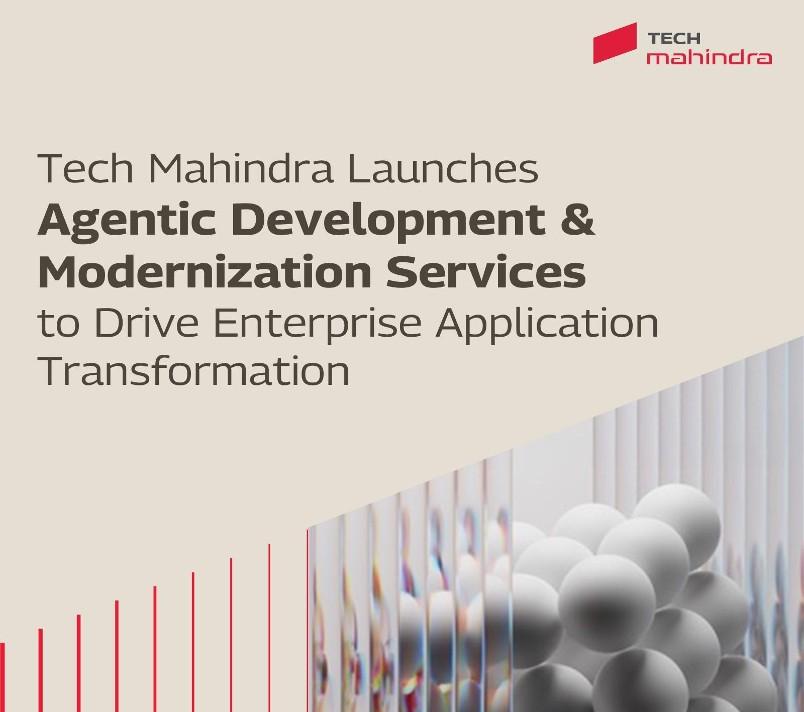
Tech Mahindra has launched its Agentic Development & Modernization Services portfolio, redefining traditional ADMS with autonomous multi-agent AI ecosystems. Built to transform software lifecycles via four core pillars, the services automate legacy modernization, accelerate engineering velocity, and yield up to 40% productivity enhancements across large-scale enterprise application environments.
PUNE, India — Global technology consulting and digital solutions provider Tech Mahindra announced the launch of its Agentic Development & Modernization Services portfolio. The strategic launch signals a massive shift in how corporate IT applications are built, scaled, and managed globally.
According to an official company statement, the newly rolled out service portfolio introduces a framework that integrates autonomous artificial intelligence (AI) agents across the entire software development lifecycle (SDLC). The initiative aims to transition enterprises from task-driven software delivery models to context-aware, intent-led autonomous business ecosystems.
Redefining ADMS for the Autonomous Enterprise Era
With this launch, Tech Mahindra is intentionally evolving the industry-standard definition of ADMS. Traditionally standing for Application Development and Maintenance Services, the acronym has been repositioned by the firm to mean Agentic Development & Modernization Services.
The re-engineered services utilize contextual reasoning, advanced orchestration, and Multi-Agent Systems to evaluate legacy software codebases, predict system issues, and continuously execute code modifications without relying heavily on manual programming queues. According to regulatory briefings, the platform approach acts as an active intelligence layer over existing enterprise applications, helping businesses rapidly reduce operational friction.
"As organizations increasingly shift toward AI-native operating models, spending on application implementation and next-generation engineering services is expected to grow significantly over the next several years," stated Kunal Purohit, President of Next Gen Verticals at Tech Mahindra, in an official press filing. "With Agentic Development & Modernization Services, Tech Mahindra is helping enterprises accelerate this transition by enabling more adaptive, resilient, and context-aware application ecosystems."
The Four pillars of Agentic Infrastructure
The newly unveiled service suite operates on four core structured technical pillars designed to handle specialized layers of enterprise software lifecycle maintenance:
Modernizing Platforms for Autonomy: Focuses on re-architecting monolithic legacy enterprise applications into highly modular, API-first, and AI-ready foundations using the company's internal platform architectures.
Agentic Software Engineering: Embeds specialized AI developer agents across DevSecOps pipelines to manage active code generation, build tasks, and continuous deployment streams.
Autonomous Operations: Establishes real-time, self-healing system environments powered by automated reasoning engines and evolving semantic knowledge graphs to clear complex IT tickets autonomously.
Autonomous Quality Fabric: deploys quality assurance agents via software platforms to generate, execute, and self-heal test scripts in real time as production code changes.
Global Corporate and Market Impacts
The launch arrives at a critical juncture for enterprise IT buyers, chief information officers (CIOs), and active technology investors. Organizations managing sprawling legacy technology stacks face growing pressure to adopt generative AI models while keeping application maintenance costs low.
According to product performance reports, the autonomous multi-agent structures can achieve greater than 40% productivity enhancements in specialized Level-2 and Level-3 IT incident handling operations. For industry stakeholders in sectors like telecom, banking, manufacturing, and retail, this shift could materially accelerate product release schedules and significantly insulate systems against unpredictable outages.
Official Sources Section
Information for this report has been sourced from official corporate updates, regulatory announcements, and institutional insights:
Official global launch announcement released by Tech Mahindra corporate communications.
Executive product architecture briefings via Tech Mahindra Next-Gen AI Services Division.
Industry market expenditure tracking data from international technology research firms.
Quote Section
"According to officials from Tech Mahindra, the deployment of this agentic portfolio will primarily utilize proprietary platform engines including the NewAgeDelivery (NAD) orchestration layer, alongside generative AI solutions like AppGinieZ, to provide clients with human-in-the-loop oversight frameworks that maintain ethical guardrails."
Why It Matters
This technology pivot transforms software code bases from static tools into dynamic, learning entities that evolve automatically alongside business demands. For major enterprises, adopting autonomous software services translates to a sharp reduction in engineering backlogs, tighter cybersecurity compliance integration, and lesser capital locked up in routine software patching, freeing resources for core commercial innovations.
Key Facts at a Glance
Pivotal Renaming: Tech Mahindra updates standard ADMS parameters to stand for Agentic Development & Modernization Services.
Productivity Goals: Core platform mechanisms deliver over 40% efficiency gains in advanced L2 and L3 enterprise operation modules.
Foundational Platforms: The agent-driven architecture utilizes internal solutions such as NewAgeDelivery (NAD) and AppGinieZ to optimize continuous quality assurance.
Industry Focus: Target application segments include transaction handling in BFSI, supply chain resilience in retail, and automated network troubleshooting in telecommunications.
FAQ Section
Q1: What makes "agentic" AI services different from standard AI tools?
Standard AI tools typically react to immediate, isolated prompts given by human operators. Agentic AI services employ multiple interconnected AI agents that can autonomously plan complex multi-step tasks, reason out software errors, interact with external systems, and execute resolutions with minimal manual human intervention.
Q2: Does this move mean human software developers are no longer necessary?
No. Tech Mahindra's strategy relies heavily on a "human-in-the-loop" model. Autonomous agents perform heavy lifting such as parsing legacy code, writing basic scripts, and running initial testing, while human engineers step into supervisory roles to oversee, govern, and formally approve agent actions.
Q3: How do the self-healing test systems function within this framework?
Utilizing the Autonomous Quality Fabric pillar, the system detects any structural modifications in the software code. It automatically rewrites the testing parameters, applies the validation checks, and repairs any failing test cases on its own without requiring a quality control manager to manually re-code the test scripts.
Source: Tech Mahindra Press Room and associated corporate product announcements.