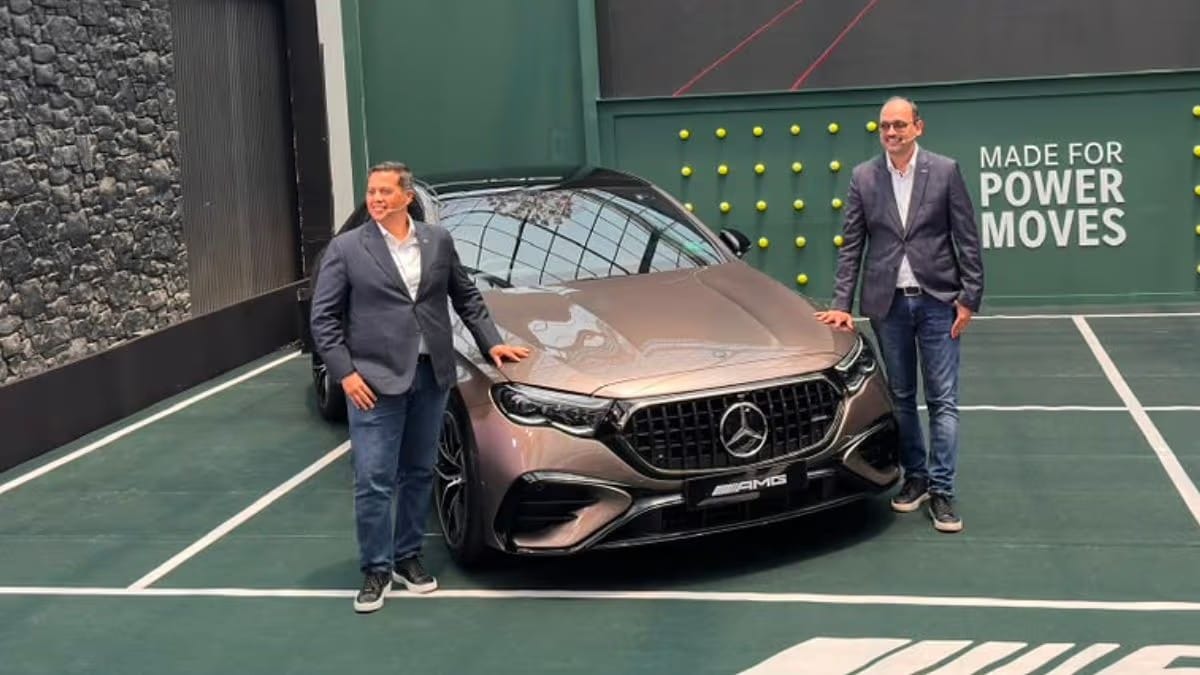
Mercedes-Benz India has confirmed it will introduce more plug-in hybrid vehicles (PHEVs) despite a lack of tax concessions. Managing Director Santosh Iyer also revealed that all petrol Mercedes-Benz models sold in India since January 2026 are E25-compliant, future-proofing its line-up against upcoming biofuel regulations.
PUNE, India — Mercedes-Benz India has confirmed it will expand its plug-in hybrid electric vehicle (PHEV) offerings in the country, maintaining that the lack of targeted government policy support or GST concessions for hybrid technology will not deter its multi-powertrain strategy.
Speaking during the national launch of the Mercedes-AMG E 53 4MATIC+ Performance Edition plug-in hybrid, Santosh Iyer, Managing Director and CEO of Mercedes-Benz India, revealed that every petrol vehicle retailed by the luxury brand in India since January 2026 is fully compatible with E25 (25% ethanol-blended petrol). The proactive alignment with higher ethanol blends makes the German carmaker one of the earliest to future-proof its entire portfolio ahead of potential regulatory mandates.
Multi-Powertrain Roadmap Navigates Tax Disparities
Under current Indian tax structures, battery electric vehicles (BEVs) attract a concessional Goods and Services Tax (GST) rate of 5%, whereas plug-in hybrids and conventional internal combustion engine (ICE) vehicles are taxed at up to 43% to 48% including compensation cesses. Despite this fiscal disparity, Mercedes-Benz India stated it will continue introducing PHEVs alongside its growing BEV line-up and refined ICE models.
The executive noted that while fiscal parity or policy backing for PHEVs would accelerate adoption, customer willingness to buy plug-in hybrids depends primarily on price positioning relative to standard petrol variants rather than government subsidies alone.
Proactive E25 Transition and Fuel Quality Safeguards
The announcement regarding E25 compliance arrives shortly after India completed the nationwide implementation of E20 fuel. While official timelines for mandating E25 remain unannounced by the Ministry of Petroleum and Natural Gas, the Bureau of Indian Standards (BIS) recently notified technical standards for higher ethanol blends up to E30.
Addressing market concerns regarding fuel compatibility, Mercedes-Benz highlighted that it previously migrated its lineup to E20 compliance in 2020—three years before official statutory mandates took effect. Moving to E25 ensures that existing customers will face no warranty invalidations or mechanical degradation if the central government raises fuel blending thresholds in coming years.
Executive Statements and Market Outlook
Outlining the brand's position on consumer choice and decarbonization, company leadership emphasized that buyers should retain the freedom to select propulsion systems aligned with their daily usage patterns.
"We strongly believe that our customers should never be forced into a particular technology," said Santosh Iyer, Managing Director and CEO of Mercedes-Benz India. "Every car we sell in India starting from January this year is E25 compliant. We are offering options—be it battery electrics, plug-in hybrids, or advanced combustion engines—driven by what the customer wants to own rather than policy constraints alone."
Company executives also urged enforcement authorities to strengthen fuel quality checks at retail outlets, noting that isolated instances of commercial fuel adulteration are sometimes misattributed to ethanol-blending issues, creating unnecessary anxiety among luxury car buyers.
Impact on Consumers and Luxury Car Market
For luxury vehicle buyers, the introduction of E25-compliant engines protects long-term residual value and guarantees seamless performance during nationwide fuel transition phases. Furthermore, the introduction of high-performance plug-in hybrids like the AMG E 53 provides commuters with over 100 kilometres of pure electric driving range for daily urban commutes, combined with combustion engine capacity for long-distance travel without range anxiety.
From an industry perspective, Mercedes-Benz’s proactive stance forces other luxury original equipment manufacturers (OEMs) to accelerate fuel-system recalibrations and broaden hybrid availability in India.
Key Facts at a Glance
Fuel Readiness: Every petrol Mercedes-Benz retailed in India since January 2026 is fully E25-compliant.
Powertrain Strategy: The brand maintains a technology-agnostic portfolio spanning ICE, PHEVs, and BEVs.
Hybrid Flagship Launch: AMG E 53 4MATIC+ Performance Edition launched at ₹1.45 crore (ex-showroom).
Electric Performance: Latest PHEV models offer an all-electric zero-emission driving range exceeding 100 km.
Taxation Context: PHEVs remain taxed at 48% GST in India compared to 5% for pure BEVs.
Frequently Asked Questions
What does E25-compliant mean for Mercedes-Benz vehicles in India?
E25 compliance means that the fuel injectors, seals, engines, and fuel lines are engineered to run safely on petrol blended with up to 25% ethanol without suffering fuel system corrosion or performance degradation.
Is plug-in hybrid technology supported by tax incentives in India?
No, plug-in hybrid vehicles currently do not receive the lower 5% GST rate granted to battery electric vehicles (BEVs) and are instead taxed at the higher rate applicable to internal combustion engine vehicles (48% inclusive of cesses).
Can older Mercedes-Benz models run on E25 fuel?
Mercedes-Benz vehicles sold in India since 2020 are E20 compliant. Models sold from January 2026 onward are officially calibrated for E25. Older engines may require technical evaluation before using higher ethanol blends.
Source: Mercedes-Benz India Press Hub, Ministry of Petroleum and Natural Gas, Society of Indian Automobile Manufacturers (SIAM), Ministry of Heavy Industries