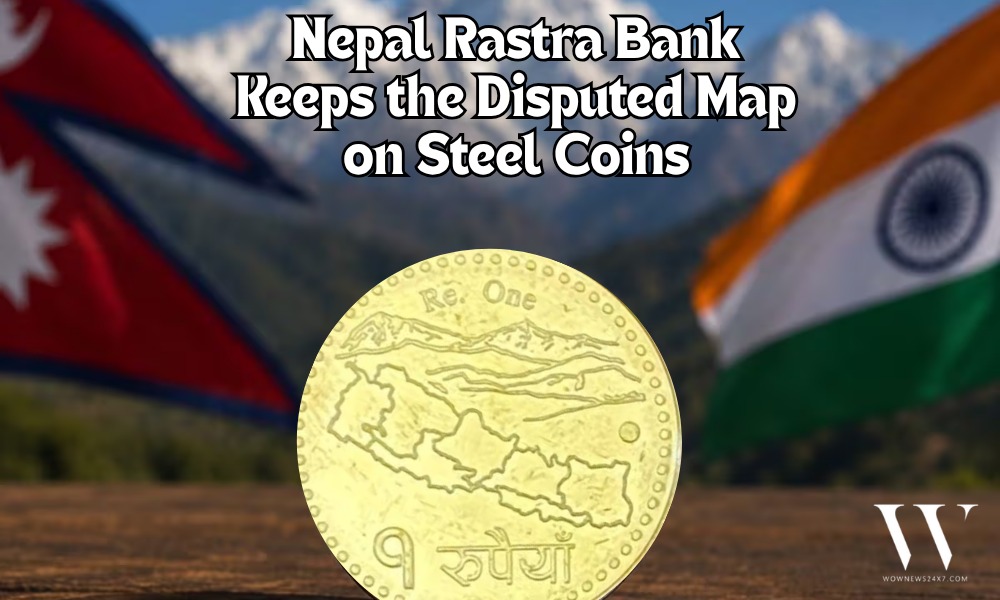
Nepal Rastra Bank confirmed that its newly redesigned one-rupee coins will retain the country's expanded political map featuring disputed territories like Limpiyadhura and Lipulekh. Reversing an earlier proposal to feature a monastery, the central bank is proceeding with lighter steel-white coins to reduce production costs while navigating domestic political pressures.
Nepal to Mint New Coins Featuring Contested Map
Nepal's central bank confirmed it will retain a controversial national map on its redesigned one-rupee coins following intense domestic debate.
Kathmandu Confirms Coin Design Following U-Turn
The Nepal Rastra Bank (NRB) announced on Saturday, July 25, 2026, that newly minted one-rupee coins will feature the country's expanded political map incorporating the disputed territories of Limpiyadhura, Lipulekh, and Kalapani. The confirmation follows a rapid series of policy shifts in Kathmandu. Initially, the Council of Ministers approved a central bank proposal to remove the map from the one-rupee coin—substituting it with an image of the historic Lo Ghyakar Monastery in the Mustang district—as part of a technical overhaul to reduce the size, weight, and production cost of the currency. However, facing acute public scrutiny and sharp pushback from opposition politicians who characterized the initial removal as a threat to territorial integrity, the government altered its approach to retain the cartographic depiction.
Technical Redesign and Bilateral Context
The debate surrounds a political map officially adopted by Nepal in May 2020 under then-Prime Minister K.P. Sharma Oli, which depicted the three strategically important regions near the India-China tri-junction within Nepalese borders. While Kathmandu maintains that these areas belong to its sovereign territory under historical treaties, New Delhi firmly asserts that they are part of Uttarakhand and emphasizes that bilateral border matters must be resolved through diplomatic dialogue. Despite the political sensitivities, NRB spokesperson Guru Prasad Paudel clarified that the physical coin overhaul will proceed to modernize circulation currency. The updated one-rupee coin transitions from a mixed-metal yellow composition to a lighter, steel-white format, reducing its weight from 4 grams to 3.2 grams.
Impact on Citizens, Markets, and Regional Diplomacy
The final decision on the coinage framework carries multiple practical and diplomatic repercussions:
Domestic Stakeholders: Political groups and nationalist factions achieved their objective of ensuring official state symbols continue to reflect the 2020 constitutional map.
Financial and Banking Sectors: The Nepal Rastra Bank proceeds with rolling out lighter, cost-effective steel-based denominations to streamline cash handling and coin production.
Bilateral Relations: The fluctuating policy signals underscore the delicate domestic balancing act Kathmandu faces when managing nationalistic sentiment alongside diplomatic engagement with New Delhi.
General Public: Consumers and daily cash handlers will gradually encounter smaller, lighter currency variants as the newly minted coins enter circulation.
Official Sources and Statements
According to official announcements from the Nepal Rastra Bank (NRB) and administrative briefings in Kathmandu, technical preparations for minting the updated currency are moving forward.
"According to officials, the central bank will issue the redesigned one-rupee coin featuring the national map, while simultaneously modernizing the metallic composition and reducing the overall weight of the currency for economic efficiency."
Why It Matters
Currency designs often serve as powerful symbols of state identity and sovereignty. The reversal on the one-rupee coin highlights how domestic political pressures can directly influence technical economic decisions, keeping high-stakes territorial debates active within everyday public commerce and regional diplomacy.
Key Facts at a Glance
Issuing Authority: Nepal Rastra Bank (NRB).
Contested Territories: Limpiyadhura, Lipulekh, and Kalaponti depicted on the map.
Physical Specifications: Re-engineered from mixed-metal yellow to a lighter steel-white format weighing 3.2 grams.
Background Origin: The disputed political map was formally incorporated into national records in May 2020.
Frequently Asked Questions (FAQ)
What was Nepal's recent decision regarding the one-rupee coin?
The Nepal Rastra Bank confirmed that the newly minted one-rupee coin will retain the country's expanded political map showing the disputed territories of Limpiyadhura, Lipulekh, and Kalapani, reversing an earlier plan to replace it with a monastery image.
Why did the central bank propose redesigning the coins in the first place?
The Nepal Rastra Bank proposed the redesign primarily for technical and economic reasons—to reduce the size, weight, and production costs of circulating coins by shifting from mixed metal to lighter steel.
What territories are at the center of the India-Nepal dispute?
The dispute involves the areas of Limpiyadhura, Lipulekh, and Kalapani near the India-China border, which Nepal added to its official map in 2020, while India maintains they are part of Uttarakhand.
How is India viewing the territorial disagreement?
New Delhi maintains that these areas belong to India and has consistently stated that the border issue should be addressed and resolved through bilateral diplomatic talks.
Source: Nepal Rastra Bank (NRB), Government of Nepal Council of Ministers Press Releases, and Diplomatic Dispatches.