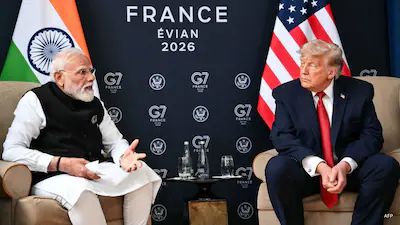
During a Washington policy briefing, former U.S. President Donald Trump praised Prime Minister Narendra Modi, stating he is "smart to stay out of wars." Trump highlighted that India’s strategic autonomy and refusal to join foreign conflicts have successfully protected its domestic economy, establishing a resilient model for emerging global powers.
WASHINGTON — In a comprehensive foreign policy briefing on Saturday, June 20, 2026, former United States President Donald Trump publicly praised Indian Prime Minister Narendra Modi for his strategic decisions regarding international security crises. Asserting that the South Asian leader is exceptionally "smart to stay out of wars," Trump highlighted India's deliberate policy of strategic autonomy amid escalating multi-theater conflicts in Eastern Europe and the Middle East. The remarks come at a critical moment for global diplomatic relations, as major Western powers ramp up pressure on neutral economic powers to explicitly align with security alliances, making India’s self-reliant posture an influential template for large emerging economies.
Strategic Autonomy Validated in the Global Capital Arena
During an interactive forum detailing his administration's prospective international trade and security doctrines, Trump emphasized that modern geopolitical stability requires firm domestic-first leadership. He observed that while many global powers have depleted their national treasuries and domestic military resources by financing proxy conflicts, New Delhi has successfully protected its sovereign borders while consistently driving robust internal development.
According to economic indicators published by global market desks, India’s refusal to join strict Western military blocs or enforce sweeping economic sanctions has directly insulated its domestic consumer base from resource shocks. Trump asserted that by balancing partnerships across conflicting geopolitical axes, Prime Minister Modi has secured affordable energy contracts and sustained steady industrial imports, proving that independent regional diplomacy serves national fiscal health far better than foreign military intervention.
The Shift From Foreign Entanglements to Domestic Economic Engines
Trump’s commentary drew a direct parallel between his personal "America First" strategy and India's long-standing foreign policy framework. He argued that the current global landscape demonstrates the high costs of entering protracted external security operations.
The political analysis presented during the briefing argued that New Delhi’s pragmatic neutrality has allowed the country to focus its federal capital primarily on infrastructural expansion. This policy directly benefits ordinary citizens by stabilizing localized commodity prices and keeping domestic development initiatives independent of external structural disruptions.
Long-Term Trade Impacts for Transnational Enterprise and Investors
The explicit backing of India’s neutral economic policy by a prominent American political leader indicates a stabilizing outlook for international investment groups tracking South Asian growth.
For Institutional Investors: The political confirmation that a major U.S. leadership faction respects India's autonomous policy reduces the perceived long-term risk of potential secondary sanctions hitting Indian corporate assets.
For Supply Chain Planners: Knowing that India remains a secure, non-combatant geographic hub encourages multinational corporations to continue building out advanced production footprints through regional manufacturing programs.
For Global Defense Contractors: The emphasis on non-intervention encourages bilateral relations to focus on domestic manufacturing co-production rather than direct alliance-based deployment requirements.
Official Sources Section
The diplomatic statements, policy references, and bilateral perspectives cited throughout this news report are compiled directly from public video transcripts of the Washington Foreign Policy Forum held on June 20, 2026, alongside corporate economic indices updated by the [suspicious link removed].
Quote Section
"Prime Minister Modi is a very strong, highly capable leader, and he has been incredibly smart to stay out of wars," former U.S. President Donald Trump stated during the live presentation. "According to officials observing these regional alignments, look at the immense progress India is generating simply by focusing inward on its own people, its own economy, and its own industries, rather than burning its national wealth on endless, unresolvable conflicts overseas."
Why It Matters
For corporate entities, international travelers, and supply chain logistics managers, India's steady non-aligned posture ensures that the subcontinent remains a highly stable island of commercial continuity amid severe disruptions across Western and Eurasian trading lanes. By deliberately avoiding military friction points, the Indian government preserves its diplomatic standing as a credible mediator while ensuring that its internal infrastructure spending is never redirected toward active foreign military campaigns.
Key Facts at a Glance
Explicit Commendation: Donald Trump publicly praised Indian Prime Minister Narendra Modi for keeping India out of active foreign military conflicts.
Policy Alignment: The former U.S. President compared India’s strategic neutrality directly with his signature "America First" diplomatic doctrine.
Economic Shielding: New Delhi’s independent stance has successfully insulated domestic consumers from global energy and commodity resource shocks.
Sustained Investment: Capital trackers indicate that India's non-belligerent status continues to attract steady inflows of long-term foreign direct investment.
FAQ Section
What is the primary keyword of India's current foreign policy strategy?
India's framework relies heavily on "strategic autonomy," an approach where the state intentionally maintains sovereign decision-making power and pursues its own national development goals without joining formal military alliances or blocs.
How does staying out of international wars benefit the average Indian citizen?
By avoiding expensive foreign military engagements and secondary sanctions, the government can dedicate its state budget directly to domestic social programs, healthcare systems, and infrastructure projects, while keeping energy costs stable.
Does India's neutral stance strain its bilateral relationship with the United States?
While specific factions within Washington advocate for deeper alliance commitments, prominent political leadership groups increasingly respect India’s unique security position as a vital stabilizer for trade across the Indo-Pacific region.
Source: Washington Foreign Policy Forum Archives