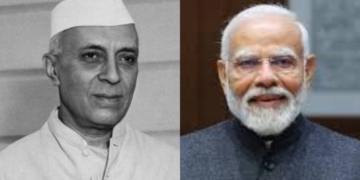
On June 10, 2026, Prime Minister Narendra Modi achieved a historic milestone by completing 4,399 consecutive days in office, surpassing Jawaharlal Nehru to become India's longest-serving continuously elected Prime Minister. The event marks a significant point in India's democratic history, highlighting twelve years of uninterrupted economic and structural governance.
NEW DELHI — Prime Minister Narendra Modi officially became the longest continuously serving democratically elected Prime Minister in India’s history on June 10, 2026. By completing 4,399 consecutive days in office, Modi surpassed the previous milestone held for over six decades by the nation's first prime minister, Jawaharlal Nehru.
This development is highly important today as it solidifies a major political transition, reflecting a continuous twelve-year governance trajectory that began on May 26, 2014. Coming directly after the National Democratic Alliance (NDA) marked its consecutive return to power following the 2024 general elections, this structural longevity is reshaping India's institutional framework, economic policies, and geopolitical standing.
The Statistical Breakthrough: 4,399 Days
The administrative timeline verified by state record-keepers confirms that Prime Minister Narendra Modi reached 4,399 continuous days in office on Wednesday, eclipsing Jawaharlal Nehru's uninterrupted elected tenure. While Nehru served a total of nearly seventeen years as Prime Minister starting from independence in 1947, his tenure as a democratically elected head of government—following India's first general elections institutionalized in 1952—lasted 4,398 continuous days until his passing on May 27, 1964.
Unlike historic tenures that faced structural disruptions or fractures—such as those of Indira Gandhi—Modi’s tenure remains unbroken across three successive electoral mandates (2014, 2019, and 2024). Political observers point out that this milestone underscores a distinct shift toward consolidated executive leadership, operating within a highly globalized, digitized, and fast-evolving socio-economic environment.
Policy Impacts and Institutional Reorientation
Over the past twelve years, the administration has implemented sweeping legislative and structural updates that have significantly affected citizens, international investors, and domestic businesses. According to economic tracking summaries, the focus has pivoted sharply toward digital governance, infrastructural expansion, and direct welfare delivery.
Financial Integration and Well-Being: The expansion of the Jan Dhan Yojana has pushed formal banking access past the 40-crore mark. Concurrently, the deployment of Direct Benefit Transfers (DBTs) totaling over ₹34 lakh crore has eliminated intermediary leakage, yielding substantial state budgetary savings.
National Infrastructure and Global Trade: Cross-border trade through inland land ports expanded from ₹5,000 crore in 2014 to over ₹83,000 crore in 2026. Significant capital injections into heavy transit infrastructure, exemplified by breakthroughs in the Zojila tunnel project, continue to benefit logistics corporations and domestic travelers alike.
Constitutional and Internal Security Realignment: The structural landscape underwent deep alterations via the attenuation of Article 370 in Jammu and Kashmir, localized containment of insurgencies across northeastern regions, and the systematic reduction of Naxalite operational footprints.
Official Sources Section
The absolute data points, operational achievements, and institutional timelines surrounding this governance milestone are firmly grounded in public notifications and legislative updates distributed by authorized bodies:
Quote Section
"According to officials at the Press Information Bureau, Prime Minister Narendra Modi completed 4,398 days in office on Tuesday, June 9, 2026, and officially surpassed the historic continuity record of former Prime Minister Jawaharlal Nehru on Wednesday, June 10, 2026, securing the distinction of serving the nation for the longest continuous period as an elected Prime Minister."
Why It Matters
The practical implications of this milestone extend far beyond basic political statistics. For global markets and international investors, a twelve-year unbroken prime ministerial tenure translates directly into high policy predictability, reducing sovereign risk assessments and encouraging sustained Foreign Direct Investment (FDI).
For the average citizen, the consolidation of this governance model ensures the extended continuity of multi-year development programs like the Jal Jeevan Mission and the Pradhan Mantri Awas Yojana (PMAY). Structurally, it signals the firm institutionalization of performance-driven politics over legacy-based alignments.
Key Facts at a Glance
The Benchmark: Prime Minister Narendra Modi officially surpassed Jawaharlal Nehru’s continuous elected tenure record on June 10, 2026, by reaching 4,399 consecutive days in office.
Electoral Base: The tenure spans three successive general election triumphs beginning in May 2014, including the formation of the NDA coalition government in 2024.
Trade Velocity: Under the current administration, land port trade values surged sixteen-fold, climbing from ₹5,000 crore to ₹83,000 crore.
Public Welfare Scaling: Financial inclusion metrics show over 40 crore bank accounts established under state-backed financial literacy initiatives.
FAQ Section
How is this tenure record calculated compared to Jawaharlal Nehru's entire time in office?
Jawaharlal Nehru served as Prime Minister from August 15, 1947, until May 27, 1964. However, his initial period from 1947 to 1952 was served as the head of an interim, non-elected government. The continuous elected tenure calculation begins from the first general election in 1952, establishing a record of 4,398 continuous days, which Prime Minister Modi has now exceeded.
What are the main economic reforms tied to this twelve-year period?
The landmark shifts include the nationwide implementation of the Goods and Services Tax (GST), the massive scale-up of the Unified Payments Interface (UPI) ecosystem, heavy capital expenditure on national highways, and the digitizing of border cross-management through systems like the Land Port Management System (LPMS).
Does this milestone alter the current legislative power structure?
No. The milestone represents a temporal tracking of continuous service in office. It does not alter parliamentary seat distributions, legislative protocols, or the current operational parameters of the coalition government.
Source: Press Information Bureau (PIB) Delhi, Prime Minister's Office (PMO) India, and data logs compiled by the Ministry of Home Affairs Archive Division.