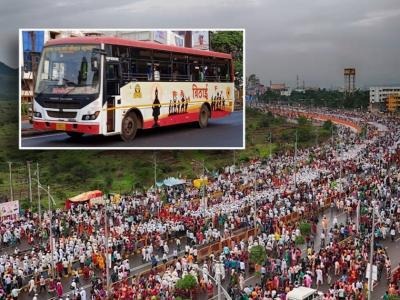
The Maharashtra State Road Transport Corporation (MSRTC) will operate 5,500 special buses to facilitate the annual Ashadhi Wari pilgrimage to Pandharpur. The state public transport initiative includes point-to-point village bookings, active travel fare concessions, and round-the-clock deployments of over 13,000 transit staff members.
MUMBAI, INDIA — The Maharashtra State Road Transport Corporation (MSRTC) has officially finalized its comprehensive transport blueprint for the upcoming Ashadhi Wari pilgrimage to Pandharpur. State transport authorities confirmed that a massive fleet of 5,500 special buses will be mobilized across multiple regional divisions to manage the intense passenger volumes expected for the annual religious event.
The designated vehicular layout will run during the peak pilgrimage operational window from July 20 to July 29, 2026, linking all major rural and urban clusters directly to the temple town. This systemic mobilization by the state utility ensures that lakhs of Varkaris (devotees) can travel securely to seek darshan of Lord Vitthal and Goddess Rukmini without facing transit bottlenecks.
Direct Village Bookings and Fare Concessions
To simplify regional accessibility, the Maharashtra State Road Transport Corporation (MSRTC) has introduced a decentralized group booking mechanism. Under this framework, any consolidated group comprising 40 or more pilgrims can request a dedicated, point-to-point special bus originating directly from their specific village or neighborhood to Pandharpur. This customized service eliminates the operational need for rural commuters to travel to primary district depots to access long-distance transport options.
Additionally, the state administration has confirmed that all existing statutory passenger fare concessions will remain fully active throughout the special pilgrimage schedule. Senior citizens aged 75 and older will receive completely free travel across the network under the Amrut Senior Citizen Scheme. Concurrently, female passengers will receive a 50% fare reduction under the ongoing provisions of the Mahila Samman Yojana.
High-Capacity Transit Hubs and Staff Deployment
To prevent traffic congestion inside Pandharpur, MSRTC is setting up four temporary satellite bus stations around the perimeter of the town. The stations are named as follows:
Chandrabhaga
Bhima (Degaon)
Vitthal Factory
Pandurang (ITI College)
According to infrastructure plans evaluated by the Ministry of Transport, Government of Maharashtra, these four terminal hubs are being fitted with essential public amenities. The installations include computerized reservation counters, drinking water plants, emergency medical aid setups, mobile toilets, and continuous CCTV security surveillance grids.
To sustain this massive round-the-clock transport workflow, MSRTC is deploying more than 13,000 personnel. This operational workforce includes drivers, conductors, mechanical engineering staff, and supervisory officers who will work in consecutive shifts throughout the ten-day cycle.
Official Sources Section
The deployment statistics, regional route matrix schedules, and structural passenger safety protocols have been extracted directly from the official transport declarations published by the Maharashtra State Road Transport Corporation (MSRTC) and verified via the executive inspection reports issued by the State Transport Ministry.
Quote Section
Reviewing the setup during a field inspection at the temporary Bhima bus terminal, Maharashtra Transport Minister Pratap Sarnaik stated:
"Our policies are geared towards providing smooth, comfortable, and safe transit to the lakhs of devotees traveling for the Ashadhi Wari pilgrimage. The provision of direct village services will prevent logistical hardships for the rural populace."
Why It Matters
For pilgrims and rural citizens across Maharashtra, the addition of 5,500 dedicated buses ensures reliable and affordable transit options during a time of extreme seasonal demand. For district administrations and local law enforcement agencies, the use of peripheral satellite bus terminals helps reduce traffic jams inside Pandharpur's core roads. Additionally, keeping the standard fare discounts active provides direct financial relief to female travelers and elderly pilgrims who form a large portion of the traditional Wari processions.
Key Facts at a Glance
Fleet Allocation: 5,500 special ST buses deployed exclusively for pilgrimage routes across the state.
Decentralized Booking: Direct point-to-point bus service available for any group of 40 or more passengers from their home village.
Workforce Deployment: Over 13,000 transport employees working 24/7 shifts to manage operations.
Temporary Terminals: Four major satellite bus hubs established around Pandharpur to handle incoming routes.
Financial Subsidies: Full travel cost waivers for citizens over 75, alongside 50% ticket fare discounts for women.
FAQ Section
How can a village group book a direct MSRTC bus to Pandharpur?
A group of 40 or more passengers can visit their nearest MSRTC depot and submit a group booking request. The corporation will then schedule a direct bus to pick up the group from their specific village.
Are the special pilgrimage buses eligible for the Mahila Samman Yojana discount?
Yes. The 50% ticket price concession for women and the free travel policy for seniors over 75 remain fully valid on all 5,500 special buses.
What facilities are available at the temporary Pandharpur bus stations?
The four temporary stations feature clean drinking water facilities, public restrooms, advance ticket booking counters, information centers, and CCTV security tracking systems.
Source: Maharashtra State Road Transport Corporation (MSRTC); Ministry of Transport, Government of Maharashtra; State Transport Ministry Press Bureau Event Briefings.