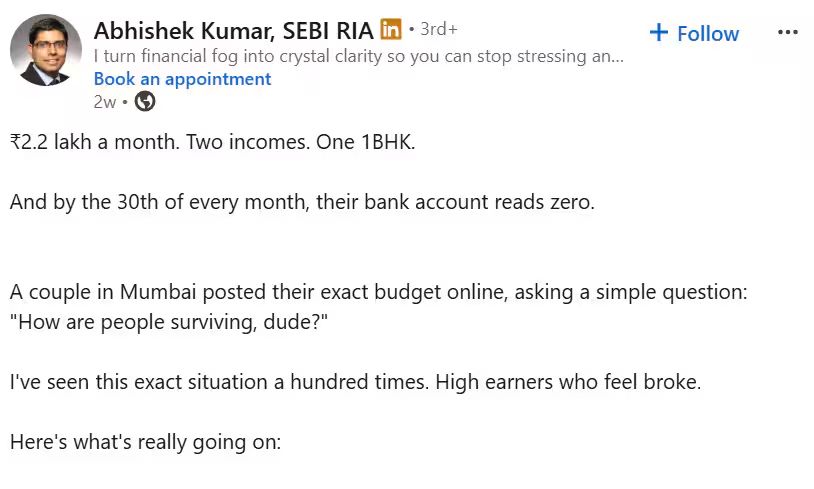
A Mumbai couple’s viral post highlighting their struggle to save on a ₹2.2 lakh monthly income illustrates the danger of lifestyle creep. Financial experts suggest that instead of income issues, the couple faces a structural one: they must front-load their savings on payday and build a dedicated fund for unpredictable expenses.
MUMBAI — A Mumbai-based couple recently ignited a nationwide conversation on personal finance after revealing they struggle to save despite a combined monthly income of ₹2.2 lakh. Their story, shared on social media and widely debated, serves as a classic case study of "lifestyle creep"—where rising income is met with a proportional rise in non-essential expenditure, leaving household savings stagnant.
The couple’s situation, which became a trending topic this June, brought to light the reality of navigating high-cost urban living. While their income sits well above the national average, their monthly breakdown—including ₹44,000 for rent, ₹60,000 in SIPs, and significant, erratic spending on travel and luxury items—demonstrates how easily financial discipline can fracture under the pressure of city life.
The Budget Breakdown and "Leakage"
Financial experts analyzing the couple's expenses note that they are not suffering from an income problem, but a structural one. According to SEBI-registered investment adviser Abhishek Kumar, the couple is already making a strong effort by earmarking ₹60,000 for Systematic Investment Plans (SIPs) monthly. However, their financial anxiety stems from the "leakage" of funds after fixed obligations are met.
The couple reported that, after accounting for rent, utilities, groceries, and investments, they should theoretically have a surplus. Instead, their remaining funds disappear into a cycle of unplanned purchases—such as high-end perfumes, clothing, and expensive last-minute travel to their hometowns. These hometown trips, which can cost as much as ₹45,000 per excursion, are often treated as emergencies rather than foreseeable expenses, forcing them to exhaust their liquid cash.
Expert Strategies for Structural Change
To move away from paycheck-to-paycheck living, financial planners emphasize a transition from "residual saving" to "structured saving."
Front-Load Savings: Experts advise moving savings and investment contributions to the very first day the salary arrives. As the saying goes, "You can't spend what you can't see."
Establish a "Travel Fund": Instead of treating hometown visits as financial shocks, experts suggest setting aside a dedicated monthly amount (e.g., ₹4,000) to ensure these trips are pre-funded.
Define "Fun Money": Planners recommend allocating a fixed, guilt-free budget for discretionary social spending and sticking to it strictly. Once the limit is reached, discretionary spending should stop until the next billing cycle.
Track Discretionary Spending: For many high-earning households, tracking every rupee for at least three months is essential to identify the "hidden" areas where money is leaking.
Why It Matters
This situation is a recurring reality for many young professionals in Tier-1 cities. The primary takeaway for urban residents is that financial stability is rarely about the absolute income number—it is about the integrity of the budget structure. Without a clear "plan for the surplus," even high-income households risk falling into a liquidity trap where growing investments coexist with dwindling monthly cash reserves.
Key Facts at a Glance
Monthly Income: ₹2.2 lakh (combined).
Fixed Outflows: Rent (₹44k), SIPs (₹60k), Groceries/Gas (₹20k), Maid (₹8k), and utilities/travel/medications (approx. ₹20k+).
The "Leakage": Significant portions of income disappear on impulse shopping and last-minute travel.
Core Solution: Shifting from "spend-then-save" to "save-then-spend" via automated transfers on salary day.
FAQ
Is a ₹2.2 lakh income truly "low" for Mumbai?
No, it is a comfortable income. The issue isn't the amount earned but the lack of budgetary boundaries, which leads to impulsive spending of the surplus.
Should they reduce their SIP contributions?
Most experts advise against reducing SIPs. Instead, they suggest tightening discretionary spending to free up liquid cash and build a separate emergency buffer.
What is the "structure problem"?
It refers to the absence of a proactive system where savings and essential funds are prioritized automatically at the start of the month, rather than relying on willpower at the end of the month.
Source: Livemint Personal Finance, Economic Times Trending Desk