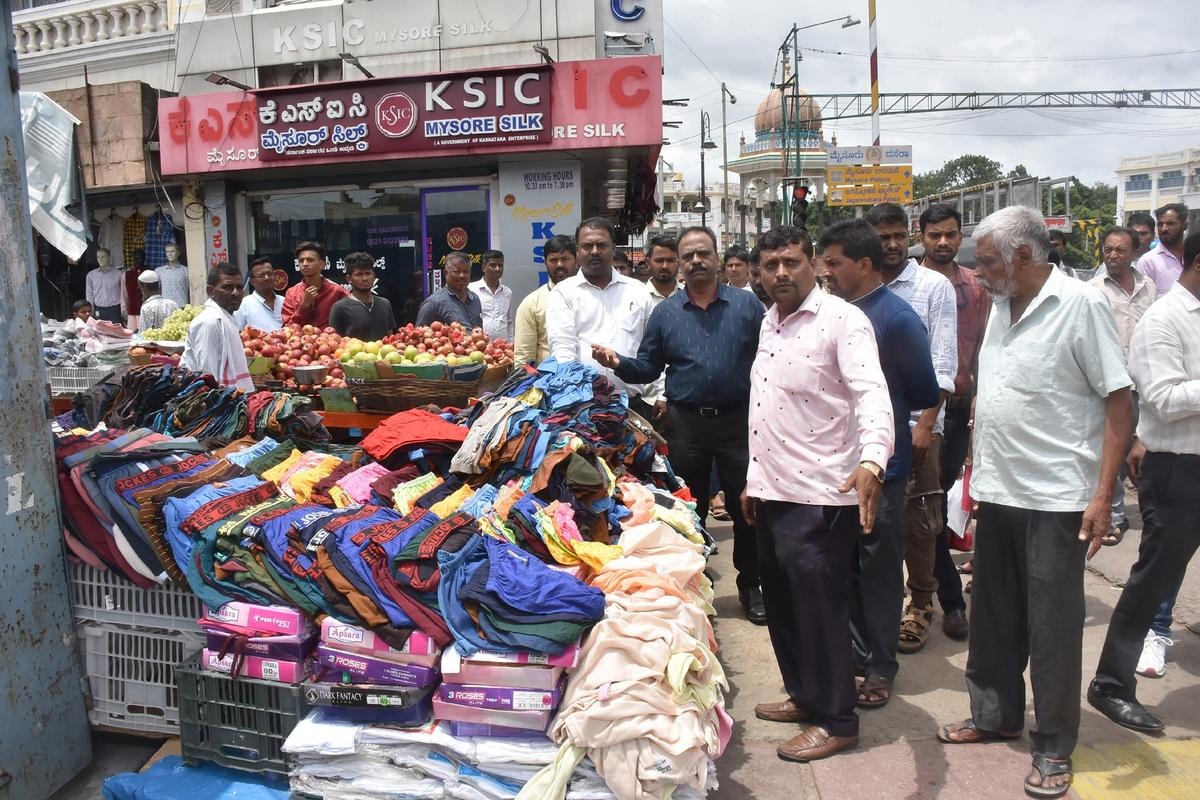
Street vendors in Mysuru have rejected free-of-cost stalls in municipal mini markets constructed by the Mysore Urban Development Authority, preferring to trade on busy roadsides. The facilities have remained vacant for nearly 25 years as sellers cite low visibility and reduced customer footfall away from main thoroughfares.
MYSURU, INDIA — Fruit and vegetable street vendors across Mysuru have officially declined to relocate to purpose-built mini markets, choosing instead to continue their operations on busy city roadsides. The urban infrastructure, developed by the Mysore Urban Development Authority (MUDA) to systematically clear public walkways, is being offered completely free of charge. Despite the lack of rental overheads, vendors state that moving away from high-traffic thoroughfares would severely compromise daily footfall and decimate customer acquisition. As a result, millions of rupees worth of civic infrastructure continues to sit abandoned, presenting a persistent logistical bottleneck for city municipal managers.
Decades of Infrastructure Abandonment Continues
The resistance from local micro-traders highlights a multi-decade disconnect between urban design and informal retail economics. According to localized municipal inventory filings, several of these mini markets have remained almost completely unoccupied for nearly 25 years. Originally conceived to modernize local produce distribution and ease inner-city sidewalk congestion, the structures have steadily deteriorated due to lack of use.
Civic evaluations reveal that instead of hosting thriving neighborhood micro-economies, the vacant plazas have turned into informal parking zones for local residents and temporary shelters for destitute individuals. A prominent example includes the long-abandoned mini market facility situated in Ward Number 45 of the Sharadadevi Nagar district. The facility was specifically built to transition pushcart vendors away from high-density intersections, yet it has failed to attract a single permanent tenant.
Logistical Conflict Between Local Vendors and Urban Planners
The core operational friction points between the street vendors and city administration center on spatial design and immediate accessibility:
| Operational Metric | Current Roadside Operations | Designated Mini Markets |
| Rental & Facility Costs | Free (subject to localized municipal fines) | Free-of-cost allocation by MUDA |
| Consumer Footfall Access | Immediate; captures passing motorists and pedestrians | Low visibility; located deep off secondary interior roads |
| Transaction Speed | Brisk; curbside transactions without parking delays | Delayed; requires consumers to park and enter a facility |
| Structural Integrity | Exposed to elements; causes sidewalk obstruction | Covered stalls; prone to neighborhood neglect |
Urban development records show that civic bodies have repeatedly attempted to bridge this operational gap. In Sharadadevi Nagar alone, at least three separate formal outreach and relocation campaigns were executed by past administrators. Every initiative collapsed before structural handovers could take place, cementing a pattern where vendors return to thoroughfares within days of an administrative push.
Official Sources Section
Details regarding structural occupancy rates, historical allocation initiatives, and spatial planning limits are based on official asset registries from the Mysore Urban Development Authority and operational enforcement logs compiled during urban clearance drives by the Mysuru City Corporation (MCC).
Quote Section
Commenting on the consecutive failures to populate the designated trading hubs, former city corporator Nirmala Harish stated:
"The space at the mini markets was made available for vendors for completely free, but absolutely no one came forward to conduct their business inside them. It is simply because they are deeply accustomed to conducting their daily business directly on the active roads. They consistently refuse to shift to the designated places since the structural locations are built too far inside the main roads, cutting them off from passing traffic."
Why It Matters
For everyday consumers and commuters, the ongoing stalemate means that major traffic arteries across Mysuru will continue to experience significant bottlenecking and reduced pedestrian safety on footpaths. For the micro-traders, remaining mobile on the roadside is a matter of economic survival, as interior markets drastically lower daily revenue margins. For municipal planners and taxpayers, it represents a stark lesson in urban development: infrastructure built without factoring in the immediate transactional habits of the target demographic will ultimately fail, leaving public capital frozen in non-performing assets.
Key Facts at a Glance
Decades of Vacancy: Multiple MUDA-constructed mini markets have sat empty for nearly 25 years.
Zero Overhead Incentives: Stalls within the complexes are offered to fruit and vegetable vendors free of charge.
Repeated Policy Failures: Administrative records show at least three separate major relocation attempts have failed in individual wards like Sharadadevi Nagar.
Secondary Structural Usage: The unused facilities are currently acting as parking spaces for nearby households and informal resting areas.
FAQ Section
Why are the mini markets completely free for vendors?
The Mysore Urban Development Authority waived all stall fees to incentivize vendors to clear the public footpaths, attempting to solve congestion issues without hurting the livelihoods of low-income traders.
Which specific areas in Mysuru are most affected by this vacancy?
While several pockets face this issue, the mini market facility located in Ward Number 45 within Sharadadevi Nagar is the most prominent example of an abandoned municipal zone.
What is the main reason vendors refuse to move inside?
Visibility and customer access. Because the mini markets are built off the main roads, vendors fear they will lose spontaneous purchases from passing motorists who prefer quick, roadside transactions.
What happens to the empty market structures now?
Without active business tenancies, local residents utilize the open concrete layouts for residential vehicle parking, while parts of the infrastructure have degraded into shelter zones for the destitute.
Source:
Mysore Urban Development Authority (MUDA) Official Portals
Directorate of Municipal Administration, Government of Karnataka
Mysuru City Corporation (MCC) Enforcement Archives