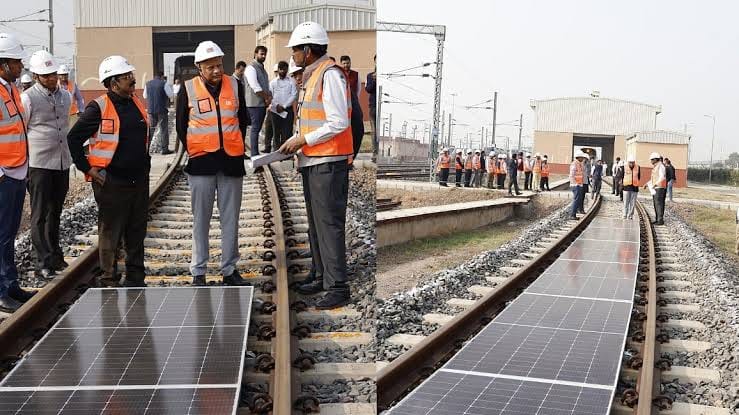
The National Capital Region Transport Corporation (NCRTC) signed a power purchase agreement for a Rs 450 crore, 110 MW captive solar power plant in Jalaun, Uttar Pradesh. The facility will fulfill nearly 60 percent of the Namo Bharat corridor's electricity demands, cutting energy costs by 25 percent.
NEW DELHI — The National Capital Region Transport Corporation (NCRTC) signed a power purchase agreement (PPA) with NNRL (NIRL NCRTC Renewables Limited) to construct a captive 110 MW solar power plant in Uttar Pradesh. The project will generate clean electricity to meet roughly 60 percent of the operational power requirements across the Delhi-Ghaziabad-Meerut Namo Bharat corridor.
Strategic Shift Toward Captive Green Energy
The power purchase agreement establishes a 25-year fixed-tariff structure under a captive power generation framework. Developed by NNRL in Jalaun, Uttar Pradesh, the solar facility carries an estimated total construction cost of Rs 450 crore. Funding will follow an 80:20 debt-to-equity capital model.
Once completed within the target 24-month commissioning window, electricity generated at the plant will be wheeled through the Uttar Pradesh state grid directly to NCRTC receiving sub-stations (RSS) across Delhi and Uttar Pradesh.
Electricity represents one of the largest operational costs for high-speed regional rail, accounting for 30 to 35 percent of overall recurring expenses on the Delhi-Meerut line. Switching to solar power under the fixed-tariff PPA is expected to reduce the transit network's long-term electricity expenditure by nearly 25 percent.
Environmental Impact and Grid Operations
Replacing grid power generated from fossil fuels with solar energy will prevent approximately 1,77,000 tonnes of carbon dioxide ($CO_2$) emissions every year. Officials also project significant reductions in nitrogen oxide ($NO_x$) and sulfur dioxide ($SO_2$) emissions across the National Capital Region.
The solar initiative leverages incentives under the Uttar Pradesh Solar Energy Policy to integrate renewable infrastructure with heavy rapid transit networks.
| Key Parameter | Project Detail |
| Plant Capacity | 110 MW (AC) Solar PV |
| Estimated Cost | ₹450 Crore |
| Location | Jalaun, Uttar Pradesh |
| Financing Structure | 80:20 Debt-to-Equity ratio |
| Agreement Duration | 25-Year Power Purchase Agreement |
| Energy Coverage | ~60% of total Namo Bharat corridor power needs |
| Target Commissioning | 24 Months |
Official Statements
"According to officials, electricity expenses account for roughly 30 to 35 percent of total operational costs for the Namo Bharat train service. By transitioning to a 110 MW captive solar facility, NCRTC expects to cut electricity spending by around 25 percent while securing long-term price stability over a 25-year period".
NCRTC Chief Public Relations Officer Puneet Vats stated that electricity generated from the plant in Jalaun will flow through the state grid to dedicated receiving sub-stations to power the high-speed regional corridor cleanly and sustainably.
Why It Matters
High-speed public transit systems consume substantial volumes of electricity daily. By sourcing 60 percent of its operational energy from captive solar power, NCRTC protects public transportation tariffs against volatile fossil fuel prices.
For local residents and regular commuters, the energy shift creates a cleaner regional transport model across the National Capital Region without inflating ticket fares due to rising utility costs.
Key Facts at a Glance
Pact Signed: NCRTC signed a PPA with NNRL for a 110 MW captive solar power project in Jalaun, UP.
Power Supply: The plant will generate roughly 60% of the energy needed for the full Namo Bharat corridor.
Financial Impact: Reduces NCRTC's energy bills by an estimated 25% over a 25-year contract term.
Carbon Offsets: Prevents nearly 1.77 lakh tonnes of carbon dioxide emissions annually.
Timeline: Commissioning is scheduled within 24 months under an 80:20 debt-equity funding model.
FAQ Section
How much power will the 110 MW solar plant supply to Namo Bharat?
The plant is expected to generate approximately 60 percent of the total power required to run the entire Delhi-Ghaziabad-Meerut Namo Bharat corridor.
Where will the solar power project be located?
The 110 MW captive solar facility will be built in Jalaun, Uttar Pradesh, and will transmit energy through the state grid to NCRTC receiving sub-stations.
How will this project affect overall ticket prices and operational costs?
Energy accounts for 30–35% of total operating expenses. Slashing electricity costs by 25% helps stabilize operational expenses, supporting long-term ticket price stability for passengers.
When will the solar plant become operational?
The construction and grid-connection timeline for the project is 24 months from the effective PPA date.
Sources: National Capital Region Transport Corporation (NCRTC), Ministry of Housing and Urban Affairs, BSE / NSE Corporate Filings