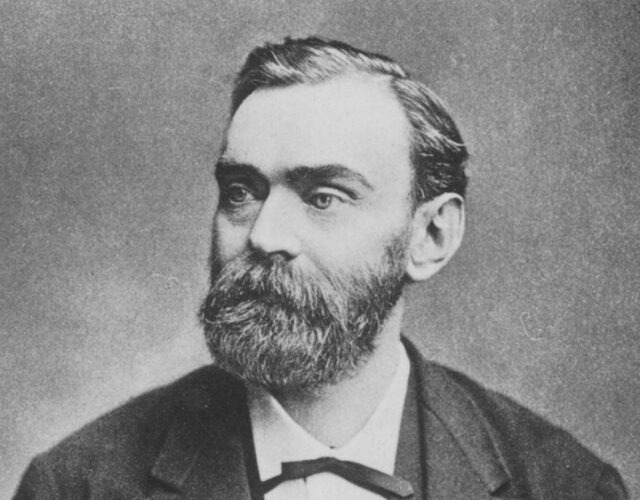









Alfred Nobel, a Swedish chemist, engineer, and inventor, is best remembered as the founder of the Nobel Prize. Known for inventing dynamite and holding 355 patents, Nobel redirected his fortune to honor achievements in science, literature, and peace after being haunted by his reputation as the “merchant of death.”
Alfred Bernhard Nobel, born on October 21, 1833, in Stockholm, Sweden, was a polymath whose contributions spanned chemistry, engineering, and literature. Despite his fame for inventing dynamite in 1867, Nobel’s legacy is defined by his decision to establish the Nobel Prizes, which have become the world’s most prestigious awards for human achievement. His life was marked by innovation, controversy, and ultimately, a desire to leave behind a legacy of peace and progress.
Key highlights from his life and legacy include
-
Nobel invented dynamite and other powerful explosives, revolutionizing construction and mining industries.
-
He held 355 patents across diverse fields, showcasing his inventive genius.
-
In 1888, a French newspaper mistakenly published his obituary, calling him the “merchant of death,” which deeply affected him.
-
Determined to reshape his legacy, Nobel wrote his will in 1895, leaving 31 million Swedish kronor to establish the Nobel Prizes.
-
The Nobel Prizes were first awarded in 1901, five years after his death.
-
Awards are given annually in Physics, Chemistry, Medicine, Literature, Peace, and later Economics.
-
Nobel was also a writer, penning poetry and drama, reflecting his wide-ranging intellectual interests.
-
He died on December 10, 1896, in San Remo, Italy, from a cerebral hemorrhage at the age of 63.
Nobel’s decision to dedicate his fortune to rewarding excellence and peace transformed his image from an inventor of explosives to a humanitarian visionary. Today, the Nobel Prizes symbolize the highest recognition of contributions to humanity, honoring individuals and organizations that embody Nobel’s vision of progress for the greatest benefit to humankind.
His story serves as a reminder that legacies are not defined solely by inventions or wealth, but by the values and impact one chooses to leave behind. Nobel’s foresight continues to inspire generations, making December 10 not only the anniversary of his death but also a global celebration of human achievement.
Sources: India TV News, Jagran Josh, Free Press Journal, NobelPrize.org, Britannica