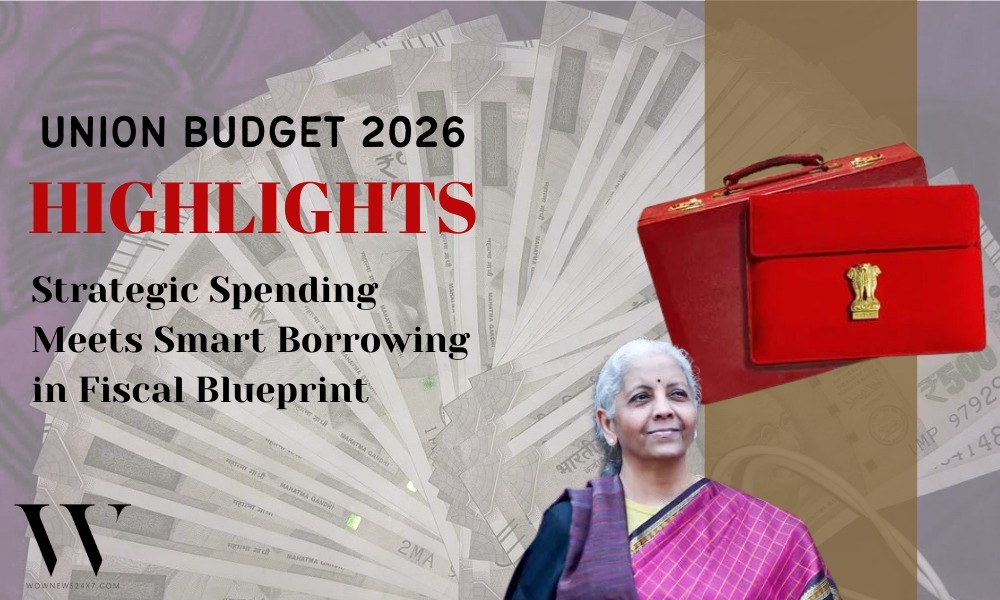
On February 1, 2026, at 12:50 PM IST, Finance Minister Nirmala Sitharaman presented India’s Union Budget with a defence allocation of ₹5.95 trillion, a ₹5 trillion cap on Ways and Means Advances, plans to raise ₹500 billion via cash management bills, and borrow ₹3.86 trillion from the National Small Savings Fund
India’s Union Budget 2026-27, presented on February 1, 2026, laid out a comprehensive fiscal roadmap balancing defence priorities, borrowing strategies, and capital receipts. The announcements reflect the government’s dual focus on national security and financial stability, while also signaling a pragmatic approach to debt management.
Key Highlights:
Defence allocation: The defence budget has been set at ₹5.95 trillion, underscoring India’s commitment to strengthening military capabilities amid evolving geopolitical challenges. This allocation covers modernization, procurement, and operational readiness, ensuring sustained investment in defence infrastructure.
Ways and Means Advances (WMA): The government has capped WMA at ₹5 trillion, a measure designed to manage short-term liquidity needs without overburdening fiscal balances. Analysts note that this ceiling reflects cautious optimism about revenue flows and borrowing discipline.
Cash management bills: The Budget proposes to raise ₹500 billion via cash management bills, correcting earlier reports of a bond buyback. This move is aimed at fine-tuning liquidity in the financial system and providing flexibility in short-term funding.
Borrowing from savings fund: The government plans to borrow ₹3.86 trillion from the National Small Savings Fund (NSSF), leveraging household savings to finance expenditure. This strategy highlights reliance on domestic resources to meet fiscal needs while reducing external vulnerability.
Dividend targets: A significant revenue source is projected from the Reserve Bank of India and financial institutions, with dividends targeted at ₹3.16 trillion. This reflects expectations of strong profitability in the financial sector and the central bank’s surplus transfer.
Bond management: The Budget outlines plans to switch bonds worth ₹2.5 trillion, a move aimed at managing debt maturity profiles and reducing refinancing risks. Such switches help smoothen repayment schedules and stabilize yields.
Capital receipts: Miscellaneous capital receipts are estimated at ₹800 billion, including proceeds from divestment initiatives. This signals continued emphasis on asset monetization and privatization to bolster fiscal resources.
Economic Impact:
At 12:50 PM IST, market analysts highlighted that the Budget’s borrowing and cash management measures are designed to balance growth with fiscal prudence. While the defence outlay strengthens India’s strategic posture, reliance on NSSF borrowing and dividend transfers reflects the government’s effort to minimize external debt exposure.
Bond markets are expected to closely monitor the ₹500 billion cash management bill issuance and ₹2.5 trillion bond switches, as these will influence yields and liquidity. Equity markets may react to divestment targets, while defence sector stocks could benefit from the enhanced allocation.
Overall, the Budget signals a careful calibration of spending, borrowing, and receipts, aiming to sustain growth momentum while safeguarding fiscal stability.
Sources: Reuters Budget Live Updates, Economic Times Budget Coverage, Business Standard, Moneycontrol, Press Information Bureau (PIB)