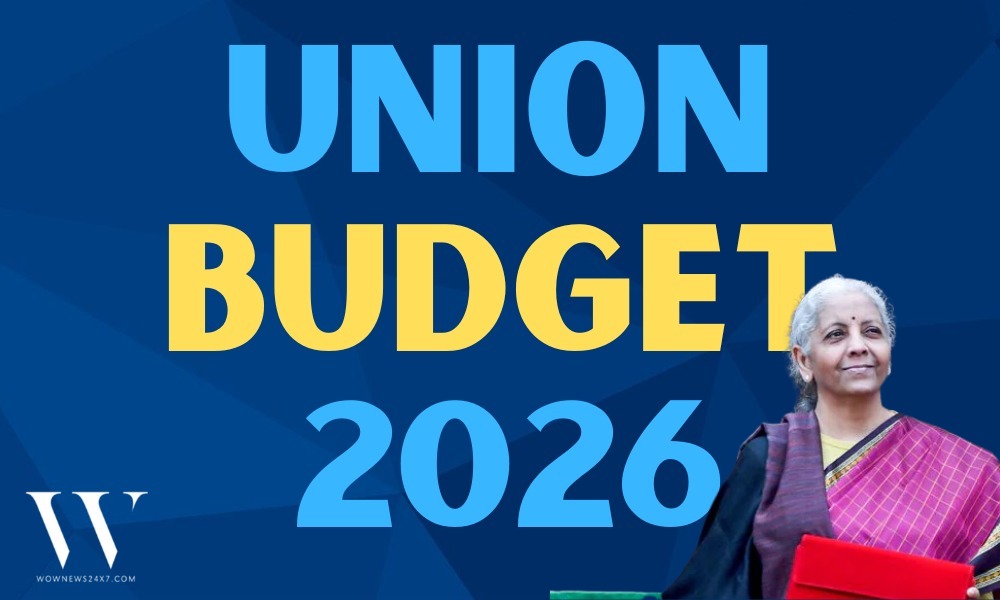
 Image Source: WowNews24x7
On February 1, 2026, Finance Minister Nirmala Sitharaman presented her ninth Union Budget, focusing on inclusive growth, fiscal discipline, and structural reforms. Key allocations targeted agriculture, infrastructure, MSMEs, defence, health, education, green energy, and digital innovation, with a fiscal deficit pegged at 4.3% of GDP and debt-to-GDP ratio projected at 55.6%.
Show more
India’s Union Budget 2026–27, unveiled on February 1, 2026, has been positioned as a growth-oriented and reform-driven roadmap to strengthen economic resilience while ensuring inclusivity. Finance Minister Nirmala Sitharaman emphasized the government’s commitment to “Reforms over Rhetoric,” presenting a fiscal plan that balances capital expenditure, social welfare, and sectoral empowerment.
Sector-Wise Highlights
Agriculture & Rural Development
-
Enhanced allocations for farm mechanization, irrigation, and crop insurance schemes.
-
Expansion of digital agriculture platforms to improve farmer access to markets.
-
Strengthening of rural infrastructure under PM Gram Sadak Yojana to boost connectivity.
Infrastructure & Manufacturing
-
Capital expenditure outlay raised significantly, focusing on highways, railways, and urban transit.
-
Push for semiconductor and rare earth manufacturing, positioning India as a global hub for advanced electronics.
-
Incentives for green hydrogen projects and renewable energy corridors.
MSMEs & Employment
-
New credit guarantee schemes for small businesses, easing access to finance.
-
Skill development programs under Yuva Shakti initiative, targeting youth employment.
-
Simplified compliance norms to improve ease of doing business.
Health & Education
-
Increased funding for primary healthcare centers and expansion of Ayushman Bharat coverage.
-
Investment in digital classrooms, AI-driven learning modules, and scholarships for disadvantaged students.
-
Strengthening of medical research and pharma innovation hubs.
Defence & Security
-
Higher allocations for defence modernization, including indigenous production of advanced weaponry.
-
Focus on cybersecurity infrastructure to safeguard digital public platforms.
Green Energy & Climate Action
-
Major push for solar, wind, and green hydrogen projects, with tax incentives for renewable investments.
-
Expansion of electric vehicle charging infrastructure nationwide.
-
Dedicated climate resilience fund to support vulnerable communities.
Digital Economy & Governance
-
Strengthening of digital public infrastructure, including UPI and Aadhaar-linked services.
-
Promotion of AI, blockchain, and quantum computing research.
-
Enhanced cybersecurity measures to protect financial and citizen data.
Fiscal Outlook
-
Fiscal deficit targeted at 4.3% of GDP for FY 2026–27.
-
Debt-to-GDP ratio projected at 55.6%, reflecting fiscal discipline.
-
Continued emphasis on tax reforms, including rationalization of GST and measures to curb speculative trading in derivatives.
Overall Impact
The Union Budget 2026 is seen as a balanced mix of growth and stability, with strong support for infrastructure, technology, and social sectors. Analysts highlight its dual focus: boosting domestic demand while preparing India for global competitiveness.
Sources: Economic Times, The Hindu BusinessLineThe Hindu BusinessLine, News18, MintJagran Josh, Reuters India
Stay Ahead – Explore Now!
Powering Finance, Energizing Growth: Budget Restructures PFC and REC to Align With Renewable Energy Goals
Advertisement
Advertisement