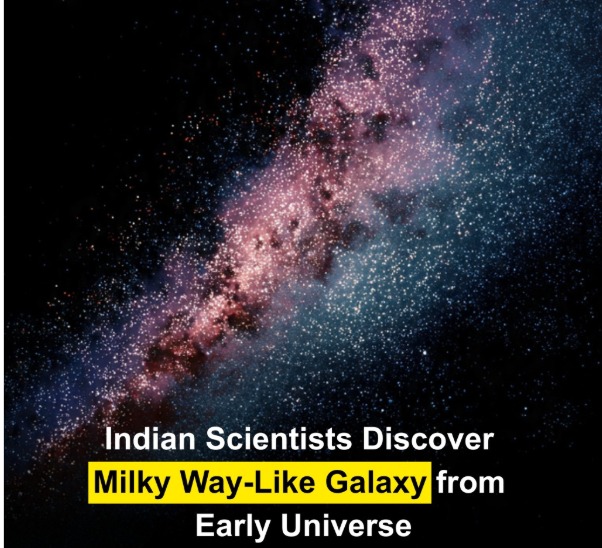








Using the James Webb Space Telescope, Indian scientists identified Alaknanda, a Milky Way-like spiral galaxy from the early universe. Its well-ordered arms and central bulge defy expectations of primitive galactic structures, forcing astronomers to rethink how quickly galaxies could stabilise and evolve after the Big Bang.
Indian astronomers have discovered a massive spiral galaxy, named *Alaknanda*, that formed just 1.5 billion years after the Big Bang. Seen as it existed 12 billion years ago, the galaxy’s mature structure challenges long-held theories that early galaxies were chaotic and irregular, rewriting timelines of cosmic evolution.
The discovery, led by PhD researcher Rashi Jain and Prof. Yogesh Wadadekar, reveals a galaxy one-third the size of the Milky Way, hosting nearly 10 billion stars. Unlike the irregular shapes expected in the universe’s infancy, *Alaknanda* displays symmetrical spiral arms and a bright central bulge. This breakthrough suggests galaxies may have matured far earlier than previously believed, reshaping models of cosmic history and galaxy formation.
Notable updates
• Galaxy Alaknanda discovered 12 billion light years away using JWST
• Formed just 1.5 billion years after the Big Bang
• One-third the size of the Milky Way, with ~10 billion stars
• Challenges existing theories of chaotic early galaxies
• Discovery published in Astronomy & Astrophysics journal
Major takeaway
The finding underscores India’s growing role in global astronomy and highlights how new observations are reshaping our understanding of the universe’s earliest chapters.
Sources: Moneycontrol, Trak.in, News18, Firstpost, India Today, Deccan Herald