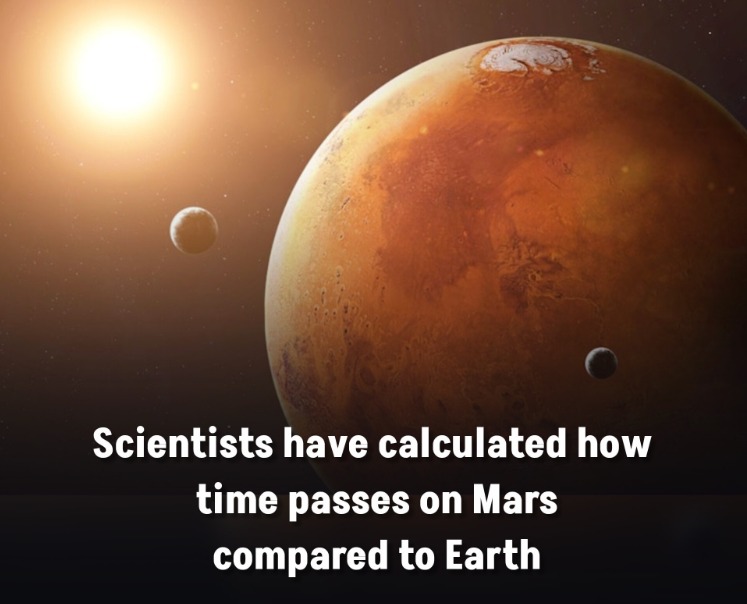

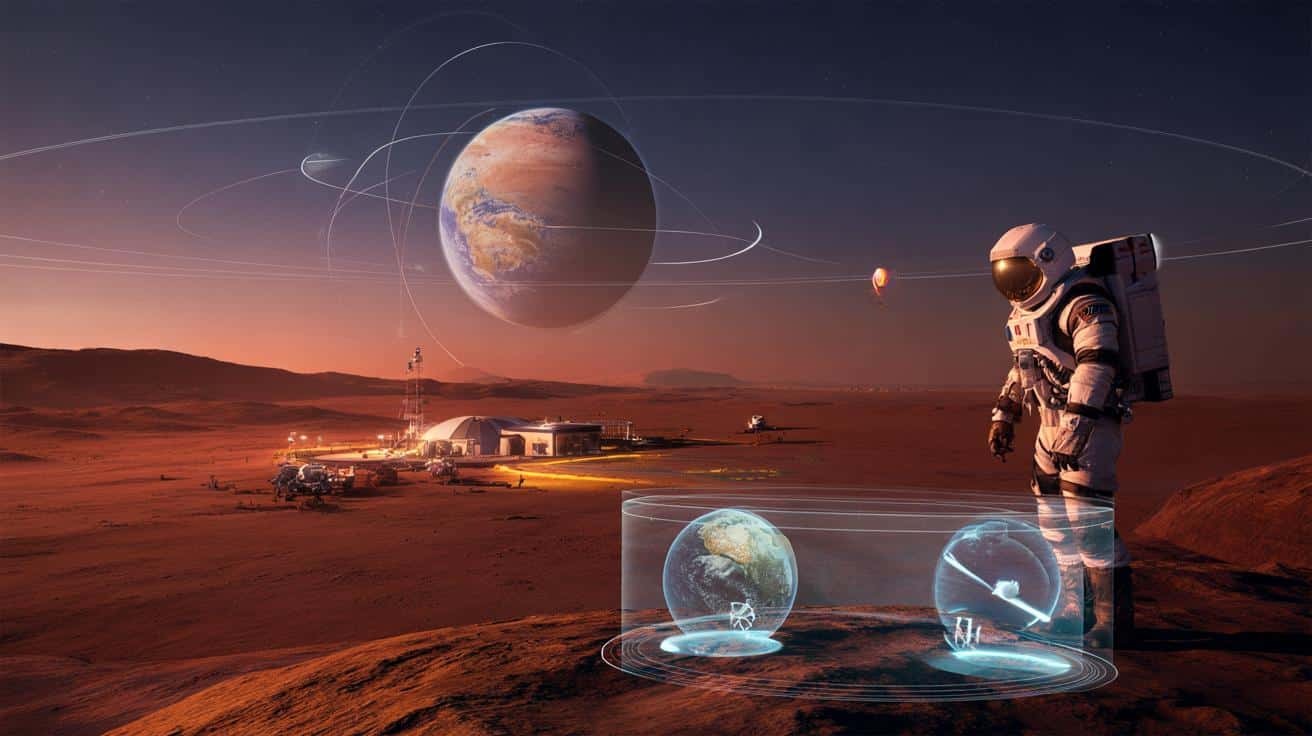
Scientists have confirmed Albert Einstein’s theory of relativity by proving that time flows differently on Mars compared to Earth. Clocks on Mars tick slightly faster, with microsecond variations observed daily. This discovery has major implications for space navigation, communication systems, and future missions to the Red Planet.
Einstein’s Theory Validated
Einstein’s general theory of relativity predicted that gravitational fields and planetary motion could alter the flow of time. Recent experiments conducted by physicists and mission engineers have now confirmed this phenomenon on Mars, where clocks run faster than those on Earth.
Impact On Space Exploration
The difference, though measured in microseconds, is significant for precision-based systems. Navigation, communication, and synchronization of spacecraft will need to account for this time gap. Scientists believe this could also pave the way for a solar-system-wide internet, where planetary time differences are factored into data transmission.
Future Missions
Mars missions will now adapt to this new understanding of time. Engineers are working on recalibrating instruments to ensure accuracy in landings, rover operations, and interplanetary communication. The discovery highlights the importance of relativity in practical space exploration.
Key Highlights
-
Clocks on Mars tick faster than Earth
-
Einstein’s relativity theory confirmed in real-time experiments
-
Microsecond differences impact navigation and communication
-
Potential for solar-system-wide internet
-
Future Mars missions to adapt instruments accordingly
Conclusion
Mars has provided a striking confirmation of Einstein’s predictions, showing that time itself is not universal. As humanity prepares for deeper space exploration, understanding these subtle shifts will be crucial for success.
Sources: ScienceDaily, WION, National Institute of Standards and Technology (NIST)