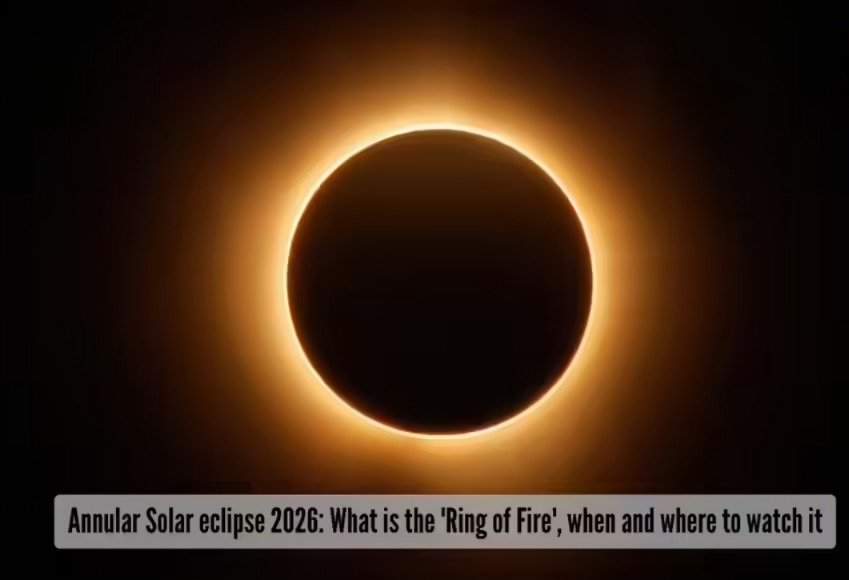





The first solar eclipse of 2026 will occur on February 17 as an annular “ring of fire” event. While the celestial spectacle will be visible mainly over Antarctica and parts of South America and Africa, India will not witness this eclipse. Skywatchers can follow live streams online.
An annular solar eclipse, popularly known as the “ring of fire,” happens when the Moon passes between the Earth and the Sun but does not completely cover the Sun’s disk. This creates a dramatic bright ring around the Moon. The February 17 eclipse is the first of the year and has generated excitement among astronomers and enthusiasts worldwide.
The eclipse’s path lies primarily over Antarctica, with partial visibility in regions of Argentina, Chile, and South Africa. Unfortunately, India will remain outside the viewing track, meaning the event cannot be seen directly from the country. However, several observatories and space agencies are expected to stream the phenomenon live, allowing Indian viewers to experience it virtually.
Experts caution that solar eclipses should never be viewed with the naked eye. ISO-certified eclipse glasses or proper solar filters are essential to avoid permanent eye damage. The event also provides scientists with valuable opportunities to study solar activity and atmospheric changes.
Key Highlights
-
Annular solar eclipse on February 17, 2026
-
Known as the “ring of fire” due to the bright ring effect
-
Visible mainly over Antarctica, with partial views in South America and Africa
-
Not visible from India; live streams available for skywatchers
-
Safety warning: use certified eclipse glasses or filters
Analysts note that while India misses out on this eclipse, future solar eclipses will be visible from the country, offering opportunities for direct observation. The February 17 event underscores the global fascination with celestial phenomena and the importance of safe viewing practices.
Sources: The Economic Times, Hindustan Times, Digit, ET Now