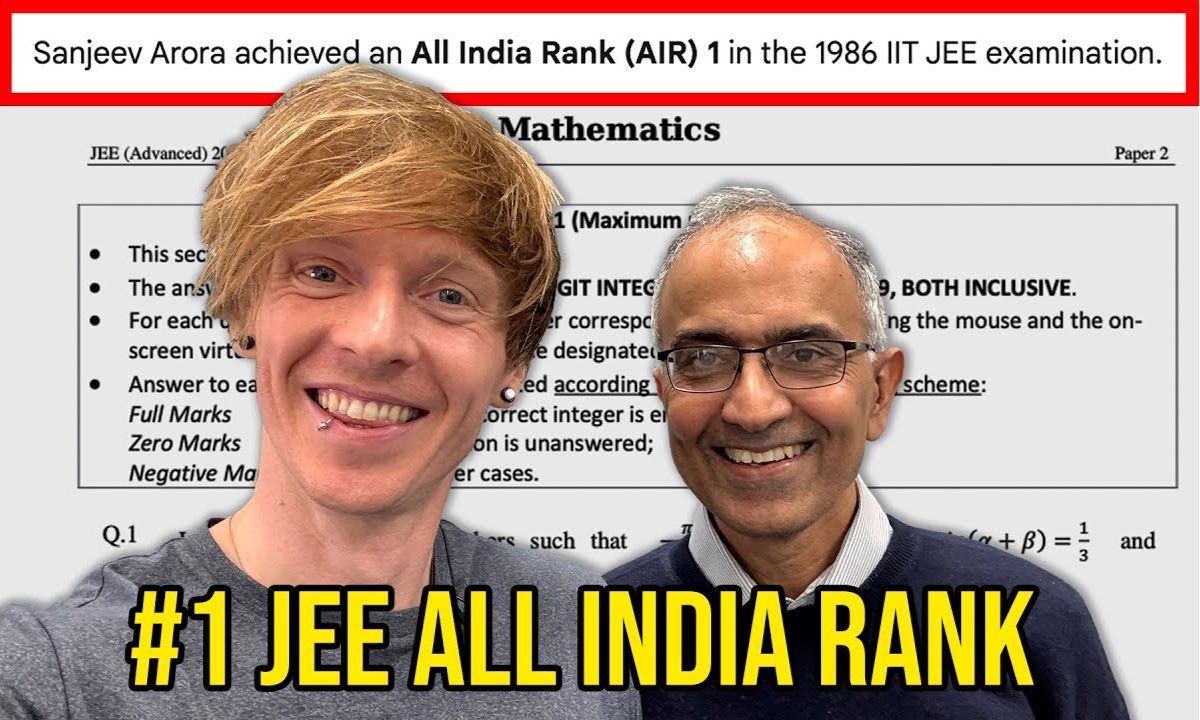








Sanjeev Arora, who secured All‑India Rank 1 in the IIT‑JEE 1986, went on to become one of the world’s leading theoretical computer scientists. Now a Princeton professor and 2011 ACM Prize in Computing winner, his story highlights how early academic excellence, curiosity, and perseverance shaped a groundbreaking research career.
Sanjeev Arora’s academic journey remains one of India’s most inspiring success stories. According to publicly available biographical records, Arora secured Rank 1 in the IIT‑JEE 1986, one of the toughest entrance exams in the world. Instead of completing his degree at IIT Kanpur, he later transferred to MIT, setting the stage for a distinguished global career.
Arora went on to earn his PhD from UC Berkeley, eventually becoming a professor at Princeton University, where he contributed foundational work to theoretical computer science, including the PCP theorem. His groundbreaking research earned him the 2011 ACM Prize in Computing, one of the field’s highest honours.
His trajectory—from a top JEE performer to a globally celebrated researcher—continues to inspire students aiming for excellence in STEM.
Key Highlights / Major Takeaways
JEE Achievement: Secured AIR 1 in IIT‑JEE 1986.
Academic Path: Studied at IIT Kanpur, transferred to MIT; PhD from UC Berkeley.
Research Impact: Known for work on probabilistically checkable proofs and complexity theory.
Global Recognition: Awarded the 2011 ACM Prize in Computing.
Current Role: Professor at Princeton University.
Conclusion
Sanjeev Arora’s journey demonstrates how early academic brilliance, paired with intellectual curiosity and persistence, can lead to extraordinary global impact. His story remains a benchmark for aspiring engineers, researchers, and innovators.
Sources: Wikiwand, Everything ExplainedEverything Explained Today