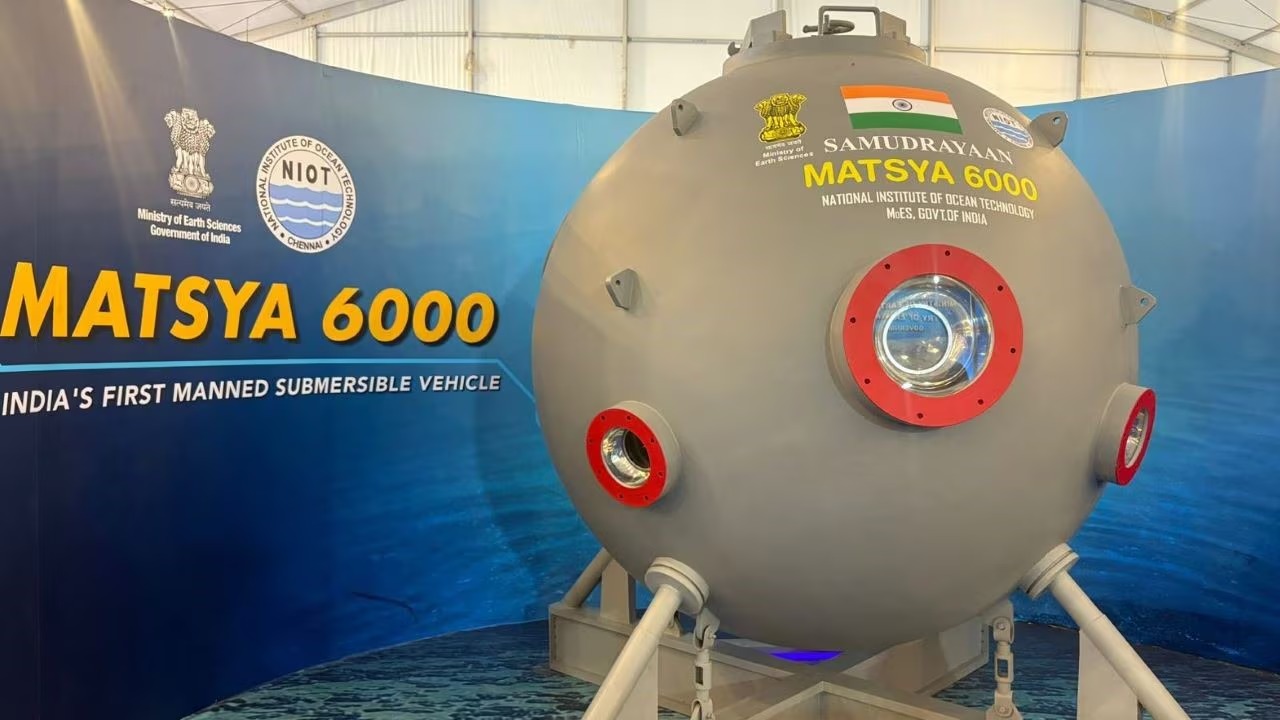
India unveiled Matsya 6000, its first manned deep-sea submersible, developed by NIOT under the Deep Ocean Mission. Capable of carrying three crew members to 6,000 meters, it targets its first dive in 2026. This breakthrough positions India among global leaders in ocean exploration, advancing marine research and the blue economy.
India has taken a bold step into the future of ocean exploration with the unveiling of Matsya 6000, the country’s first indigenously developed manned deep-sea submersible. Announced by Union Minister of State for Science & Technology Jitendra Singh at the India International Science Festival (IISF) 2025, this milestone project places India among a select group of nations capable of ultra-deep-sea exploration.
Key Highlights from the Announcement
Indigenous Breakthrough: Matsya 6000 has been designed and developed by the National Institute of Ocean Technology (NIOT) under the Deep Ocean Mission. It is India’s first human-operated submersible engineered to withstand extreme oceanic pressures.
Capacity & Design: The submersible can carry three crew members inside a 2.1-meter diameter titanium alloy sphere, enabling dives up to 6,000 meters beneath the ocean surface.
Mission Timeline: The first 500-meter manned dive is targeted for 2026, with a full-depth 6,000-meter mission planned for 2027.
Technological Features: Matsya 6000 is equipped with syntactic foam for buoyancy, advanced thrusters for navigation, high-density battery systems, and underwater communication tools, ensuring safety and efficiency during deep-sea missions.
Strategic Importance: The submersible will enable India to explore marine biodiversity, mineral resources, and hydrothermal systems, contributing to the blue economy and advancing scientific research.
Global Standing: Once operational, India will join an elite league of countries like the U.S., Russia, France, and China that possess manned deep-sea exploration capabilities.
Broader Impact
The unveiling of Matsya 6000 is not just a technological feat but also a strategic move to strengthen India’s scientific leadership in ocean research. It complements India’s parallel ambitions in space exploration, symbolizing a dual frontier push—into the depths of the ocean and the expanse of space. The project is expected to open new opportunities in marine science, resource mapping, and sustainable development, while inspiring future generations of researchers and engineers.
Sources: CNBC TV18, WebIndia123, NewsBytes, PIB Press Release