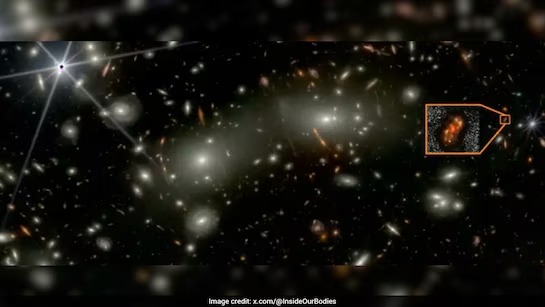










Indian astronomers have discovered an ancient galaxy named Alaknanda, located 12 billion light years away, with striking spiral arms resembling the Milky Way. Formed when the universe was just 1.5 billion years old, the discovery challenges existing theories of galaxy formation, which suggest spiral structures take billions of years to evolve.
Indian scientists from the National Centre for Radio Astrophysics (NCRA-TIFR) in Pune, using data from NASA’s James Webb Space Telescope (JWST), have identified a remarkable galaxy named Alaknanda. Unlike most early galaxies, which were chaotic and irregular, Alaknanda displays a well-defined spiral structure similar to our Milky Way. This finding is significant because spiral galaxies were believed to require at least three billion years to develop such orderly arms, yet Alaknanda achieved this far earlier in cosmic history.
Key highlights from the announcement include
-
Alaknanda is located approximately 12 billion light years away and spans nearly 30,000 light years across.
-
The galaxy formed when the universe was only 1.5 billion years old, compared to its current age of 13.8 billion years.
-
It contains stars with a combined mass nearly 10 billion times that of the Sun.
-
The discovery was made by astronomers Rashi Jain and Yogesh Wadadekar, who screened thousands of galaxies catalogued by JWST.
-
Alaknanda’s two clear spiral arms defy conventional models of early galaxy evolution, which predicted irregular shapes at that epoch.
-
The galaxy has been named after the Alaknanda river in Uttarakhand, symbolizing its cosmic flow and connection to India.
-
The findings were published in the European journal Astronomy & Astrophysics, highlighting the global significance of the discovery.
This breakthrough not only reshapes scientific understanding of galaxy evolution but also underscores India’s growing role in cutting-edge astronomical research. By revealing that mature spiral galaxies could exist much earlier than previously thought, Alaknanda opens new avenues for studying the dynamics of cosmic structures and the forces shaping the universe.
Sources: NDTV, Times of India, Telegraph India, India Today