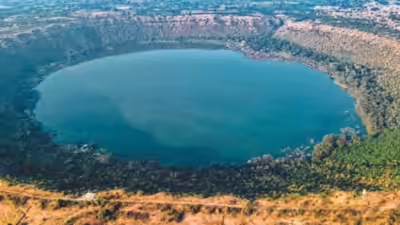

Water levels at Maharashtra’s Lonar Lake—formed by a meteorite impact nearly 50,000 years ago—rose by 20 feet. The sudden surge has submerged ancient temples, triggered ecological concerns, and prompted judicial and scientific intervention. Authorities are investigating causes ranging from underground springs to climate-linked anomalies.
In a startling development, Lonar Lake in Maharashtra’s Buldhana district has witnessed a dramatic 20-foot rise in water levels, sparking concern among environmentalists, researchers, and local communities. The announcement, made on January 22, 2026, highlights the urgency of addressing ecological imbalances at one of India’s most unique natural heritage sites.
Key highlights of the situation:
-
The Nagpur Bench of the Bombay High Court has taken suo motu cognisance of the rising waters, ordering a public interest litigation (PIL) to safeguard the lake and its biodiversity.
-
The surge has already submerged several ancient temples along the lake’s periphery, raising alarms about heritage preservation.
-
Local reports suggest the rise began in September 2025, fueled by continuous inflows from four natural sources and underground springs.
-
The district administration has sought expert inputs from IIT Bombay, tasking researchers to determine whether geological shifts, climate change, or human activity are driving the anomaly.
-
Lonar Lake, formed by a meteorite impact on basalt rock nearly 50,000 years ago, is globally renowned for its saline-alkaline waters and rare ecosystem, attracting scientists and tourists alike.
Experts caution that unchecked water level increases could disrupt the lake’s delicate ecological balance, threatening endemic species and altering its chemical composition. Conservationists also warn of potential damage to the archaeological structures that line the crater’s rim, many of which date back centuries.
The phenomenon has drawn international attention, with researchers noting that Lonar Lake’s unique geology makes it a natural laboratory for planetary science and ecology. The rising waters, however, risk undermining this status unless scientific interventions and protective measures are swiftly implemented.
Authorities are now working to balance tourism, heritage preservation, and ecological sustainability, recognizing that Lonar Lake is not just a local treasure but a global scientific asset. The coming months will be crucial in determining whether the surge is a temporary anomaly or a sign of deeper environmental shifts.
Sources: Times of India, Hindu Press International, Telegraph India, Reuters