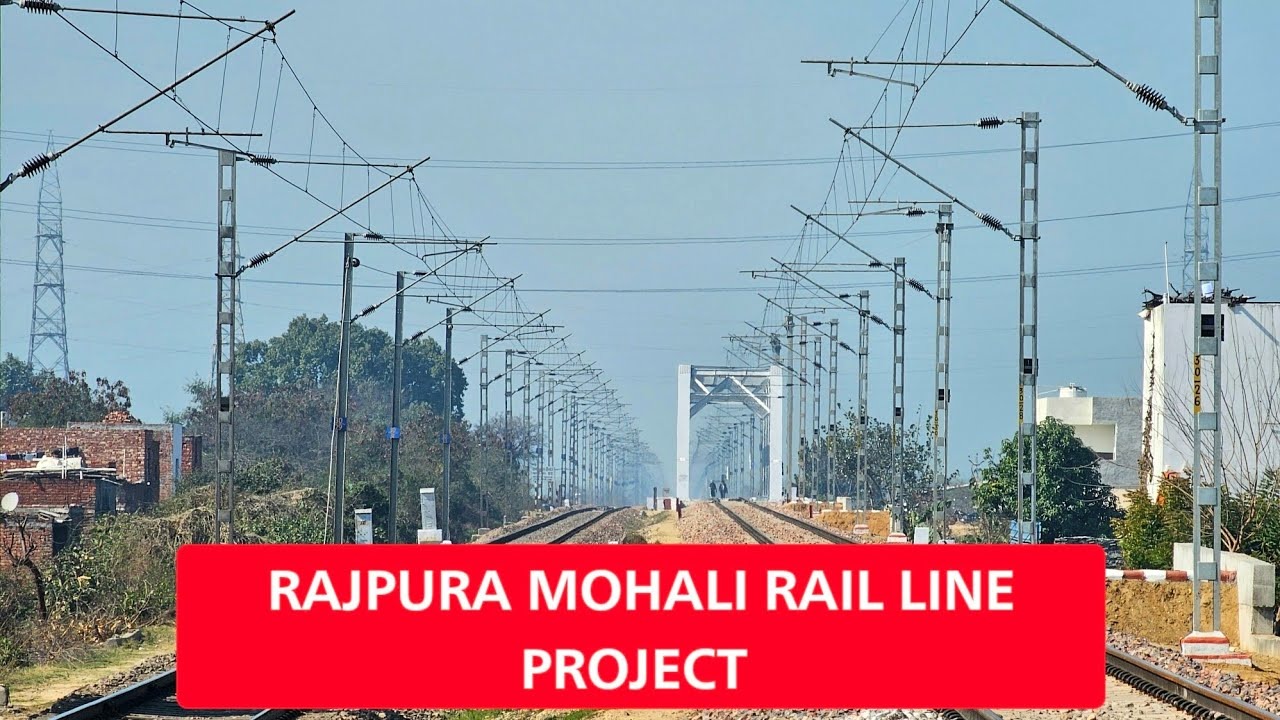
In a landmark development for Punjab’s transportation infrastructure, Indian Railways has approved an 18-kilometre rail line linking Rajpura and Mohali at an investment of Rs 443 crore. This new line will directly connect the Malwa region with the state capital Chandigarh, fulfilling a demand that has persisted for over five decades. The project is expected to significantly reduce travel distance, decongest existing routes, and stimulate economic growth in the region.
Key Highlights Of The Rajpura–Mohali Rail Line Project
The 18.11 km rail line will cost Rs 443 crore and will create a direct rail corridor connecting the Malwa region’s 13 districts with Chandigarh.
The new connection will shorten travel distance between Patiala and Chandigarh by approximately 66 km, reducing journey times and easing congestion on the current Rajpura–Ambala route.
The alignment was strategically chosen to minimize agricultural land acquisition, requiring only about 54 hectares mostly outside farming zones, preserving farmers’ livelihoods.
The project aims to bolster key industries such as textiles, manufacturing, and agriculture by facilitating faster movement of goods and lowering transportation costs.
Enhanced access will also benefit prominent pilgrimage and heritage sites including Gurudwara Fatehgarh Sahib, Sanghol Museum, and the Haveli of Todar Mal.
The rail link complements other ongoing railway initiatives in Punjab, including the proposal for a new Vande Bharat Express running between Firozpur Cantt, Bathinda, Patiala, and Delhi, promising travel of 486 km in under seven hours.
Punjab has seen a near 24-fold increase in railway investment under the current government, from Rs 225 crore in 2009-14 to Rs 5,421 crore in 2025-26, facilitating massive infrastructure upgrades.
Background: Meeting A Half-Century Old Demand
Since the 1960s, demands have been rising for a direct rail connection between the Malwa region and Chandigarh. Currently, trains from key cities like Ludhiana and Patiala must circuitously travel via Ambala, adding significant distance and travel time. The approved Rajpura–Mohali line will finally answer this long-standing need, improving connectivity and accessibility for millions.
Easing Congestion And Improving Efficiency On Existing Routes
The new rail line will reduce traffic congestion on the critical Rajpura–Ambala section and enhance the Ambala–Morinda corridor by diverting a portion of trains to this shorter route. This route optimization is anticipated to improve overall network efficiency and reduce delays, benefiting both passenger and freight movements.
Economic And Social Impact On The Malwa Region
Faster, smoother transportation will invigorate textile, manufacturing, and agricultural sectors by enabling quicker market access and reducing logistics costs.
By improving connectivity with Chandigarh, the economic and administrative hub of the region, the project will facilitate better trade linkages and business growth.
Pilgrimage and tourism sectors stand to gain from enhanced accessibility, boosting local cultural preservation and revenue streams.
The project’s minimal environmental and agricultural footprint reflects a balanced approach aligning infrastructure growth with community welfare.
Complementary Railway Initiatives In Punjab
Alongside the Rajpura–Mohali line, Indian Railways is pursuing multiple projects in Punjab, including:
New track constructions like the 123 km Nangal Dam-Talwara line and the 63 km Bhanupali-Bilaspur-Beri line.
Development of 30 Amrit Stations with modern amenities.
Expansion of electrification covering 1,634 km of railway tracks.
Proposed introduction of a new Vande Bharat Express covering major cities in Punjab and Delhi.
Strategic creation of economic corridors linking Punjab’s border districts to Gujarat ports.
Government’s Role And Future Outlook
The Punjab railway budget allocation has soared dramatically in recent years, reflecting the central government’s commitment to boosting regional connectivity. Railway Minister Ashwini Vaishnaw and Minister of State Ravneet Singh Bittu have expressed strong support for the new line and related projects, emphasizing their transformational potential.
With a proposed construction timeline of two years, the Rajpura–Mohali rail line is set to become a cornerstone of Punjab’s transportation network, accelerating mobility and economic development in the Malwa region.
Conclusion: A Game-Changer For Punjab’s Rail Connectivity
The Rs 443 crore Rajpura–Mohali rail line sanction marks a historic step toward bridging Punjab’s Malwa heartland with its capital city Chandigarh. Combining travel efficiency, community-friendly design, and economic stimulus, this project promises far-reaching benefits for passengers, industries, and cultural heritage. As construction commences, Punjab’s rail connectivity is poised to enter a new era of growth and modernization.
Sources: PIB, DD India, The Indian Express, Projects Monitor, Economic Times