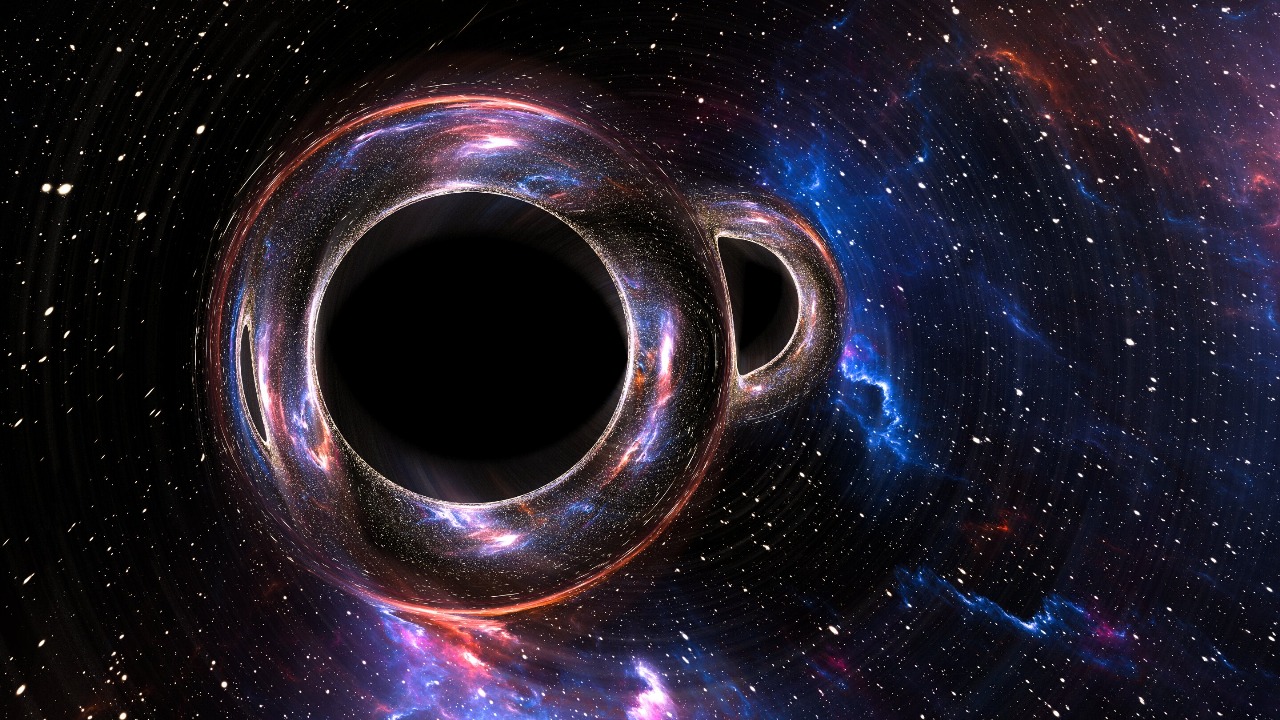





Scientists have confirmed the detection of rare “second-generation” black holes through gravitational wave events GW241011 and GW241110. These findings, published by the LIGO-Virgo-KAGRA Collaboration, offer groundbreaking insights into black hole evolution, suggesting that some black holes are born from previous black hole mergers, not just stellar collapse.
A Cosmic Rarity With Deep Implications
In a landmark discovery, astrophysicists have identified two black holes—detected via gravitational wave signals in late 2024—that exhibit spin characteristics pointing to a second-generation origin. Unlike traditional black holes formed from dying stars, these are believed to be the result of earlier black hole mergers, making them cosmic “offspring” in a multi-generational lineage.
The events, named GW241011 and GW241110, were observed by the LIGO-Virgo-KAGRA Collaboration and published in The Astrophysical Journal Letters. Their unusual spin patterns and mass ratios suggest they are not first-generation black holes, but rather products of previous collisions. This challenges long-held assumptions in astrophysics and opens new avenues for studying black hole populations and galactic dynamics.
Key Highlights
-
Two second-generation black holes detected: GW241011 and GW241110
-
Observed via gravitational wave signals in October and November 2024
-
Spin and mass data suggest origin from earlier black hole mergers
-
Confirms predictions from Einstein’s general relativity
-
Published by LIGO-Virgo-KAGRA Collaboration in The Astrophysical Journal Letters
Notable Updates
-
Second-generation black holes are rare and difficult to detect
-
Their existence supports hierarchical black hole formation models
-
Findings may help explain black hole growth in dense star clusters
-
Advanced algorithms used to decode spin signatures and merger history
-
Opens new research paths in gravitational wave astronomy and cosmology
Outlook Ahead
This discovery marks a turning point in our understanding of black hole evolution. As gravitational wave observatories become more sensitive, scientists expect to uncover more second-generation black holes, refining models of cosmic structure and deepening our grasp of the universe’s most mysterious phenomena.
Sources: Phys.org, Northwestern Now, EurekAlert