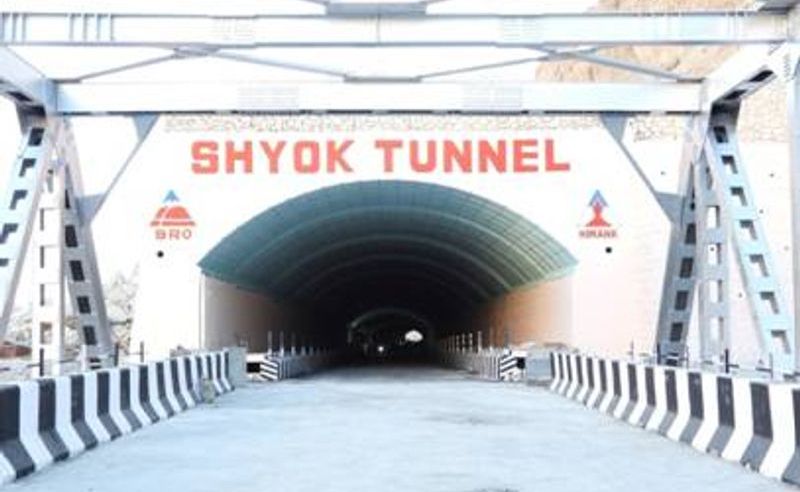







The newly inaugurated Shyok tunnel on the Darbuk–Shyok–Daulat Beg Oldie (DS‑DBO) road secures year‑round connectivity near the Line of Actual Control, enabling faster troop movement and logistics in a harsh, avalanche‑prone zone. The 920‑metre, cut‑and‑cover tunnel at ~12,500 ft bypasses a landslide‑prone riverbank, reducing reliance on costly air maintenance.
What was inaugurated and where it sits
Defence Minister Rajnath Singh inaugurated the Shyok tunnel as part of 125 Border Roads Organisation projects in eastern Ladakh. Located on the DS‑DBO road that runs parallel to the LAC, the tunnel is intended to deliver reliable, all‑weather connectivity to a strategically sensitive corridor.
Why the tunnel is strategically important
Built at around 12,523 ft, the 920‑metre cut‑and‑cover tunnel circumvents a landslide‑prone stretch along the Shyok riverbank, a segment historically vulnerable to closures from snowfall, flooding, and high winds. It strengthens mobility, rapid deployment, and resupply while reducing dependence on air maintenance in extreme winter conditions.
Major takeaways
All‑weather access: Ensures year‑round movement on the DS‑DBO corridor close to the LAC.
Faster deployments: Improves speed and predictability of troop rotation and logistics.
Risk mitigation: Bypasses landslide/flood‑prone riverbank section to cut disruption risk.
Cost efficiency: Likely lowers reliance on air sorties for maintenance and supplies.
Post‑2020 focus: Part of accelerated infra push after heightened deployments in Ladakh.
Notable updates
Engineering feat: High‑altitude construction declared an “engineering marvel” given terrain challenges.
Network effect: One of 125 BRO projects enhancing border infrastructure resilience in the sector.
Operational readiness: Improves winter survivability of logistics chains supporting forward areas.
Conclusion
The Shyok tunnel is a force multiplier: it converts a fragile, weather‑dependent artery into a dependable logistics backbone, tightening India’s operational timelines and resilience in eastern Ladakh. By shrinking uncertainty on the DS‑DBO road, it materially elevates readiness and reduces long‑run supply risks near the LAC.
Sources: The Indian Express; BusinessLine