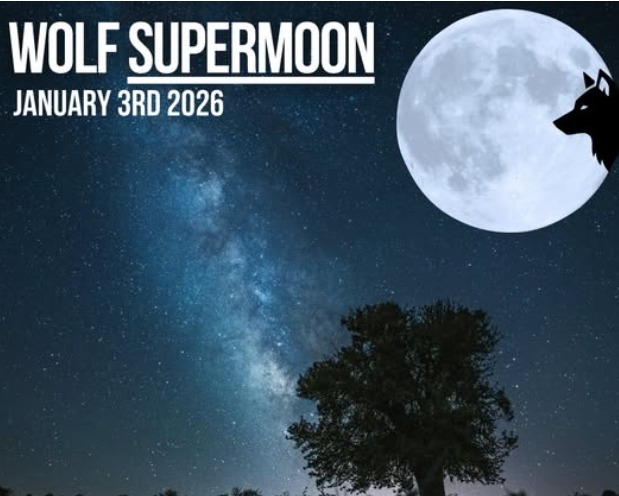

The year’s first supermoon, the Wolf Supermoon, will be visible across India shortly after sunset today. Expect a larger, brighter Moon with an orange-yellow hue near the horizon. Peak viewing is around local moonrise, with the supermoon appearing up to 14% larger and 30% brighter than an average full Moon.
What Is A Supermoon
A supermoon occurs when a full Moon coincides with perigee, the point where the Moon is closest to Earth. This alignment makes the Moon appear significantly larger and brighter than usual. The Wolf Supermoon, named after traditional January full Moon folklore, opens the celestial calendar for 2026.
Visibility In India
Across India, the supermoon will be visible shortly after sunset, with the best viewing window around 5:45 pm to 6:00 pm IST depending on the city. The Moon will appear largest near the horizon, often glowing orange-yellow due to atmospheric scattering. The spectacle will continue into the early hours, offering extended opportunities for observation.
Skywatching Experience
Astronomy enthusiasts highlight that tonight’s sky will also feature bright winter constellations and planets like Jupiter and Saturn, adding depth to the viewing experience. Clear eastern horizons will provide the most dramatic views, especially for photographers capturing the Moon’s rise.
Key Highlights
-
First supermoon of 2026, known as the Wolf Supermoon
-
Visible shortly after sunset across India with peak around moonrise
-
Moon may appear up to 14% larger and 30% brighter than an average full Moon
-
Orange-yellow hue likely near the horizon due to atmospheric scattering
-
Best viewing window around 5:45 pm to 6:00 pm IST depending on city
-
Occurs at perigee, with distance near 362,000 km from Earth
-
Continues into the early hours, weather permitting
The Wolf Supermoon offers India’s skywatchers a luminous start to 2026. With its striking size and brightness, tonight’s event is both a scientific phenomenon and a cultural spectacle. Observers are encouraged to find clear horizons near sunset to enjoy the most dramatic views of this celestial highlight.
Sources: Hindustan Times, India Today, Digit, WION