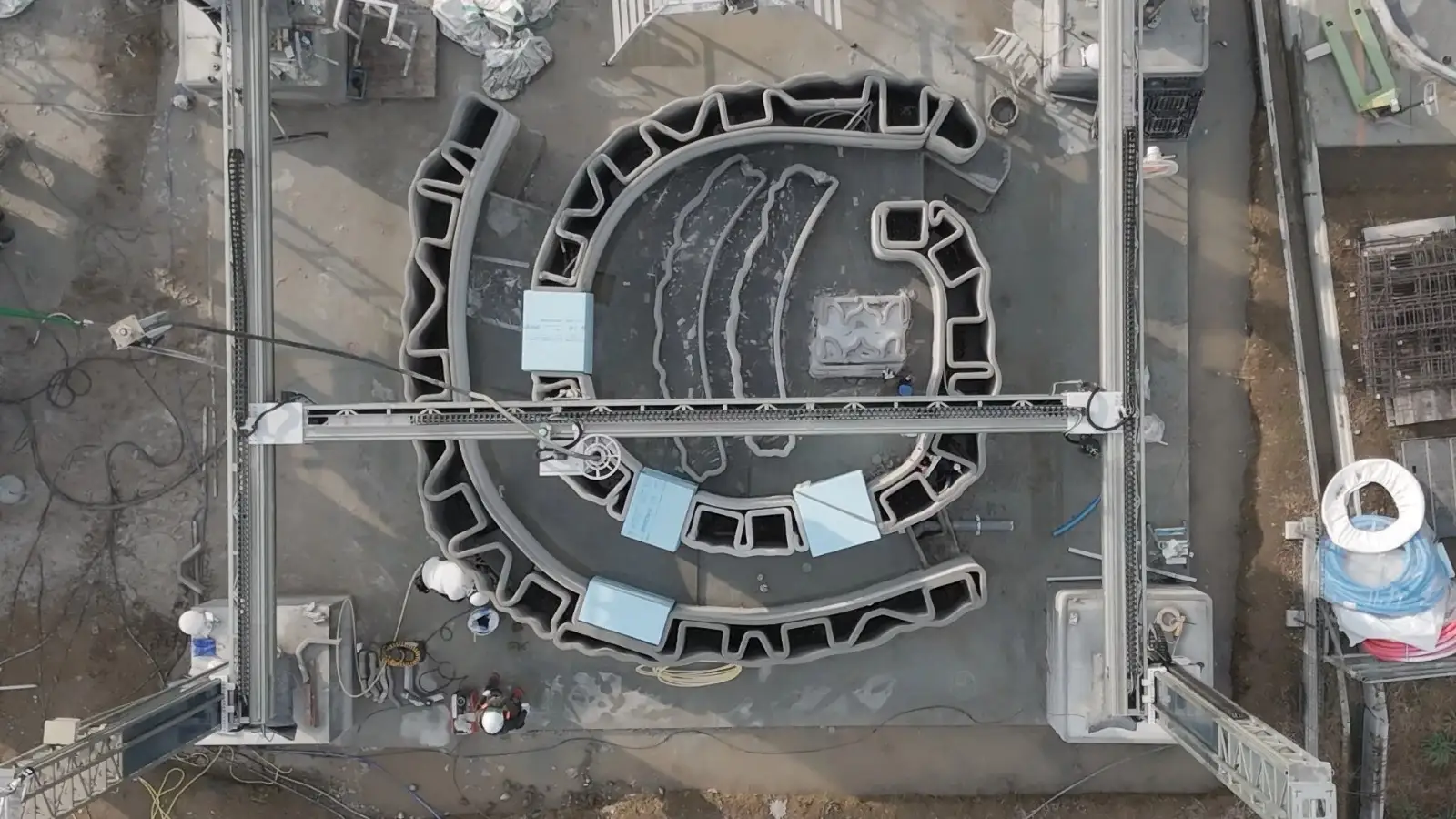







Japan has unveiled its first government-approved two-story 3D-printed reinforced concrete house, designed with cave-like geometry to withstand earthquakes. Known as the “O House,” this innovation merges robotic construction with seismic engineering, offering a sustainable and resilient housing solution for earthquake-prone regions.
Japan has taken a groundbreaking step in architectural innovation with the introduction of the O House, a two-story 3D-printed reinforced concrete home engineered to meet strict seismic standards. Developed by Kizuki Co. Ltd. in collaboration with architectural studio Onocom, the project uses advanced robotic 3D printing technology to create curved, layered walls inspired by cave structures. This design enhances durability and distributes seismic forces more effectively.
Spanning 50 square meters across two compact floors, the O House demonstrates how 3D printing can combine aesthetics with resilience. Its earthquake-resistant frame is anchored into reinforced foundations, ensuring compliance with Japan’s stringent building codes. The project highlights the potential of automated construction as a faster, cost-effective, and sustainable alternative to traditional housing methods.
Industry experts view this as a milestone in sustainable architecture, signaling a future where robotic construction could revolutionize urban planning and disaster-resilient infrastructure worldwide.
Key Highlights
-
Japan debuts first government-approved two-story 3D-printed house
-
Inspired by cave-like geometry for seismic resilience
-
Built using reinforced concrete and robotic 3D printing
-
Measures 50 sq m across two compact floors
-
Represents breakthrough in sustainable, automated construction
Sources: New Atlas, Interesting Engineering, COBOD International