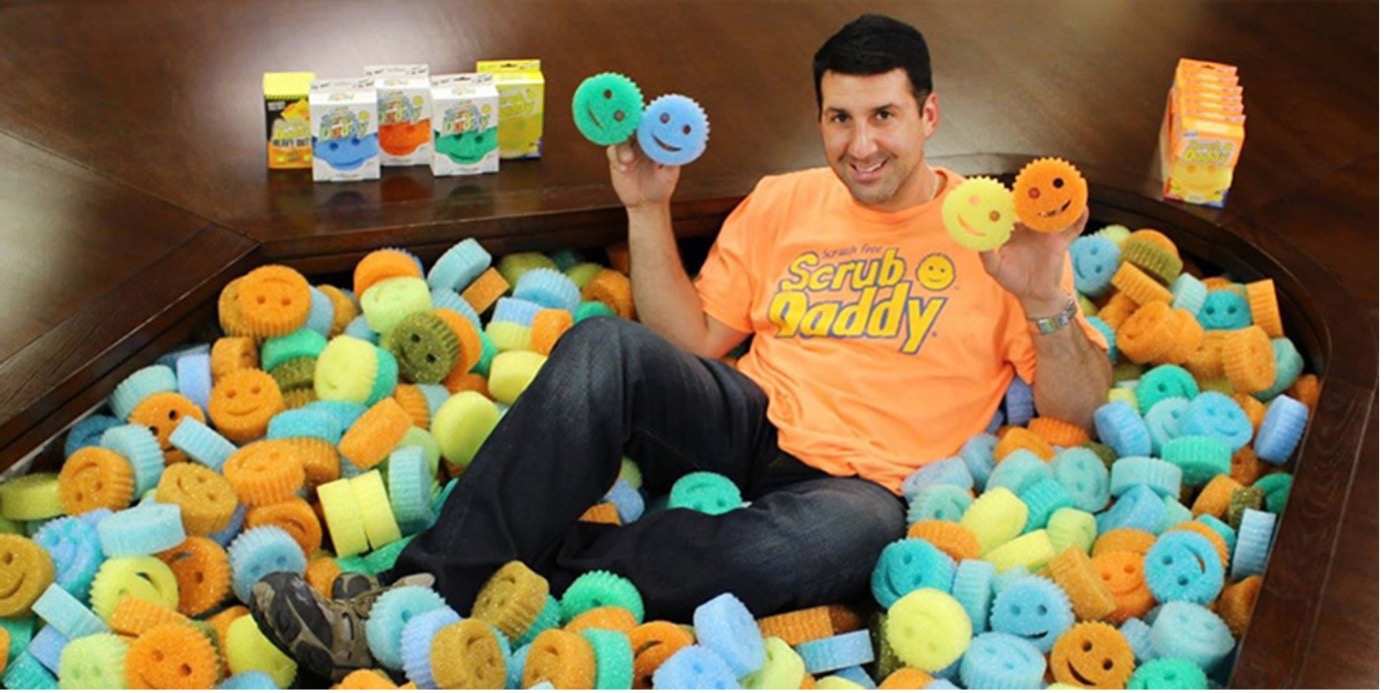
A simple sponge with a smile reshaped the cleaning aisle. Aaron Krause transformed an overlooked foam experiment into Scrub Daddy — a brand that has generated over $1.3 billion in lifetime sales. With ~$340 million in annual revenue and a $250–500 million valuation, this Shark Tank success became a global powerhouse.
A Smile That Built a Billion-Dollar Brand
A sponge smiles from a supermarket shelf.
It changes texture with temperature.
It feels playful, yet performs like a powerhouse.
Behind that smile stands a man who turned a forgotten material into a global empire.
The Origin: From Car Buffing Pads to Kitchen Innovation
-
Long before Scrub Daddy entered American kitchens, Aaron Krause was running a car-detailing products company called Dedication to Detail. While developing buffing pads, he created a unique polymer foam that changed texture depending on water temperature, firm in cold water for tough scrubbing, soft in warm water for gentle cleaning.
-
Initially, the material had no clear mass-market use. It sat unused in storage after Krause sold his car-care company. Then, while cleaning patio furniture one day, he reached for the foam. The performance clicked instantly.
-
A simple redesign followed: a round shape with two eye holes for grip and a smile that cleaned both sides of utensils.
Scrub Daddy was born.
The Defining Turning Point: Shark Tank
-
In 2012, Krause stepped onto the stage of Shark Tank (U.S.) and pitched Scrub Daddy. He asked for $100,000 for 10% equity. Investor Lori Greiner saw the product’s retail potential immediately and offered $200,000 for 20%.
-
That decision became one of the most successful deals in the show’s history.
-
Within minutes of airing on QVC with Lori Greiner, Scrub Daddy sold out. Major retailers followed — Walmart, Target, Bed Bath & Beyond, and eventually international markets.
The smile was everywhere.
Strategic Genius: Turning a Commodity into a Character
-
Sponges are typically invisible household items. Krause turned one into a personality.
-
The temperature-reactive material created functional differentiation. The ergonomic smile design created memorability. Bright colors created shelf impact. Demonstrations created instant understanding.
-
Instead of competing on price, Scrub Daddy competed on performance and emotional connection.
The strategy worked because it combined three forces:
-
Product innovation
-
Retail storytelling
-
Mass distribution leverage
A commodity became a branded icon.
Scale, Numbers & Global Impact
The results speak clearly:
-
Scrub Daddy has generated over $1.3 billion in lifetime sales, making it the highest-grossing product in Shark Tank history.
-
The company now generates approximately $340 million in annual revenue.
-
As of 2025, estimates place the company’s valuation between $250–500 million, depending on retail performance and private market assessments.
-
Scrub Daddy products are sold in major retailers across the United States and in multiple international markets. The brand has expanded into a full product ecosystem including Scrub Mommy, Power Paste, Scour Daddy, and other cleaning innovations.
-
From a single sponge, an entire cleaning portfolio emerged.
The Bigger Lesson
-
Aaron Krause did not invent the sponge, he reinvented how people felt about one.
-
Innovation often lives in overlooked materials. Branding transforms function into emotion. Distribution scales simplicity into dominance.
The Scrub Daddy story proves a powerful truth:
Small products, when engineered with imagination and executed with precision, can create billion-dollar impact.
A smile changed cleaning forever.
Execution built the empire.
Source: ABC’s Shark Tank official deal archive, CNBC, Forbes, QVC press releases and retail performance data, Business Insider reports on Shark Tank’s top-earning products,Company statements and retail distribution disclosures