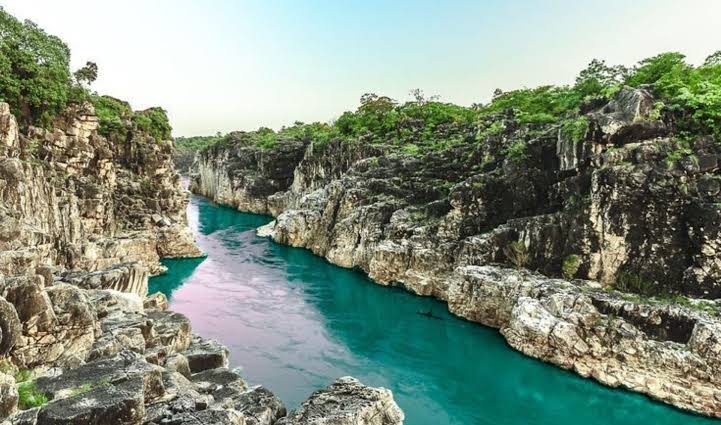

The Narmada River, one of India’s most revered waterways, flows westward into the Arabian Sea, unlike most major rivers that drain eastward into the Bay of Bengal. Its unique course is shaped by geological forces, cultural traditions, and ecological significance, making it a symbol of resilience and spirituality.
The Narmada River, often called the lifeline of central India, has fascinated geographers, historians, and pilgrims for centuries. Stretching over 1,300 kilometers, the river originates from Amarkantak in Madhya Pradesh and flows westward through the states of Maharashtra and Gujarat before emptying into the Arabian Sea. Its unusual westward journey sets it apart from most Indian rivers, which follow an eastward course.
Key highlights from the announcement include
-
Narmada originates from Amarkantak Plateau in Madhya Pradesh.
-
Unlike most rivers, it flows westward due to the geological tilt of the Indian Peninsula.
-
River travels through Madhya Pradesh, Maharashtra, and Gujarat before reaching the Arabian Sea.
-
Narmada is considered sacred in Hindu tradition, with the Narmada Parikrama pilgrimage tracing its banks.
-
The river supports major irrigation, hydroelectric projects, and sustains millions of livelihoods.
-
Its basin is rich in biodiversity, home to forests, wildlife sanctuaries, and cultural heritage sites.
Geologists explain that the westward flow of the Narmada is a result of the rift valley formation between the Vindhya and Satpura ranges, which channels the river toward the Arabian Sea. This tectonic feature makes the Narmada one of the few rivers in India to defy the eastward drainage pattern.
Beyond its geological uniqueness, the Narmada holds immense cultural and spiritual importance. It is revered as one of the seven holy rivers in Hinduism, with legends describing it as a daughter of Lord Shiva. Pilgrims undertake the arduous Narmada Parikrama, a circumambulation of the river, believed to bring spiritual merit.
Economically, the river is vital for irrigation, drinking water, and power generation, with projects like the Sardar Sarovar Dam transforming agriculture and energy supply in western India. Ecologically, the Narmada basin sustains diverse flora and fauna, making it a crucial natural resource.
The Narmada’s westward journey is not just a geographical curiosity but a story of nature’s design, human reverence, and national significance. It continues to inspire awe as a river that flows against the norm, carving its own path across India’s heartland.
Sources: The Hindu, Indian Express, Down To Earth