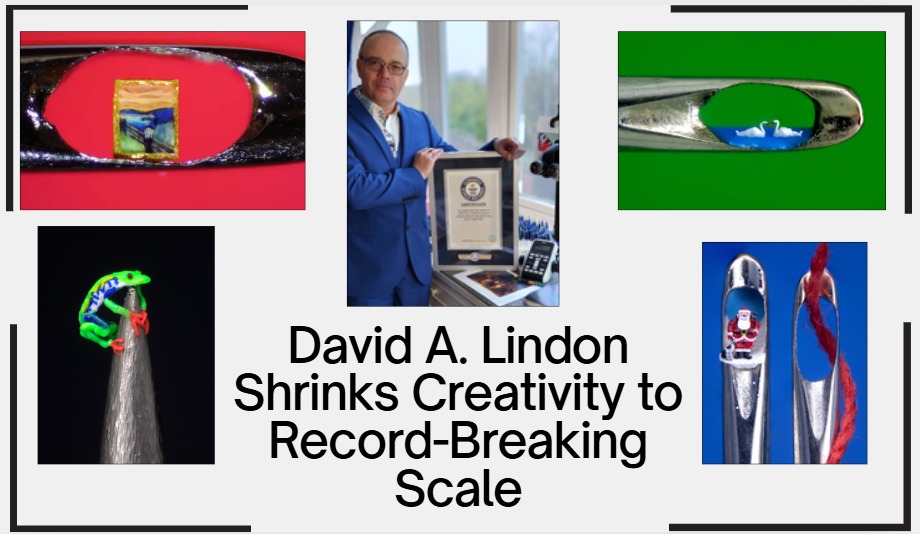
UK artist David A. Lindon has set new Guinness World Records with microscopic sculptures that fit inside needle eyes. His latest yellow smiley face broke his own record, surpassing a previous red Lego brick creation. Invisible to the naked eye, these works showcase the fusion of art, science, and human ingenuity.
Art has always been about pushing boundaries, but UK artist David A. Lindon has taken that idea to microscopic extremes. His latest creations—tiny sculptures that fit inside the eye of a needle or balance on pinheads—have set new Guinness World Records, redefining what it means to create art at the smallest scale imaginable.
Breaking His Own Records
Lindon’s newest masterpiece, a yellow smiley face sculpture, is so minuscule that it cannot be seen with the naked eye. It surpasses his earlier record-breaking work, a red Lego brick sculpture, both of which were measured and verified by scientists at Bournemouth University. The researchers compared his art to a grain of sand, remarking that the sand looked like a “mountain” next to Lindon’s intricate creations.
The Science Behind the Art
Creating sculptures at this scale requires extraordinary precision. Lindon works under powerful microscopes, using specialized tools and an almost superhuman level of patience. Even the slightest tremor or breath could ruin hours of work. His ability to craft recognizable shapes at a scale comparable to a human blood cell has fascinated both art lovers and scientists alike.
Why It Matters
Beyond the novelty, Lindon’s work highlights the intersection of art and science. His sculptures demonstrate not only artistic creativity but also the possibilities of working at microscopic scales, inspiring conversations about nanotechnology, precision engineering, and human ingenuity.
Recognition and Impact
Guinness World Records has officially recognized Lindon’s achievements, cementing his place as one of the most unique artists in the world. His work has drawn global attention, with exhibitions showcasing these invisible wonders through high-powered microscopes, allowing audiences to glimpse the extraordinary detail hidden within the tiniest of canvases.
Key Highlights
-
Record-breaking art: Lindon’s sculptures are smaller than a grain of sand and invisible without microscopes.
-
Latest creation: A microscopic yellow smiley face broke his own previous record for the tiniest sculpture.
-
Comparison: Scientists at Bournemouth University measured his works, noting that a grain of sand looked like a “mountain” compared to his art.
-
Past works: Previous record-holder was a red Lego brick sculpture, also microscopic.
-
Technique: Requires extreme patience, steady hands, and specialized tools to craft artworks at cellular scale.
-
Recognition: Guinness World Records confirmed his achievements, spotlighting Lindon’s unique contribution to art and science.
Conclusion
David A. Lindon’s record-breaking needle-eye sculptures are more than just artistic curiosities—they are a testament to human creativity, patience, and innovation. By crafting works invisible to the naked eye, Lindon has expanded the boundaries of art, proving that even the smallest creations can leave the biggest impact.
Sources: Guinness World Records, MSN, Mid-Day