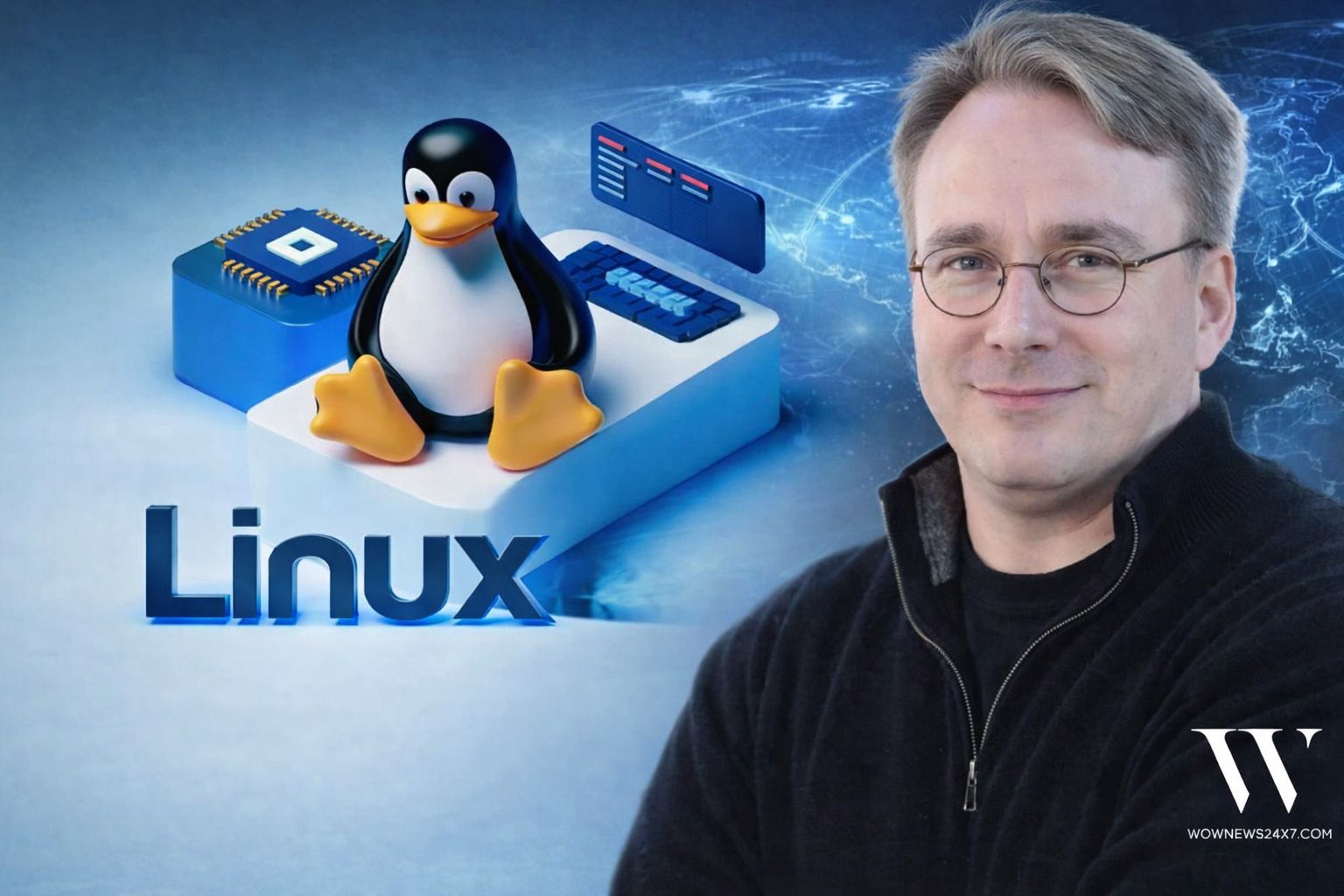
In 1991, a Finnish student named Linus Torvalds created Linux after being unable to afford a commercial operating system. Released as open source, Linux grew through global collaboration into a foundation of the modern digital economy powering Google, Amazon, smartphones, banks, supercomputers, and critical global infrastructure.
In the early 1990s, software was not a shared resource it was a locked gate. A handful of corporations controlled operating systems, charged steep licensing fees, and dictated how computers could be used. Innovation moved slowly, bound by corporate priorities and proprietary code.
Then, from a university dorm room in Finland, that model quietly collapsed.
The Closed World of Software in 1991
At the time, operating systems were dominated by companies like Microsoft and IBM. Access came at a cost, and experimentation was limited. For students, hobbyists, and independent developers, professional-grade systems were often financially out of reach. Software wasn’t built with users it was sold to them.
This environment left little room for openness, collaboration, or rapid experimentation. The internet itself was still in its infancy, and the idea of crowdsourced software development was almost unthinkable.
A Student with a Problem and a Keyboard
In 1991, Linus Torvalds, then a 21-year-old computer science student at the University of Helsinki, faced a simple problem: he wanted a Unix-like operating system for his personal computer but could not afford one.
Instead of accepting the limitation, Torvalds began writing his own operating system kernel as a personal project. His goal was modest build something functional for his own use. There was no business plan, no funding, and no ambition to disrupt an industry.
What happened next would redefine how software is built.
“Take It”: The Power of Open Source
Rather than commercializing his work, Torvalds released his code publicly and invited others to use, modify, and improve it. This decision to license Linux as free and open-source software was radical at the time.
Developers from around the world began contributing. Bugs were fixed faster than any single company could manage. Features evolved organically. Linux began improving at the speed of global collaboration rather than corporate hierarchy.
It became one of the largest collaborative projects in human history.
Resistance from the Giants
The rise of Linux did not go unnoticed. Established software companies viewed it as a threat to their business models. Internal documents and public statements from the era show deep concern about open-source software undermining proprietary systems.
Most notably, Bill Gates of Microsoft publicly criticized Linux, famously describing it as a threat to intellectual property. Legal strategies, competitive positioning, and lobbying efforts were deployed to slow its adoption.
They failed.
Linux had no single owner to sue, no headquarters to pressure, and no boardroom to negotiate with. It belonged to everyone and no one.
From Servers to Smartphones
As the internet expanded, Linux quietly became its backbone. Web servers, data centers, and enterprise systems adopted it for its stability, security, and cost efficiency.
Then came the smartphone revolution.
-
Google used the Linux kernel as the foundation for Android. Today, billions of devices worldwide run Android, meaning billions of people interact daily with software built on Torvalds’ original work without ever knowing it.
-
Linux also underpins cloud infrastructure used by Amazon, global banks, stock exchanges, and government systems.
-
The Invisible King of the Digital World
Today, Linux runs:
-
All of the world’s top 500 supercomputers
-
Major cloud platforms and data centers
-
Financial markets, including global exchanges
-
Space systems, including satellites and research platforms
-
Despite this dominance, Linux has no marketing department, no sales force, and no licensing fees. Its adoption is driven entirely by performance, reliability, and trust.
If Linux were to fail tomorrow, vast portions of modern digital infrastructure would stall.
A $20+ Billion Ecosystem Given Away
-
What began as a personal workaround evolved into an ecosystem valued at over $20 billion, spanning enterprise software, cloud computing, mobile technology, and embedded systems.
-
Torvalds never charged royalties. He did not seek venture capital. He did not monetize control. Instead, he proved that collaboration could outperform ownership and that openness could outscale monopoly.
Why the Linux Story Matters
-
Linux is more than an operating system. It is a case study in how innovation can emerge outside traditional power structures. It shows that:
-
Access can matter more than ownership
-
Collaboration can outpace corporate scale
-
Giving something away can sometimes create more value than selling it
-
In an era dominated by subscriptions and closed platforms, Linux remains the ultimate counterexample.
Looking Ahead
Over three decades later, Linux continues to evolve maintained by a global community and quietly powering the systems the world depends on. Its creator still oversees its development, guided by the same principle that started it all: build what works, and let others make it better.
Linux did not win through marketing.
It won by working.
Sources: Linux Foundation Official Documentation & History, Britannica Linus Torvalds and Linux, Wired The Origins of Linux, Android Developers Blog, Linux Kernel Overview, Top500.org, Supercomputer Operating Systems