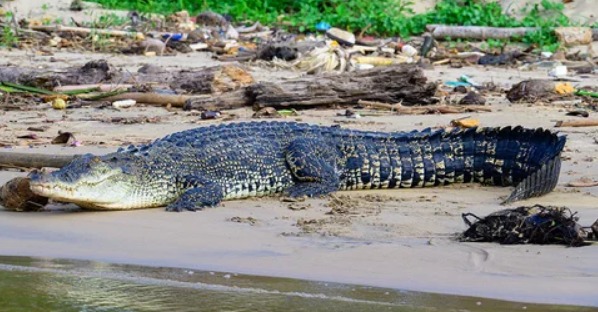
New genetic research has finally explained how “marathon” crocodiles managed to colonise the Seychelles after travelling roughly 3,000 km across the Indian Ocean. The crocodiles, once thought to be a separate or mystery species, have now been confirmed as saltwater crocodiles that drifted and swam across open sea to reach the remote islands. The finding rewrites a 250 year old puzzle about the origin of Seychelles’ now extinct crocodile population and highlights just how far these reptiles can roam.
Ancient Mystery Of Seychelles Crocodiles
Historical accounts from the late 18th and 19th centuries described crocodiles as common along the coasts and mangroves of the Seychelles, but the animals were wiped out within about 50 years of permanent human settlement. Because only skulls and a few specimens survived in European museums, scientists were unsure whether they were Nile crocodiles, an unknown species or something else entirely. The question lingered for generations, becoming a classic biogeography puzzle in the western Indian Ocean.
DNA Study Tracks Their True Origins
A new study, published in Royal Society Open Science, used ancient DNA from historic specimens to reconstruct the identity and evolutionary relationships of these crocodiles. The genetic analysis showed that the Seychelles animals were not a distinct species but the westernmost population of the saltwater crocodile Crocodylus porosus. Their DNA closely matches crocodiles found thousands of kilometres away in the Indo Pacific, confirming that populations remained connected over long periods and great distances.
How Crocodiles Pulled Off A 3,000 Km Sea Voyage
Researchers say the founders of the Seychelles population must have drifted at least 3,000 km across the Indian Ocean, likely riding currents, storm surges and their own swimming power. Saltwater crocodiles are unusually tolerant of seawater compared to other crocodilians, allowing them to survive in marine conditions for weeks at a time. Large adults, some over six metres long and weighing close to a tonne, could conceivably cross vast stretches of ocean, using islands as stepping stones when available.
What The Findings Mean For Crocodile Range And Evolution
Before the Seychelles population was exterminated, saltwater crocodiles occupied an enormous range spanning more than 12,000 km from Vanuatu in the Pacific to the Seychelles in the western Indian Ocean. That makes Crocodylus porosus one of the most widely distributed and mobile reptiles on Earth, far exceeding earlier assumptions about how tied they are to coastlines and estuaries. The new data also refine the crocodile family tree, using complete mitochondrial genomes to clarify how saltwater crocs relate to other species within Crocodylia.
Conservation Lessons From A Lost Island Population
Although the Seychelles crocodiles themselves are long gone, their DNA offers lessons for current conservation debates. The study shows how easily saltwater crocodiles can recolonise distant coasts if suitable habitat exists and human persecution is limited, which may shape how reintroduction and conflict management are discussed in the region. More broadly, it is a reminder that marine and coastal ecosystems have long been linked by natural “rafts” of wildlife, long before humans started drawing hard lines on maps.
Key Highlights
- New genetic analysis solves a 250 year old mystery about Seychelles crocodiles
- Historic island crocodiles were actually saltwater crocodiles, not a separate species
- Founding animals likely drifted at least 3,000 km across the Indian Ocean
- Saltwater crocs once ranged over 12,000 km, from Vanuatu to the Seychelles
- Findings highlight extreme long distance dispersal and high mobility in Crocodylus porosus
Sources: Royal Society Open Science study on Seychelles crocodile DNA; press summaries from SciTechDaily, Phys.org, ScienceDaily and University of Potsdam; coverage in LiveScience, Times of India and Exame on saltwater crocodile ocean voyages.