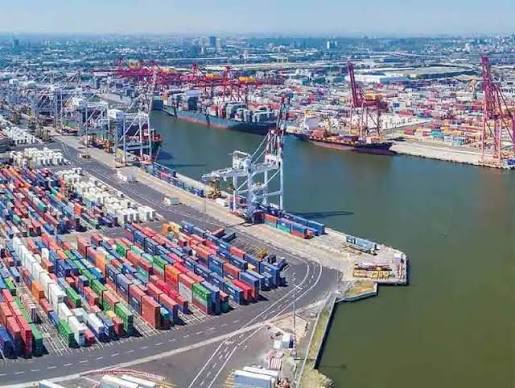
One Bold Maritime Plan Could Reshape India's Global Standing
Kalpana Kanungo - Mumbai Bureau
Aug 03, 2026 2,100
Views
India is accelerating its maritime growth by targeting over 700 MTPA of additional port capacity by 2030. Driven by major projects like Vadhavan Port and a 41% rise in shipbuilding output, the government's roadmap aims to slash logistics costs, boost private investment, and position India as a global maritime powerhouse.
NEW DELHI — The Indian government has launched an aggressive maritime infrastructure roadmap, setting a firm target to create more than 700 million tonnes per annum (MTPA) of additional port capacity by 2030. This expansion, a cornerstone of the nation’s "Viksit Bharat 2047" vision, seeks to modernize India’s logistics landscape through high-value port development, digitisation, and a significant push to revive domestic shipbuilding.
Union Minister for Ports, Shipping and Waterways, Sarbananda Sonowal, recently chaired a high-level review meeting to oversee the execution of these maritime goals. Officials were directed to accelerate flagship projects, emphasizing the need for "speed and scale" to maintain India’s momentum as a growing global maritime economy.
Expanding Port Capacity
The government’s plan envisages a quantified capacity creation of 682 MTPA through a mix of new infrastructure, operational efficiency, and private investment, with the overall target exceeding 700 MTPA. Key flagship projects driving this growth include:
Vadhavan Port: Expected to contribute 164 MTPA by 2030-31.
Tuticorin Outer Harbour: Planned to add 39 MTPA.
Kandla Tuna Tekra Terminal: Projected to add 33 MTPA by 2027-28.
Beyond these major developments, the Ministry intends to enhance efficiency by increasing cargo-handling mechanisation across ports from 76% in FY26 to 93% by 2030. Furthermore, the share of cargo handled through Public-Private Partnership (PPP) projects is projected to rise to 85% by 2030-31, ensuring robust private sector participation in terminal management and port operations.
Revitalizing the Shipbuilding Sector
Alongside port expansion, India is actively stepping up its shipbuilding capabilities. Recent data shows a 41% increase in domestic shipbuilding output, rising from 40,923 gross tonnes (GT) in 2024 to 57,637 GT in 2025.
To capitalize on this growth, the government has granted in-principle approvals for several greenfield shipbuilding clusters in states including Tamil Nadu, Andhra Pradesh, and Gujarat, each with a planned capacity of 1.2 million GT. Similar approvals for Maharashtra and Odisha are expected by September 2026. A notable step in this transition is a tripartite Memorandum of Understanding signed with HD Hyundai-KSOE for developing a cluster in Tamil Nadu, supported by full financial backing for common maritime infrastructure.
NBM&CW: Reported on the specific capacity additions at Vadhavan, Tuticorin, and Kandla.
Quote Section
According to Union Minister Sarbananda Sonowal:
"These achievements demonstrate what India can accomplish when policy, execution and teamwork move together. Under the visionary leadership of Prime Minister Narendra Modi, the maritime sector has emerged as one of the strongest pillars of India's economic transformation. We must continue to work with the same sense of purpose... and ensure that every milestone under 'Viksit Bharat 2047' is delivered on time."
Why It Matters
For businesses and investors, these maritime initiatives represent a critical shift toward reducing logistics costs and improving vessel turnaround times. By fostering a domestic shipbuilding ecosystem and digitising port operations, India is lowering barriers to trade, which is expected to enhance the competitiveness of Indian exports and attract further global investment into the industrial and logistics sectors.
Key Facts at a Glance
Capacity Target: >700 MTPA of additional port capacity by 2030.
Mechanisation Goal: Increase cargo-handling mechanisation to 93% by 2030.
Shipbuilding Growth: Output rose 41% year-on-year to 57,637 GT in 2025.
PPP Focus: Targeted 85% of cargo handling via Public-Private Partnerships by 2030-31.
FAQ Section
What is the core objective of the 700 MTPA port expansion?
The target aims to strengthen India’s maritime infrastructure to improve trade competitiveness, reduce logistics costs, and support the broader "Viksit Bharat 2047" economic roadmap.
What is the status of the shipbuilding sector?
Domestic shipbuilding output grew 41% in 2025, with the government approving new greenfield clusters in multiple coastal states to scale up manufacturing capacity.
How will efficiency be improved in Indian ports?
The government is focusing on three pillars: increasing cargo-handling mechanisation, promoting PPP-led operations, and achieving 100% digitisation of maritime services by 2030.