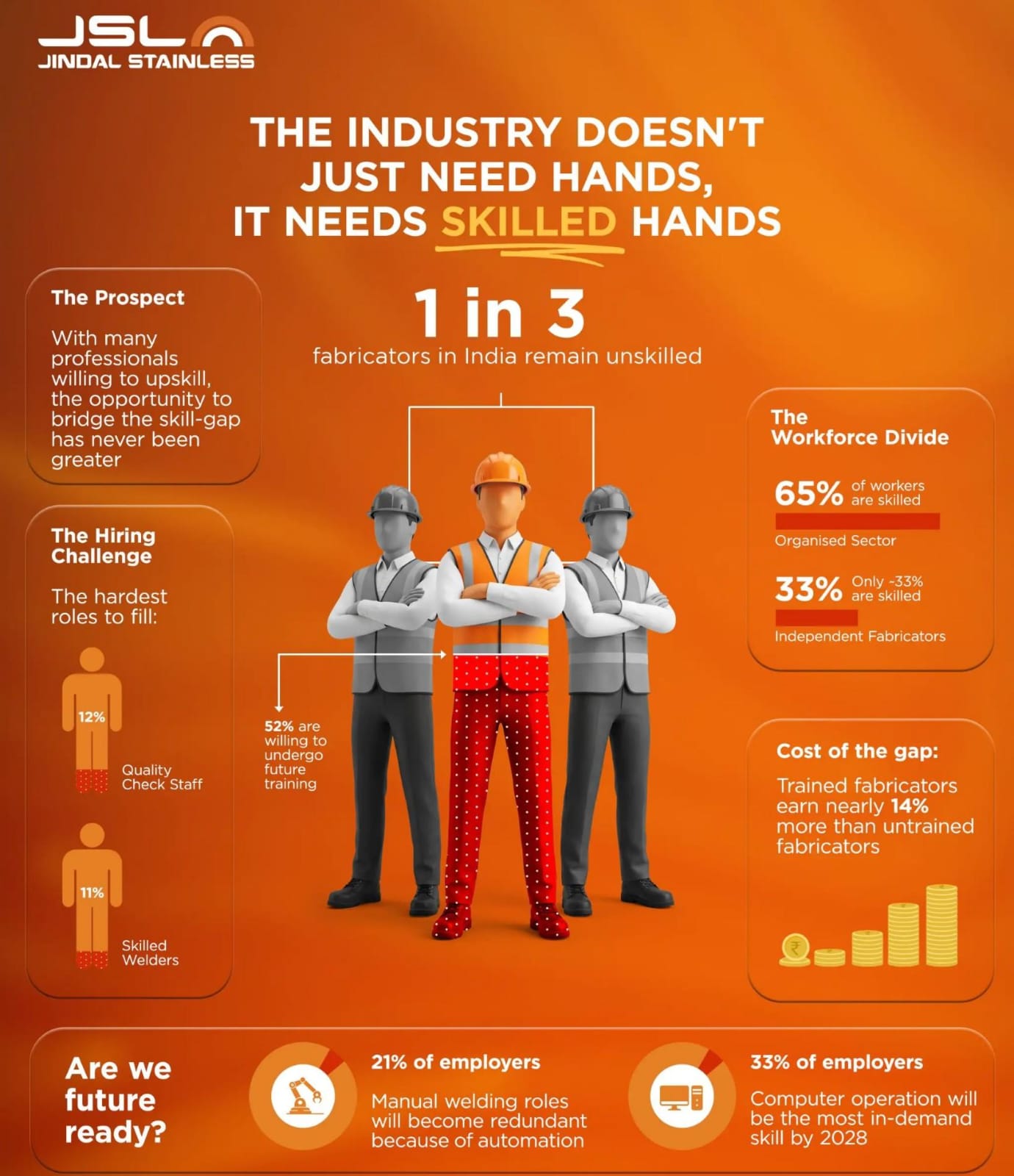
A joint study by PwC India and Jindal Stainless reveals that only 33% of independent stainless steel fabricators in India are skilled. Highlighting an earnings gap where trained workers make 14% more, the report emphasizes a critical need for industry-led vocational programs to prepare the workforce for upcoming automation.
NEW DELHI, India — A groundbreaking national study has revealed a critical talent bottleneck in India's industrial sector, warning that a lack of structured technical training could hinder the nation's infrastructure ambitions. The first-of-its-kind Training Need Assessment (TNA), commissioned by Jindal Stainless and executed by PricewaterhouseCoopers India (PwC), highlights that only 33% of independent metal fabricators possess formal industry skills. This development comes at a vital time as India pushes forward with major modernization projects in railways, green energy, and coastal infrastructure, all of which demand highly specialized steel fabrication capabilities.
Addressing the Skilling Divide in India's Steel Sector
The exhaustive report, titled Only one in three independent stainless steel fabricators are skilled: PwC - Jindal Stainless study, maps out the deep structural divide within India's manufacturing workforce. According to the assessment, which surveyed 1,904 respondents across nine states, there is a stark contrast between workers in formal and informal environments.
While 65% of workers employed in the organized manufacturing sector are considered skilled, that number plummets to just 33% among independent, self-employed fabricators. The study underscores that the primary issue is not a shortage of workers, but a systemic lack of transitional training to elevate existing workers to modern engineering standards.
This gap also carries direct financial consequences. The Only one in three independent stainless steel fabricators are skilled: PwC - Jindal Stainless study reveals that certified, trained fabricators earn approximately 14% more than their unskilled peers. Improving access to training is therefore seen not just as an industrial necessity, but as a direct driver of household income growth. Fortunately, demand for education is high, with 52% of surveyed independent fabricators expressing a strong willingness to undergo formal technical training.
The Academic Mismatch and the Role of Industry Training
A key area of concern highlighted in the joint Only one in three independent stainless steel fabricators are skilled: PwC - Jindal Stainless study is the disconnect between vocational institutions and actual industry needs.
Among the students surveyed:
58% reported feeling only moderately prepared or completely unprepared to enter a professional industrial role upon graduation.
18% of those relying solely on standard institutional curricula felt prepared for immediate employment.
93% of students who participated in direct, industry-led training initiatives reported feeling fully prepared for employment.
These numbers clearly demonstrate that standalone academic programs are struggling to keep pace with rapid manufacturing advancements, whereas hands-on collaborations yield significantly better employment outcomes.
Future Shock: Automation to Displace Manual Welding
Looking toward the near future, the workforce pressure is only expected to intensify as manufacturing facilities digitalize. Employers surveyed in the Only one in three independent stainless steel fabricators are skilled: PwC - Jindal Stainless study anticipate massive shifts in required job roles over the next three years:
21% of industrial employers believe traditional manual welding roles will become completely redundant due to automated robotics.
33% identify computer and numerical control (CNC) operation as the single most critical, in-demand skill for future hires.
Hardest-to-Fill Roles: Quality Check (QC) staff and specialized, certified welders remain the most difficult positions for employers to secure, indicating a severe shortage of high-tier technical talent.
Official Sources Section
The findings were compiled during a thorough field assessment covering Gujarat, Haryana, Tamil Nadu, Odisha, Uttar Pradesh, Maharashtra, Karnataka, Andhra Pradesh, and Jharkhand. Data collection included structured interviews with 629 fabricators, 575 on-site workers, 250 industrial employers, and 450 engineering and vocational students. The official release of the assessment was coordinated by the communications desks of Jindal Stainless and PwC India.
Quote Section
Commenting on the publication of the joint study, Abhyuday Jindal, Managing Director of Jindal Stainless, stated:
"India's stainless steel industry is poised for sustained growth, but long-term competitiveness will depend on the availability of a skilled and future-ready workforce. This study gives us, for the first time, a ground-level and evidence-based picture of where that workforce stands today and where the gaps are deepest. The findings reinforce why we established our education and skilling initiative, Stainless Academy."
Why It Matters
For developers, infrastructure planners, and the public, the findings of this study have massive practical implications. Stainless steel is highly valued for its sustainability and anti-corrosive properties, making it essential for public safety in bridges, high-speed rail systems, and marine structures. If the workforce lacks the skills to properly fabricate and weld these advanced alloys, structural integrity can be compromised, leading to project delays, inflated maintenance costs, and reduced asset lifespans. For the labor market, targeted skilling is the most reliable bridge to higher wages and protection against automation-driven layoffs.
Key Facts at a Glance
The Skill Divide: Only 33% of independent fabricators are skilled, compared to 65% in the organized sector.
The Income Multiplier: Formally trained fabricators earn approximately 14% more than their untrained peers.
The Training Disconnect: Just 18% of students relying on traditional school programs feel job-ready, compared to 93% who receive industry-led training.
Automation Threat: More than 1 in 5 employers (21%) expect manual welding to become redundant within three years.
FAQ Section
What is the main finding of the PwC - Jindal Stainless study?
The study shows that only 33% (one in three) of independent stainless steel fabricators in India are skilled, revealing a significant talent gap outside organized manufacturing environments.
Why is there a difference in earnings between skilled and unskilled fabricators?
Trained fabricators possess the specialized technical knowledge required to work with advanced alloys and modern machinery. Because of their higher productivity and lower error rates, they earn nearly 14% more than their untrained counterparts.
How is automation expected to impact the welding industry?
Employers expect automation to significantly alter operations, with 21% predicting that manual welding roles will be replaced by machines within three years. Conversely, the demand for computer-literate operators and quality-control inspectors is rising sharply.
Sources: Jindal Stainless Press Room, PricewaterhouseCoopers India (PwC) Research and Publications