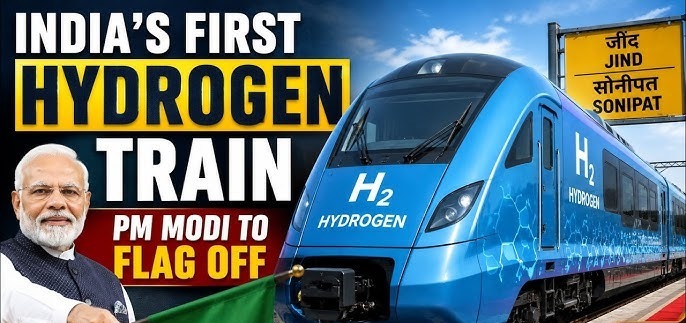
Prime Minister Narendra Modi flagged off India's first hydrogen train from Jind, Haryana, on July 17, 2026. The zero-emission, 10-coach trainset generates electricity onboard using PEM fuel cells, carrying up to 2,600 passengers along the Jind-Sonipat line, signaling a new era of eco-friendly rail transport.
JIND — Prime Minister Narendra Modi officially flagged off India's first hydrogen train today, Friday, July 17, 2026, at the Jind railway station in Haryana. The high-profile launch marks a crucial shift in the nation's transit infrastructure, introducing commercial green-hydrogen propulsion to the public network. Running on the 89-kilometer Jind-Sonipat regional section, the project showcases indigenous clean energy integration designed to systematically phase out high-emission diesel engines on short commuter corridors.
The launch occurred alongside the rollout of developmental projects valued at ₹14,700 crore across Haryana, including three major medical colleges and massive National Highway extensions. By introducing operational hydrogen fuel cell trainsets, the central government aims to directly advance its net-zero carbon targets while lowering long-term reliance on imported fossil fuels.
Onboard Electrochemical Generation Replaces Overhead Catenaries
The technological centerpiece of Friday's launch is a significant departure from standard locomotive traction. Unlike typical electric locomotives that depend entirely on overhead catenary cables, or conventional diesel multiple units (DMUs) that burn fossil fuel directly, the newly deployed hydrogen train produces all its electricity onboard. The powertrain utilizes advanced Proton Exchange Membrane (PEM) fuel cells paired seamlessly with high-capacity Lithium Iron Phosphate (LFP) backup batteries.
Inside the onboard fuel cell network, compressed hydrogen gas combines with oxygen drawn from the surrounding atmosphere. This electrochemical reaction generates clean electricity to power the main traction motors, leaving only harmless water vapor and heat as by-products. Developed under the oversight of the Research, Design & Standards Organisation (RDSO), the propulsion architecture operates at a maximum service speed of 75 km/h, with a structural design limit reaching up to 110 km/h.
Unprecedented Scale for Passenger Commuter Traffic
While early global pilot projects in countries like Germany, China, and the United States have typically focused on shorter, lower-capacity two- or three-coach configurations, the Indian Railways variant is scaled for massive commuter numbers. The new trainset features a full 10-coach layout consisting of eight passenger cars and two independent Hydrogen Driving Power Cars (DPCs) with an ultimate carrying capacity of up to 2,600 passengers.
The total energy generation tops out at a powerful 2,400 kilowatts ($3,200\text{ HP}$), establishing it as one of the most capable hydrogen passenger configurations currently operational worldwide. To maintain smooth operations, a permanent 3,000-kilogram dedicated refueling facility has been completed in Jind. The hub uses an industrial chiller system to keep the compressed gas at minus 15 degrees Celsius, allowing rapid and simultaneous dispensing to both driving power cars at an operational pressure of 350 bar.
Official Sources Section
Project spending metrics, route specifications, and fuel safety compliance profiles are formally documented according to technical briefs from the Ministry of Railways and safety certifications approved by the Petroleum and Explosives Safety Organisation (PESO).
Quote Section
"The launch of the first hydrogen-powered train marks an important step towards the adoption of clean and sustainable mobility in the railway sector," an official statement released via the Press Information Bureau (PIB) detailed. "Designed, engineered, and integrated in India, the train has been developed using indigenous technology, reflecting the country's growing capabilities in advanced railway engineering."
Why It Matters
The deployment of the hydrogen train introduces concrete shifts for various public stakeholders:
For Regular Commuters: Provides a highly refined, low-noise transit experience across regional corridors without direct exposure to diesel smoke or particulate exhaust.
For Industrial Suppliers: Opens an extensive commercial domestic market for green hydrogen production, specialized high-pressure storage systems, and specialized fuel cell sub-assemblies.
For Environmental Goals: Sets a clear framework for fully decarbonizing non-electrified local loop connections, moving closer to the target of a net-zero emission rail network.
Key Facts at a Glance
Pilot Network: The train operates along the 89-kilometer Jind-Gohana-Sonipat rail corridor in Haryana.
Extreme Capacity: Features a 10-coach configuration designed to transport up to 2,600 passengers per run.
Power Capability: Delivers a combined output of 2,400 kW ($3,200\text{ HP}$) via dual hydrogen driving power cars.
Advanced Protection: Built with multi-layered safety mechanisms including continuous leak monitoring, flame sensors, and automatic isolation overrides.
FAQ Section
How exactly does the hydrogen train generate its movement?
It features an onboard PEM fuel cell where stored hydrogen reacts electrochemically with oxygen from the air, creating electricity to power its traction motors. The only direct emissions are water vapor and heat.
What is the maximum speed of the new trainset?
The hydrogen train runs at a maximum operational speed of 75 km/h for the pilot phase, though its components are designed to comfortably hit 110 km/h.
Is hydrogen fuel safe for public passenger trains?
Yes. The rolling stock is equipped with strict safety monitors, featuring real-time leak detectors, flame sensors, automatic gas isolation valves, and specialized constant-ventilation channels.
Source: Ministry of Railways, Press Information Bureau (PIB) India, Research Design & Standards Organisation (RDSO) Technical Circulars.