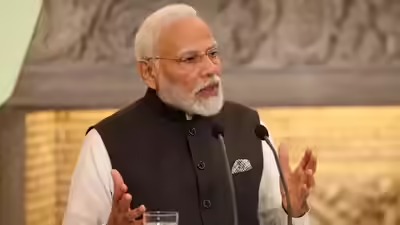
Prime Minister Narendra Modi will visit Indonesia, Australia, and New Zealand from July 6 to 11, 2026. The strategic Indo-Pacific tour focuses on maritime security, securing critical minerals, and executing a historic bilateral Free Trade Agreement with New Zealand, ending a 40-year prime ministerial diplomatic gap.
NEW DELHI — Indian Prime Minister Narendra Modi will embark on a high-profile, three-nation diplomatic tour across the Indo-Pacific from July 6 to 11, 2026, targeting enhanced maritime defense ties, critical mineral supply chains, and historic trade agreements. Announcing the itinerary during a media briefing on Friday, July 3, 2026, the Ministry of External Affairs (MEA) confirmed that the Prime Minister will travel to Indonesia, Australia, and New Zealand. The strategic tour highlights New Delhi's "Act East" doctrine and marks a historic milestone in New Zealand, where it will stand as the first official visit by an Indian Prime Minister in nearly 40 years.
Maritime Defense and Economic Reviews in Jakarta
Prime Minister Modi’s diplomatic mission begins in Indonesia on July 8 and 9, a nation representing a critical maritime neighbor within India’s extended security architecture. High-level bilateral discussions in Jakarta are slated to review the comprehensive strategic partnership between the two Indian Ocean littoral states.
According to MEA Secretary (East) Rudrendra Tandon, the focus will center heavily on expanding security tracking arrays in the Malacca Strait, stabilizing shared exclusive economic zones (EEZs), and deepening robust people-to-people links. The leaders are expected to establish real-time automated coast guard protocols to protect deep-sea logistics channels from non-traditional piracy and illegal fishing networks.
Securing Critical Mineral Tracks in Melbourne
Following the engagements in Southeast Asia, the Prime Minister will travel to Australia on July 10, with major state events centered in the industrial hub of Melbourne. Building on the strong momentum of the pre-existing Quad framework, the discussions with Australian officials will focus heavily on next-generation supply chain security.
The technical discussions are set to zero in on:
Critical Mineral Offtake Agreements: Guaranteeing stable shipments of Australian lithium and cobalt to fuel India's electric vehicle gigafactories.
Cyber Security Frameworks: Syncing defense responses to secure cross-border quantum networks and telecommunications setups.
Clean Energy Integration: Developing shared manufacturing projects for high-capacity green hydrogen electrolyzers.
Ending the Historic 40-Year Bilateral Gap in New Zealand
The tour culminates in New Zealand on July 11, marking a monumental shift in Wellington-New Delhi relations. The arrival will represent the first state visit by an Indian Prime Minister since Rajiv Gandhi's historic trip in 1986, ending a 40-year diplomatic gap. New Zealand Prime Minister Christopher Luxon formally announced the visit, noting that India's surging economy remains of enormous importance to the long-term prosperity of the Pacific nation.
The main focus will center on implementing the comprehensive New Zealand-India Free Trade Agreement (FTA) signed earlier this year. The landmark trade pact slashes tariffs across 95 percent of New Zealand's exports, opening a vast consumer market of 1.4 billion people for local goods and services.
While certain access limits on dairy products remain a point of ongoing negotiation, the trade deal is projected to significantly expand job creation and economic growth across both countries. Alongside the trade talks, a massive diaspora reception titled "Kia Ora Modi" is being organized in Auckland, with crowds expected to surpass 20,000 attendees at premier sports and event arenas.
Official Sources Section
The underlying itineraries, diplomatic agendas, trade agreements, and bilateral statistics referenced in this foreign policy report are verified by:
Executive Statements
"I'm delighted to announce Indian Prime Minister Narendra Modi will make his first official visit to New Zealand next week. We are taking the two countries' relationship to the next level with our New Zealand-India Free Trade Agreement (FTA), which will deliver more jobs, higher exports, and stronger economic growth."
— Christopher Luxon, Prime Minister of New Zealand
"According to officials from the external affairs ministry, the upcoming three-nation tour represents a concerted push to align India's economic capabilities with major Indo-Pacific partnerships, ensuring resilient resource lines and a stable maritime corridor."
Why It Matters
The execution of this comprehensive Indo-Pacific tour carries real-world structural impacts:
For Technology Industries: Securing Australian critical mineral processing pipelines gives electronics and battery manufacturers a stable source of raw materials, insulating them from global price shocks.
For Global Trade Exporters: The execution of the India-New Zealand FTA opens massive new commercial export vectors, cutting transaction costs across consumer goods sectors.
For the Indian Diaspora: The massive community gatherings in Auckland reinforce soft-power connections, making it easier to expand cultural and educational exchange programs.
Key Facts at a Glance
Three-Nation Horizon: Prime Minister Modi is scheduled to visit Indonesia, Australia, and New Zealand from July 6 to 11, 2026.
Breaking a 40-Year Gap: The New Zealand stop marks the first state visit by an Indian Prime Minister to the country since 1986.
Trade Execution: Main talks in Auckland will focus on utilizing the freshly signed bilateral Free Trade Agreement (FTA).
Resource Alignment: The Australian leg will prioritize high-yield critical mineral offtake deals and collaborative cyber security defense networks.
FAQ Section
Why is the New Zealand leg of Prime Minister Modi's tour considered historic?
The visit marks the first time an Indian Prime Minister has officially traveled to New Zealand in nearly 40 years. This long-awaited step aims to add strong momentum to bilateral relations following the recent signing of their Free Trade Agreement.
What specific commodities are being targeted during the Australian visit in Melbourne?
Bilateral talks will focus heavily on securing reliable access to critical minerals like lithium and cobalt. These resources are essential to support India's rapidly expanding domestic electric vehicle and electronics manufacturing sectors.
How will the newly signed FTA benefit businesses in India and New Zealand?
The agreement reduces tariffs on 95 percent of exports, granting New Zealand firms direct market access to a consumer base of 1.4 billion people while streamlining supply chains and cutting component costs for Indian importers.
Source: Ministry of External Affairs (MEA) India, New Zealand Government Official Press Room, S&P Global Market Insights, Reuters Diplomatic Bureau.