President Droupadi Murmu and Prime Minister Narendra Modi launched 72 massive development projects in Odisha worth over ₹47,600 crore. The infrastructure package introduces a ₹25,000 crore commercial coal gasification complex, extensive railway multi-tracking systems, and transforms the tribal village of Pahadpur into a model, grid-connected solar-powered community.
RAIRANGPUR, Odisha — President Droupadi Murmu and Prime Minister Narendra Modi on Saturday jointly unveiled a massive slate of infrastructure and industrial initiatives, launching various development projects in Odisha valued at over ₹47,600 crore. The high-profile state-level event, held under the theme “Vikas ra Dhara, Odisha Sara” (Flow of Development Across Odisha), coincided with the two-year anniversary of the state's current administration led by Chief Minister Mohan Charan Majhi. The development package accelerates India's 'Purvodaya' strategy, an economic master plan aiming to transform eastern states into primary engines for national industrial growth ahead of the country's economic milestones in 2036 and 2047.
Transformative Clean Energy and Heavy Industry Investments
The foundational cornerstone of the investment package is the ₹25,000 crore Bharat Coal Gasification and Chemicals Limited (BCGCL) complex. Scheduled for construction in Lakhanpur within the Jharsuguda district, this installation will operate as India's first commercial-scale coal-to-ammonium nitrate facility.
According to industrial briefs released by the Ministry of Chemicals and Fertilizers, the BCGCL facility aims to significantly lower the carbon footprint of domestic heavy manufacturing by utilizing cleaner coal-gasification processes, directly reducing India's structural reliance on imported chemical feeds.
Alongside the coal gasification plant, the union and state governments launched advanced power infrastructure projects worth over ₹17,717 crore. These energy security initiatives include laying the foundation stone for the 600-megawatt (MW) Upper Indravati Pumped Storage Project and initiating the Stage-II expansion of the IB Thermal Power Station, which will introduce two new 660-MW ultra-supercritical generation units to the regional grid.
Pahadpur Selected as a Model Solar Village
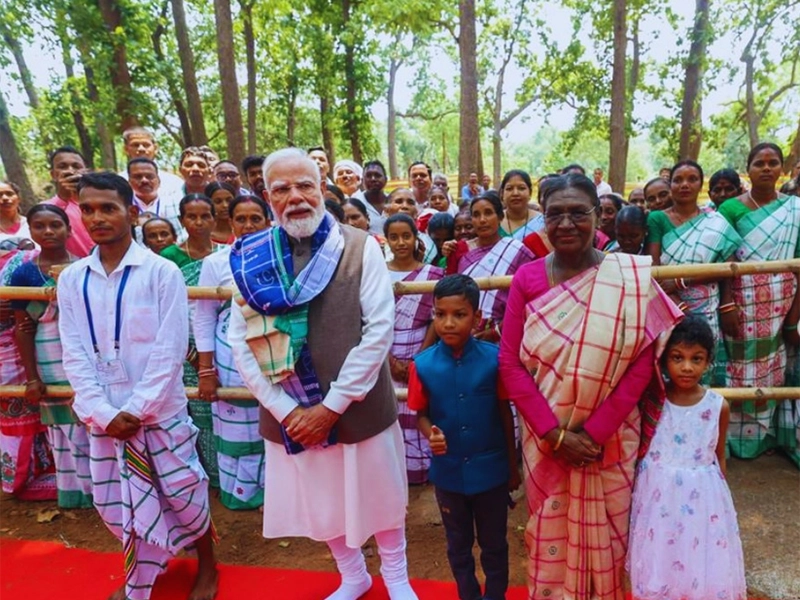
In a significant policy shift linking renewable energy directly to rural livelihood creation, Prime Minister Modi announced that Pahadpur—the tribal native village of President Murmu in the Mayurbhanj district—will be systematically developed into a model "Surya Gram" (Solar Village).
Under this green energy initiative, the Ministry of New and Renewable Energy will oversee the deployment of rooftop solar infrastructure across every residential household in the village.
The structural blueprint specifies that all homes will be equipped to generate independent solar energy. According to regional grid administrators, surplus power generated by these household arrays will be routed back into the local distribution grid through net-metering systems, providing a sustained source of supplemental income for local families. The Prime Minister drew historical parallels to Odisha's heritage, stating that just as the ancient Konark Sun Temple stands as a monument to solar energy, Pahadpur will serve as a modern national model for rural electrification.
Enhancing Transit and Healthcare Across Tribal Regions
The multi-sectoral development push allocates considerable funding to public transport, healthcare access, and regional logistics corridors. A total of ₹1,300 crore has been directed into high-priority civic connectivity projects designed to bridge rural-urban divides:
Transit Infrastructure: The immediate roll-out of 24 automated Atal Bus Stands alongside nine vehicle-testing centers to upgrade public transport safety.
Logistics and Multi-Tracking: The inauguration of extensive railway multi-tracking projects traversing critical industrial belts in Jajpur-Keonjhar and Dhenkanal.
Public Healthcare Expansion: The commissioning of a new 300-bed District Headquarters Hospital in Boudh to alleviate patient loads in central Odisha.
Official Sources Section
The logistical scope and fiscal outlays for the 72 coordinated projects were officially detailed through joint statements issued by the Prime Minister's Office (PMO) and administrative notifications distributed by the Government of Odisha Information & Public Relations Department. Project specific investment figures were cross-verified using regulatory updates published by the Ministry of Coal and Coal India Limited.
Official Statements
"Odisha is rapidly emerging as a key growth engine in India's development journey," stated Prime Minister Narendra Modi during his address in Rairangpur. "The progress achieved recently reflects the absolute strength of a double-engine government, where the Centre and the state work in complete coordination to deliver development projects in Odisha at a significantly accelerated pace. This state will play a central role in achieving our vision of a developed nation."
"The rapid execution of infrastructure, welfare delivery, and large-scale industrial projects over the past two years shows our unwavering commitment to the people," observed Odisha Chief Minister Mohan Charan Majhi. "With the continued structural support of the central government, we are translating our rich natural resources into long-term economic opportunities for every citizen, particularly across our tribal and rural districts."
Why It Matters
For citizens and regional businesses, the implementation of these development projects in Odisha resolves long-standing infrastructure deficits. Massive investments in logistics—such as the Nayagarh bypass on National Highway 57 and river bridges connecting Cuttack and Bhubaneswar—will lower transport overheads for commercial enterprises.
For international and domestic institutional investors, the formal push into clean energy, coal gasification, and pump-storage networks signals a stable regulatory environment for sustainable capital placement. The focus on rural solar initiatives like the Surya Gram model also provides a clear blueprint for companies looking to participate in India's massive decentralized green energy transition.
Key Facts at a Glance
Total Investment: Over ₹47,600 crore allocated across 72 individual infrastructure, energy, and transit projects.
Industrial Anchor: A ₹25,000 crore coal-to-ammonium nitrate gasification complex at Lakhanpur.
Green Energy Model: Development of Pahadpur into a fully solar-powered village with household net-metering.
Grid Upgrades: Over ₹17,717 crore directed into power generation, including the 600-MW Upper Indravati Pumped Storage facility.
FAQ Section
What is the core focus of the new development projects in Odisha?
The projects span multiple economic sectors, focusing heavily on heavy industrial clean energy, regional railway and highway connectivity, public healthcare facilities, and decentralized solar energy systems.
How will the Solar Village initiative in Pahadpur function practically?
Every household in Pahadpur will receive rooftop solar installations. The systems will supply clean domestic electricity, while any surplus energy generated can be sold back to the local power grid to generate household income.
What is the significance of the BCGCL project in Lakhanpur?
The ₹25,000 crore Bharat Coal Gasification and Chemicals Limited complex is India’s premier commercial-scale facility designed to convert domestic coal into ammonium nitrate cleanly, lowering industrial carbon emissions and cutting chemical import dependencies.
Which agencies are executing these multi-sector infrastructure upgrades?
The projects are being co-executed by various central ministries, including the Ministry of Coal and the Ministry of Road Transport and Highways, in direct coordination with the state departments of the Government of Odisha.
Source: Prime Minister's Office Portal, Odisha State Government Official Portal, Ministry of New and Renewable Energy regular status updates.