Defence Minister Rajnath Singh stated that future wars will be defined by technology, speed, and innovation rather than troop strength. Highlighting India's record ₹1.54 lakh crore defense production, Singh urged new military officers to focus on algorithms, automated systems, and private sector innovation to preserve strategic superiority.
HYDERABAD — Union Defence Minister Rajnath Singh urged newly commissioned officers of the Indian Air Force (IAF) to prepare for a paradigm shift in global conflict dynamics, asserting that future wars will be fought with technology, speed, and innovation. Speaking at the Air Force Academy on Saturday, June 13, 2026, Singh outlined how rapid technological changes and the weaponization of everyday devices have fundamentally altered the rules of engagement. He stated that military dominance no longer rests on conventional parameters like troop strength, but on a nation's agility in adapting to automated warfare platforms and deploying state-of-the-art indigenous systems.
The Shift from Battlefields to Innovation Laboratories
The Defence Minister emphasized that the character of modern military conflicts has evolved rapidly over the last few years, moving away from protracted, conventional armor battles toward highly dynamic, sensor-driven combat. This transition requires military personnel to cultivate an acute focus on research and a capacity to leverage tactical surprises against adversaries.
According to official briefings from the address, Singh noted that the ongoing Russia-Ukraine conflict and recent security tensions in West Asia serve as clear indicators of this transition. In these theaters, unmanned aerial vehicles (UAVs), electronic warfare counters, and high-scale autonomous networks have emerged as the defining elements of battlefield supremacy. The Minister warned that the pace of human technological evolution means that almost any civilian infrastructure or everyday technology can now be weaponized, requiring a proactive defensive and offensive posture from India's armed forces.
Indigenous Development Scales New Infrastructure Benchmarks
To address these emerging Multi-Domain challenges, the Ministry of Defence has significantly altered its domestic technology development and financial allocations:
Targeted R&D Funding: The Government of India has earmarked 25% of the national defence Research and Development (R&D) budget exclusively for private industries, academic institutions, and defense startups.
Capital Utilization: Over ₹4,500 crore has already been deployed under this policy framework to accelerate production in frontier sectors.
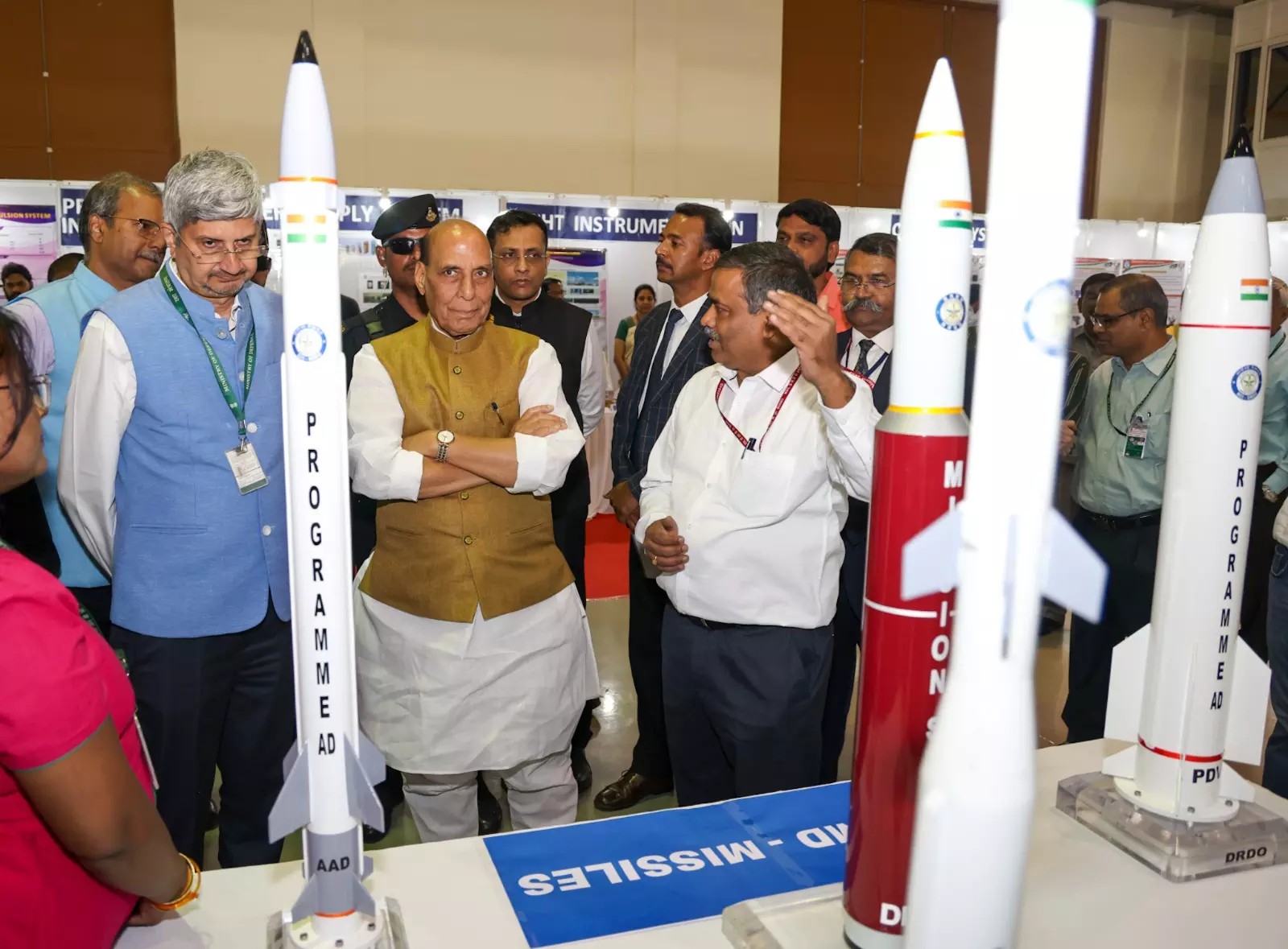
Technology Transfers: The Defence Research and Development Organisation (DRDO) has transferred more than 2,200 unique technologies to private sector firms while completely waiving technology transfer fees under updated regulatory rules.
Singh pointed out that these changes have elevated India's domestic defence production value to an unprecedented record high of ₹1.54 lakh crore, while defence exports surged to an all-time peak of ₹38,424 crore. The strategy aims to expand the private sector's share of domestic defence manufacturing from its current position of roughly 25-30% up to 50% over the coming years.
Official Sources Section
The defense production targets, R&D budgetary allocations, and technological milestones detailed in this report are verified through official public releases from the Ministry of Defence and verified industrial indicators distributed by the Defence Research and Development Organisation (DRDO).
Ministerial Commentary
"Future wars will be fought with technology, speed, and innovation. The decisive edge in warfare no longer belongs to those with the largest conventional armies, but to those who can adapt faster, innovate continuously, and strike unexpectedly. Research and the element of surprise are essential to remain future-ready in today’s technology-driven era."
— Rajnath Singh, Union Defence Minister, Government of India
Why It Matters: National Security and Industry Impact
For defense startups, small businesses (MSMEs), and tech investors, the government’s explicit pivot toward algorithms and automated systems creates an institutional market for domestic software and advanced hardware solutions. The elimination of DRDO patent fees enables small enterprises to commercialize laboratory-proven defense technologies rapidly without upfront financial friction.
For citizens and the armed forces, this transition directly enhances localized defense capabilities. By prioritizing "Make in India" mandates across complex fields—such as Directed Energy Weapons (DEWs), quantum computing, hypersonic platforms, and AI-driven airspace management systems—India is working to completely insulate its sovereign borders against foreign supply chain cutoffs during periods of geopolitical crisis.
Key Facts at a Glance
Core Strategic Mandate: Defence Minister Rajnath Singh declares that future warfare outcomes will be dictated by technology, speed, and innovation rather than soldier counts.
Earmarked Funding: Exactly 25% of the national defence R&D budget is legally preserved for startups, private firms, and universities.
Economic Benchmark: India’s domestic defence production value reached an all-time high of ₹1.54 lakh crore, supported by record exports of ₹38,424 crore.
Infrastructure Liberalization: DRDO has transferred over 2,200 technologies to corporate partners and opened up its testing facilities to accelerate private sector innovation.
Frequently Asked Questions
What does the phrase "future wars will be fought with technology, speed and innovation" mean practically?
It implies that modern military success relies on real-time data processing, autonomous drone swarms, automated weapons systems, and rapid software adaptation, rather than deploying massive ground forces or relying on slow, traditional industrial manufacturing loops.
How is the Government of India encouraging private tech companies to join defense production?
The Ministry of Defence has allocated a quarter of its R&D budget specifically to private industry and startups. Furthermore, DRDO has made its internal patents free to access and waived standard technology transfer fees.
What specific advanced technologies are being prioritized for the Indian Armed Forces?
The government is aggressively funding and fast-tracking development in Artificial Intelligence (AI), autonomous combat systems, directed energy weapons, hypersonic missile platforms, space technologies, and quantum computing.
Source: Ministry of Defence Media Release Division, Press Information Bureau (PIB) India, DRDO Technology Transfer Directory