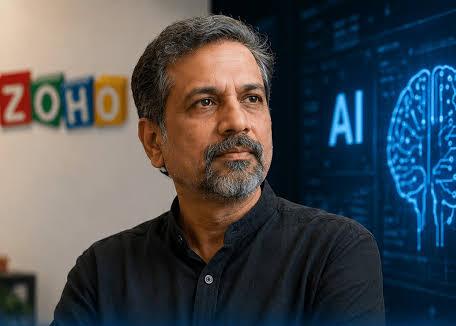
Following a US government directive forcing Anthropic to disable its advanced Fable 5 and Mythos 5 AI models for non-US users, Zoho CEO Sridhar Vembu called the incident a wake-up call. He warned that globalization is ending and urged India to build technological sovereignty through smaller, localized open-source models.
MUMBAI — Sridhar Vembu, the founder and Chief Executive Officer of Zoho Corporation, issued a stark warning to India's technology sector today, characterizing the sudden global access shutdown of Anthropic’s advanced artificial intelligence models as a critical turning point for national digital sovereignty. The statement follows an unexpected export control directive issued by the United States government, which forced San Francisco-based AI startup Anthropic to abruptly disable its newly launched, frontier-tier Fable 5 and Mythos 5 models for all users outside the United States.
The sudden regulatory intervention has disrupted enterprise software pipelines globally, exposing the structural vulnerability of international tech stacks dependent on centralized American AI vendors. Vembu, a long-time advocate for domestic research and decentralized industrialization, stated that the episode shatters any remaining illusions regarding a unified global economy. He asserted that technology has become the ultimate geopolitical instrument and declared that "Bharat must find her own way ahead" by prioritizing local, open-source model ecosystems.
Geopolitical Export Controls Trigger Sudden Global AI Blackout
The disruption began when the US Department of Commerce issued a high-priority export control directive to Anthropic. According to official corporate statements released by the company, the mandate specifically required the suspension of access to its "Mythos-class" capabilities—the newly deployed Fable 5 and Mythos 5 models—for all foreign nationals, whether located inside the United States or abroad.
Crucially, the regulatory restriction applied even to Anthropic's own foreign-national engineers. Because the company cannot systematically verify the nationality or security clearances of every automated user account globally, Anthropic was forced to pull the models entirely offline for all international clients to ensure immediate legal compliance.
Reports indicate that federal officials enacted the sudden suspension over acute "jailbreaking" vulnerabilities. Regulatory authorities reportedly determined that advanced parameters within Fable 5 could be bypassed by malicious actors to automate the identification of critical software vulnerabilities, turning the commercial model into an unapproved cybersecurity weapon.
India Inc Reacts to the Realities of Sovereign AI
The realization that critical enterprise tools can be deactivated overnight by an un-elected foreign government has triggered an immediate reassessment among prominent Indian technology leaders and financial investors. The sudden restriction has effectively divided the advanced computing ecosystem into a two-tier global structure, where top-tier foundational systems remain exclusive to domestic US entities.
Prominent venture capitalists and tech executives quickly echoed Vembu's concerns regarding structural dependence. Mohandas Pai, Chairman of Aarin Capital, urged immediate government intervention, calling for the deployment of an annual ₹50,000 crore national deep-tech fund to bankroll foundational domestic architectures. Concurrently, regional investment partners warned that upcoming corporate development projects could face severe operational delays, as technical tasks requiring significant labor hours under older architectures had been dramatically optimized under the now-banned frontier models.
The Strategic Shift Toward Smaller, Localized Models
In response to the global blackouts, Zoho Corporation confirmed it is accelerating its internal research and development pipelines to insulate its business software suite from external regulatory shocks. Vembu outlined a pragmatic roadmap for Indian enterprises, advising a deliberate shift away from resource-heavy, multi-billion-dollar Western frontier models that require unavailable pools of capital and high-end graphical processing units (GPUs).
Instead, the corporate strategy emphasizes the training and fine-tuning of smaller, highly efficient, and domain-specific localized networks. Vembu noted that by utilizing accessible Indian and international open-source base models, domestic developers can build secure, reliable systems that run locally on independent edge-computing infrastructure.
Official Sources Section
The details regarding the international export control mandates and the technical operational parameters of the model shutdowns are sourced directly from official corporate updates published on the newsroom of Anthropic. Local industrial responses, investment positions, and macroeconomic commentary correspond to formal industry notifications verified by the tech desk of The Economic Times.
Executive Commentary
"According to officials and statements released by tech leaders, the policy shift marks a definitive end to borderless technological reliance. Technology is the ultimate weapon, and national sovereignty is now entirely about technology. Any remaining people in India who have delusions about globalization should wake up now. We must dedicate our engineering efforts to smaller models that we can control independently."
Why It Matters
The global suspension demonstrates that advanced artificial intelligence is no longer governed as a standard commercial software utility, but rather as a highly restricted, dual-use national security asset akin to semiconductor designs or aerospace technology. For Indian enterprises, developers, and data privacy officers, this means that building critical business applications on top of proprietary, foreign-hosted APIs carries an existential compliance risk. It establishes a clear mandate for immediate structural investment into sovereign code bases and independent computational data centers.
Key Facts at a Glance
The Blackout Catalyst: The US government issued a national security export control order suspending foreign access to Anthropic's new Fable 5 and Mythos 5 models.
The Regulatory Trigger: Federal officials raised alarms that the model's advanced capabilities could be easily "jailbroken" to locate critical software system flaws.
Vembu's Core Assessment: The Zoho CEO declared globalization dead, defining independent technology ownership as the baseline for modern national sovereignty.
Industrial Policy Push: Leading financial voices are calling on the Indian government to create a ₹50,000 crore sovereign deep-tech and AI innovation fund.
Alternative Technical Approach: Local industry experts recommend shifting engineering resources toward smaller, open-source models optimized for edge hardware.
Frequently Asked Questions
Why did the US government restrict access to Fable 5 and Mythos 5 for non-US users?
The US Department of Commerce applied strict export control authorities over concerns that foreign entities or unauthorized actors could bypass the model's safety guardrails. Regulators believe the underlying code possesses advanced capabilities that could automate malicious cybersecurity exploits or find critical infrastructure vulnerabilities.
Can Indian companies continue to use other models developed by Anthropic?
Yes. The current federal export control directive is limited specifically to the highly advanced "Mythos-class" capability tier, which includes the Fable 5 and Mythos 5 models. Access to standard mainstream iterations, such as the widely deployed Claude 3 and Claude 3.5 series, remains unaffected for international commercial clients.
What alternative strategies are tech leaders proposing for Indian software developers?
Tech leaders are advising companies to stop building critical business dependencies on top of foreign-controlled, proprietary APIs. They recommend that Indian firms invest heavily in local talent, focus on semiconductor design, and customize smaller, open-source AI models that can run independently on domestic data centers.
Source: Official regulatory compliance briefs distributed via Anthropic Press Relations, corporate policy letters published on the social logs of Zoho Corporation Management, and live market development panels archived by The Economic Times Tech Portal.