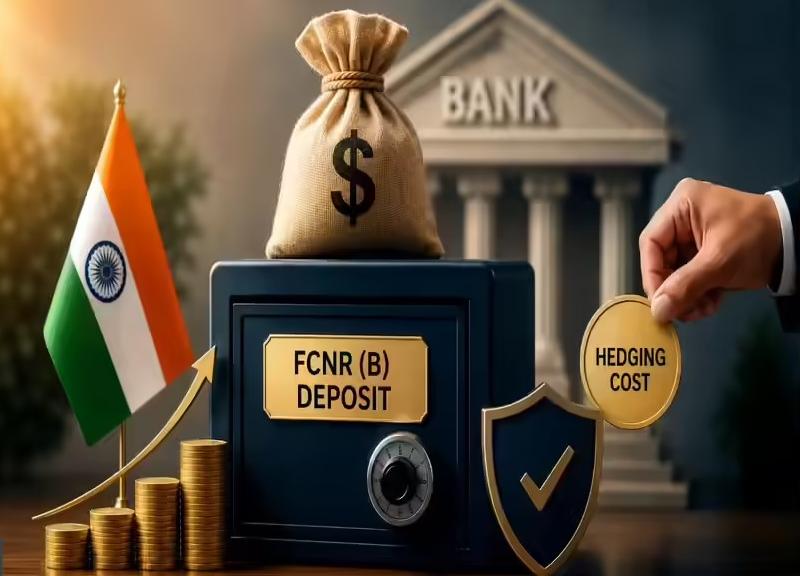
The Reserve Bank of India has ordered commercial banks to aggressively pull in foreign currency inflows through FCNR(B) deposits. By absorbing all back-end currency hedging costs until September 30, 2026, the central bank has triggered an intense interest rate war, pushing dollar deposit returns above 7% to rebuild national forex reserves.
MUMBAI — The Reserve Bank of India (RBI) has directed chief executives of major public and private sector banks to intensify efforts to attract overseas funds through Foreign Currency Non-Resident (Bank), or FCNR(B), deposits. During a high-level, closed-door meeting held on June 12, 2026, RBI Deputy Governor Rohit Jain urged financial institutions to launch an aggressive campaign targeting the non-resident Indian (NRI) diaspora. The regulatory push comes after a dramatic 86% plunge in new FCNR(B) inflows during the last fiscal year, moving the central bank to intervene directly to protect external finances and insulate the domestic currency from ongoing global macroeconomic volatility.
RBI Absorbs Hedging Risks to Defend Rupee
The central bank's directive follows its recent rollout of a dedicated FCNR(B) swap window, which effectively alters the economics of foreign currency mobilization for domestic lenders. Under this framework, the Reserve Bank of India absorbs the annual currency hedging cost—traditionally a 280 to 300 basis point burden—on all fresh three- to five-year foreign deposits.
By eliminating this hedging risk, commercial banks can offer substantially higher interest rates to overseas depositors without eroding their domestic profit margins. The swap facility is open for foreign currency deposits booked until September 30, 2026, with the operational swap window closing on October 16, 2026.
Economists note that the strategy mirrors the successful 2013 emergency stabilization plan, which brought 34 billion US dollars into the country within a few months. Global financial institutions and domestic brokerages, including Jefferies and ICICI Bank Research, project that the current intervention could generate between 50 billion and 70 billion US dollars in fresh foreign currency inflows, which could help strengthen the Indian rupee toward the 92–93 range against the US dollar.
Commercial Banks Launch Aggressive Interest Rate War
The regulatory relief has immediately triggered a highly competitive rate war across the Indian banking sector. Over the past week, major commercial entities and smaller lenders have aggressively revised their FCNR(B) rate sheets upward by 200 to 300 basis points.
| Bank Name | Peak USD FCNR(B) Interest Rate | Target Deposit Tenure |
| UCO Bank | 7.20% | 5 Years |
| DCB Bank | 7.13% | 3 Years & 5 Years |
| AU Small Finance Bank | 7.10% | 3 Years to 4 Years |
| CSB Bank | 7.05% | 5 Years |
| Bandhan Bank | 7.00% | 3 Years & 5 Years |
| State Bank of India (SBI) | 6.00% | 5 Years (For deposits over $1 million) |
| HDFC Bank | 6.00% | 3 Years to 5 Years |
The dramatic surge in yields makes Indian FCNR(B) accounts highly lucrative when compared to domestic certificate of deposit rates in western jurisdictions, where top-tier US dollar deposits currently yield just over 4%.
Official Sources Section
The operational guidelines and macroeconomic data supporting these developments have been compiled from formal regulatory communications and official bank disclosures:
The Reserve Bank of India (RBI): Official operational guidelines released on June 5, 2026, mapping out the at-par US dollar swap framework, minimum 1 million dollar transaction limits via Financial Benchmarks India Pvt. Ltd. (FBIL), and Statutory Liquidity Ratio (SLR) exemptions.
State Bank of India (SBI) Research: Macroeconomic impact projections and structural estimation reports published on June 10, 2026.
, and
ICICI Bankeffective between June 1 and June 12, 2026.
Quote Section
"The RBI's message to banks is that the country needs foreign currency inflows—it is the need of the hour. Mobilise as much as you can," stated a senior commercial banking executive present at the closed-door meeting with Deputy Governor Rohit Jain.
"The scheme is expected to be very successful in attracting dollar inflows as the RBI has absorbed the full hedge cost, which is more than 3%. Moreover, the deposits are CRR and SLR exempt. This will make it lucrative for both NRIs as well as banks," noted Gaura Sen Gupta, Chief Economist at IDFC FIRST Bank.
Why It Matters
For non-resident Indian investors, this development represents a generational high in tax-free, currency-protected returns. Because FCNR(B) accounts are held entirely in foreign denominations like the US dollar, euro, or British pound, depositors bear zero risk from Indian rupee depreciation.
For the broader Indian economy, a massive influx of stable, long-term non-resident capital helps replenish foreign exchange reserves, which declined to 681 billion US dollars in early June. This influx provides the central bank with the necessary ammunition to defend the rupee against external shocks arising from persistent geopolitical friction in the Middle East.
Key Facts at a Glance
Total Hedging Relief: The RBI is absorbing a 2.8% to 3.0% annual currency swap cost, allowing banks to pass total savings directly to global savers.
Record Interest Rates: Peak deposit interest rates for foreign currency accounts have crossed 7% for the first time in over a decade.
Strict Closing Deadline: The specialized window closes for fresh client deposits on September 30, 2026.
Regulatory Exemptions: Incremental FCNR(B) deposits under this window are exempt from Cash Reserve Ratio (CRR) and SLR mandates.
FAQ Section
What is an FCNR(B) deposit account?
Foreign Currency Non-Resident (Bank) accounts are fixed-term deposits that allow non-resident Indians to maintain their wealth in India using foreign currencies. Supported denominations include the US Dollar, Pound Sterling, Euro, Japanese Yen, Australian Dollar, and Canadian Dollar.
Is the interest income earned on FCNR(B) deposits taxable?
No. Under current Indian fiscal regulations, the interest income earned on FCNR(B) deposits remains entirely exempt from income tax in India for eligible non-residents.
Do depositors face exchange rate risks if the rupee depreciates?
No. Because the principal and interest are maintained and paid out in the original foreign currency, depositors face no rupee exchange rate risk. The back-end currency swap is strictly an arrangement between commercial banks and the central bank.
Source: Reserve Bank of India Circulars, State Bank of India Treasury Portal, HDFC Bank NRI Services, ICICI Bank Compliance Filings.