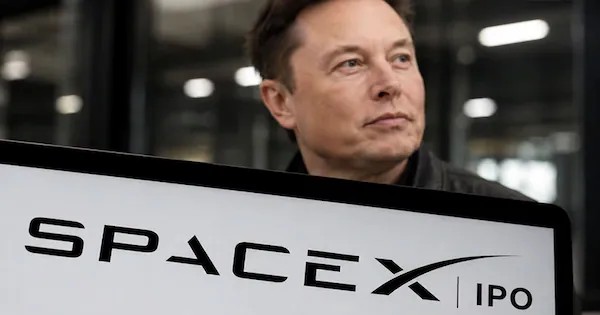
SpaceX has completed the largest initial public offering in history, raising $75 billion at a valuation of $1.77 trillion. The historic stock market debut on the Nasdaq exchange pushes founder Elon Musk's paper net worth to an unprecedented $1.1 trillion, making him the world's first documented trillionaire.
NEW YORK — Space Exploration Technologies Corp., widely known as SpaceX, completed its historic public market debut on June 12, 2026, raising a record-breaking $75 billion in the largest initial public offering (IPO) in financial history. According to securities filings and market data, the transaction values the newly combined rocket, satellite, and artificial intelligence group at approximately $1.77 trillion.
The public offering has simultaneously propelled SpaceX founder and Chief Executive Officer Elon Musk toward an unprecedented financial milestone. Financial assessments based on his non-contingent equity stakes across both SpaceX and Tesla Inc. place Musk's paper net worth at approximately $1.1 trillion following the opening bell, solidifying his status as the world's first theoretical trillionaire.
Record-Breaking Listing Overturns Global IPO Standards
The historic listing on the Nasdaq stock exchange, trading under the ticker symbol SPCX, comfortably surpassed the previous world record set by state-owned oil giant Saudi Aramco, which raised $29.4 billion during its 2019 public flotation.
According to investment bank data compiled during the bookbuilding process, the offering was heavily oversubscribed, drawing total investor demand exceeding four times the available shares. To satisfy this demand, SpaceX priced 555.6 million Class A shares at $135 each.
Lead underwriters—including Goldman Sachs, JPMorgan Chase, and Morgan Stanley—have also been granted a 30-day over-allotment greenshoe option to purchase an additional 83.3 million shares. If exercised fully, the total capital raised from the public debut could scale to approximately $86 billion.
Institutional and Retail Capital Split Driven by AI Expectations
The massive demand for SpaceX shares reflects an aggressive expansion of the company’s core business model. Earlier in 2026, Musk reorganized his holdings by merging his artificial intelligence venture, xAI, and X Holdings directly into SpaceX operations. This corporate structural shift allowed the organization to pitch itself to Wall Street not merely as a launch provider, but as an integrated orbital infrastructure and AI platform.
While institutional giants like BlackRock requested over $5 billion in shares, and sovereign wealth entities from the Gulf region secured allocations near $1 billion, individual retail investors placed orders totaling more than $100 billion. Under the unique allocation framework managed by Bank of America, small-scale retail accounts were prioritized, securing roughly 20% to 25% of the finalized public book.
Index Fast-Tracking Impacts Global Investors and Retirement Funds
Due to the monumental size of the listing, major global index providers modified traditional entry rules to absorb SpaceX into benchmark equity gauges rapidly.
Nasdaq: Approved special "fast entry" provisions, allowing the company to enter the heavily tracked Nasdaq-100 index after just 15 days of live market trading.
FTSE Russell: Enacted a swift five-trading-day entry rule to sweep the aerospace firm into the broad Russell 1000 and Russell 3000 indexes.
These rapid listings mean that passive investment instruments—such as mutual funds, pension funds, and target-date retirement accounts held by millions of average citizens—will automatically be required to purchase billions of dollars in SpaceX stock to mirror index metrics.
Official Sources Section
The financial parameters, share counts, and structural risk factors cited in this report originate directly from the official regulatory prospectus filed by Space Exploration Technologies Corp. with the U.S. Securities and Exchange Commission. Operational metrics regarding satellite numbers and subscribers are sourced from corporate data verified by the Federal Communications Commission.
Executive and Analyst Statements
During an interactive pre-IPO roadshow broadcast conducted alongside banking executives, corporate leadership detailed the immediate capital utilization plans for the incoming funds.
"According to officials, we are embarking on a massive new growth phase and we need capital for that. Doing AI data centers in space will be another massive capital endeavor, but it is also the best way to overcome energy limitations on Earth."
Conversely, some market analysts urged caution regarding the company’s current operational fundamentals. In an evaluation provided to financial media, veteran short-seller James Chanos characterized the debut as "a hopes-and-dreams IPO," pointing out that the underlying prospectus shows the company remains structurally loss-making despite its rapid topline growth.
Why It Matters
The financial arrival of SpaceX as a public entity marks a fundamental shift for retail portfolios and global tech boundaries. Financially, it forces passive index funds to alter their asset sheets, exposing ordinary retirement savers directly to the volatile space and AI sectors. Operationally, the infusion of $75 billion allows the company to aggressively build out its Starlink network and space-based data center architectures without relying on private venture rounds, accelerating the commercialization of low-Earth orbit.
Key Facts at a Glance
Total Capital Raised: $75 billion generated by selling 555.6 million shares at $135 each, making it the largest IPO in global history.
Corporate Valuation: Market capitalization established at $1.77 trillion, placing SpaceX among the top 10 largest publicly traded U.S. enterprises.
Musk's Equity Control: Elon Musk maintains 84.4% of the combined voting power, keeping him firmly insulated from typical public shareholder pressure.
Financial Performance: Company revenues rose to $18.7 billion in 2025, though net losses widened to $4.9 billion following massive research and development investments.
Starlink Network Footprint: As of mid-2026, the network operates roughly 9,600 low-Earth orbit satellites serving 10.3 million global subscribers.
Frequently Asked Questions
Does this IPO mean Elon Musk is officially worth one trillion dollars in cash?
No. The trillionaire calculation is purely an on-paper valuation based on the closing prices of his equity shares in SpaceX and Tesla. The vast majority of his wealth remains locked in illiquid corporate stock and cannot be converted easily into immediate liquid cash.
Where will the $75 billion in newly raised capital be spent?
According to company documentation, approximately $20 billion is earmarked to clear an outstanding bridge loan taken out during recent corporate mergers. The remaining multi-billion-dollar pool will fund massive infrastructure projects, including next-generation Starship deployments, Starlink network scaling, and orbital AI data centers.
Are there major risks listed in the SpaceX public prospectus?
Yes. The regulatory filings explicitly emphasize that the group continues to operate at a net loss due to extreme capital expenditure. It notes that the company may struggle to achieve long-term profitability if the commercial demand for space-based AI computing or planetary settlement fails to match current projections.
Source: S-1 Prospectus filings retrieved from the U.S. Securities and Exchange Commission, operational data logs published via the Federal Communications Commission, and financial transaction manifests released by the Nasdaq Stock Market.