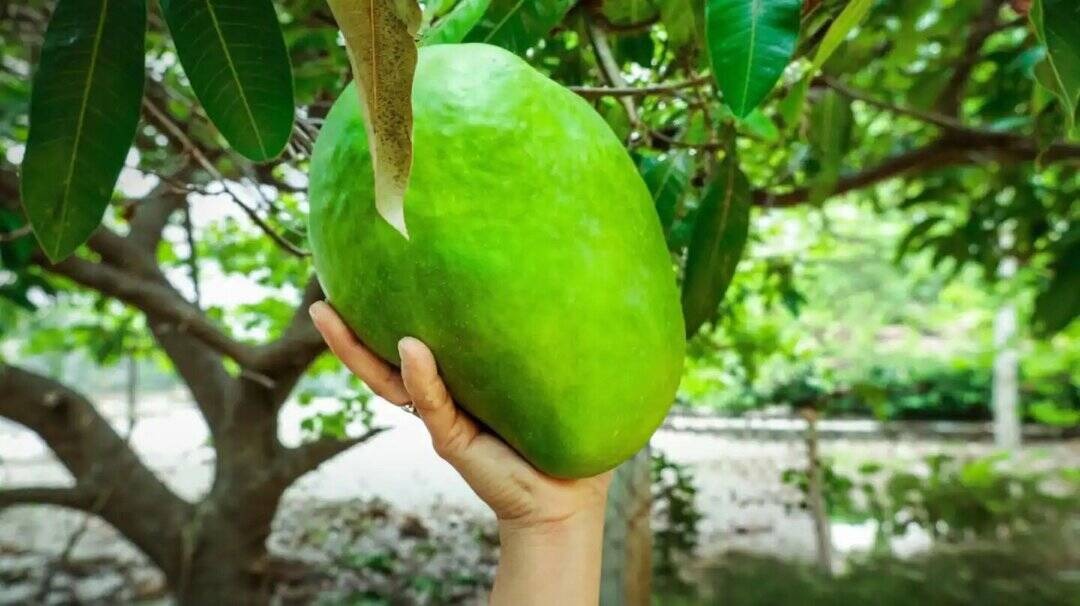
In Madhya Pradesh’s Alirajpur district, a rare 3.3 kg "Noorjahan" mango sold for ₹3,800, highlighting its status as the "Queen of Mangoes." With production limited to just three trees, the variety remains a prized, high-priced rarity that attracts enthusiasts and tourists alike during its short June harvest season.
ALIRAJPUR, Madhya Pradesh — The "Noorjahan" mango, often celebrated as the "Queen of Mangoes," has returned to the spotlight this June as local growers in the Katthiwada region report significant sales during the current harvesting season. On Tuesday, a notable specimen weighing 3.3 kilograms was sold for ₹3,800, underscoring the exclusivity and high demand for this unique horticultural variety.
Known for its extraordinary size, which can occasionally rival a papaya, the Noorjahan variety is cultivated almost exclusively in the Katthiwada region, located approximately 250 kilometers from Indore. While the current season has seen fruits reach up to 3.3 kg, growers anticipate that some of the remaining unharvested fruits could potentially reach weights of up to 4 kilograms before the season concludes.
Cultivation and Conservation Challenges
The rarity of the Noorjahan mango is rooted in its limited production. According to Bharatraj Singh Jadav, a prominent mango grower in the region, the variety is incredibly difficult to propagate. Despite numerous attempts by both the local farming community and the government’s Horticulture Department, the number of successful grafts has remained extremely low.
"There are only three mother trees of this variety remaining in the entire country, and all three are located within our family orchard," Jadav explained. Efforts to graft new saplings—including a recent project involving 70 attempts by the Horticulture Department—have largely failed to yield results, making the conservation of these existing trees a matter of priority for local agriculturalists.
Market Demand and Premium Status
The exclusivity of the Noorjahan mango has turned it into a luxury item, attracting buyers from across India, including Rajasthan, Maharashtra, Gujarat, and even inquiries from Tamil Nadu. While large-scale commercial export remains difficult due to limited yields, local growers report that the fruit often reaches international markets like the United Arab Emirates, the US, and Spain through private arrangements by enthusiasts.
Because of the limited supply—which often requires enthusiasts to pre-book months in advance—the fruit is sold individually rather than by weight. Prices typically range from ₹1,500 to ₹3,000 per piece, though exceptional specimens can command even higher premiums.
Historical Context and Development
Local legend suggests the Noorjahan variety was developed approximately 50 years ago by grafting the "Jahangir" and Gujarat’s "Rajapuri" mango varieties. The fruit was named after the famous actress Noor Jehan. While some local lore associates the fruit with Afghan origins dating back to the Mughal era, these claims lack formal documentation. Nevertheless, the mango remains a point of regional pride, having been honored at various national-level exhibitions in 1999 and 2010.
Why It Matters
For the residents of Alirajpur, the Noorjahan mango serves as a significant economic and cultural asset. Its presence boosts local tourism, with enthusiasts traveling long distances during the harvest season to witness these "giant" fruits firsthand. The potential extinction of the variety poses a risk to the region's agricultural heritage, prompting local farming families to seek sustainable ways to ensure the legacy of these trees for future generations.
Key Facts at a Glance
Record Weight: Recent specimens have reached up to 3.3 kg, with expectations for fruits up to 4 kg.
Limited Supply: The variety is believed to be restricted to only three mother trees in Katthiwada, Alirajpur.
Pricing: Individual fruits are typically sold between ₹1,500 and ₹3,000, depending on weight and size.
Cultural Significance: Often dubbed the "Queen of Mangoes," the variety has received multiple national accolades since 1999.
FAQ
Why is the Noorjahan mango so expensive?
Its high price is driven by extreme scarcity, large physical size, and the fact that it is a luxury collector’s item that requires months of pre-booking.
Where is this mango grown?
It is grown almost exclusively in the Katthiwada region of the Alirajpur district in Madhya Pradesh.
Can the Noorjahan tree be easily propagated?
No. Despite decades of effort by growers and the state Horticulture Department, propagation through grafting has proven exceptionally difficult, keeping supply constrained.
Source: Press Trust of India (PTI), ANI News, The Financial Express