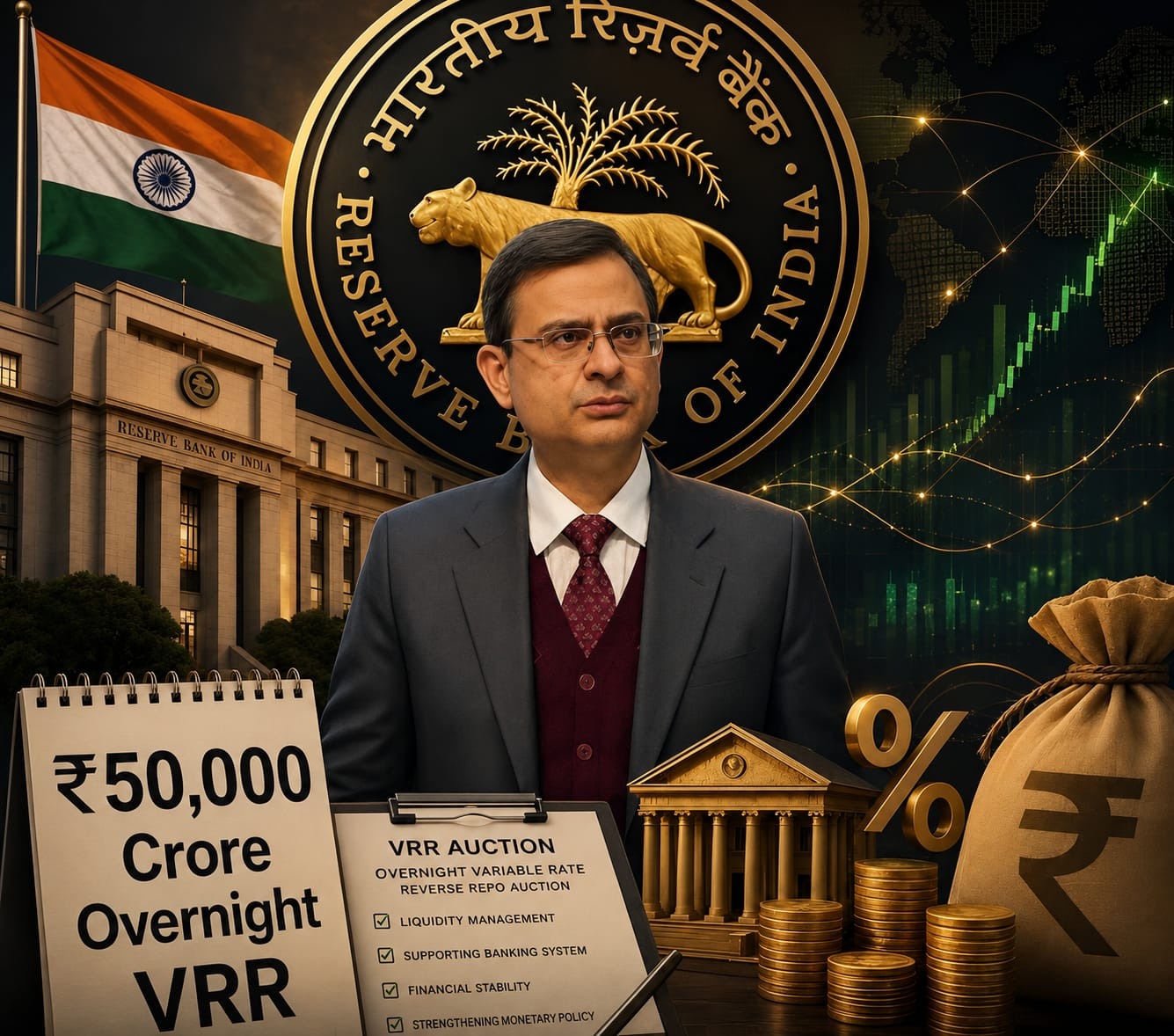
The Reserve Bank of India has announced a 3-day Variable Rate Repo (VRR) auction for a notified amount of ₹500 billion, to be conducted under the Liquidity Adjustment Facility on July 10, 2026. The operation serves as routine liquidity management to stabilize short-term interbank money market rates ahead of the weekend.
MUMBAI — Acting to fine-tune short-term liquidity distribution across the domestic banking system, the Reserve Bank of India (RBI) announced on July 9, 2026, its plan to conduct a 3-day Variable Rate Repo (VRR) auction. According to formal operational logs, the central bank has fixed the total notified amount for the upcoming intervention at ₹500 billion ($500.00 bln rupees).
The auction will be carried out under the regulatory guidelines of the Liquidity Adjustment Facility (LAF) on Friday, July 10, 2026. This structural action comes at an essential time for money market operators as the monetary authority balances immediate commercial credit needs against broader interbank capital reserves. The goal is to keep daily transaction rates close to the national policy repo rate.
Calibrating Interbank Liquidity Distribution Under LAF
The 3-day Variable Rate Repo operation targets the transactional plumbing that connects corporate lending channels and public balance sheets. Under the auction parameters issued by the central bank's communication wing, the bidding window will open on July 10, 2026, between 9:30 AM and 10:00 AM.
All scheduled commercial banks holding eligible government securities portfolios are permitted to submit competitive yield tenders during this timeframe. The funds allotted via the auction are legally scheduled for reversal on Monday, July 13, 2026, converting the injection into a standard weekend liquidity bridge designed to cover automated settlement spikes.
The operational baseline for the VRR mechanism remains tied to the updated procedural guidelines established by the central bank on January 20, 2022. Rather than adjusting macro policy, these temporary operations act as short-term open market tools. By absorbing eligible government sovereign papers from commercial bank balance sheets for a pre-set multi-day window, the central bank provides short-term cash reserves. This helps smooth out temporary transaction imbalances that can arise when quarterly advance corporate tax outlays or regional GST payouts shift cash out of commercial banks and into central government storage chests.
Navigating Structural Shifts and Interbank Funding Rates
The decision to offer a ₹500 billion 3-day repo allocation comes amid an interesting period of liquidity transitions within India’s financial architecture. Throughout June and early July 2026, the interbank lending corridor shifted through multiple structural phases. Large-scale public tax payments pushed the overall system into a temporary deficit of ₹1.99 trillion in late June, prompting the central bank to step in with a series of high-volume short-term injections.
However, currency chest numbers from early July revealed a shift toward a comfortable system-wide liquidity surplus, which recently hovered around ₹1.19 trillion. This shift led to muted demand during recent overnight operations, with banks utilizing just a fraction of the available funding windows.
| Recent RBI VRR Operations (July 2026) | Notified Amount | Total Bids Allotted | Cut-off Rate |
| July 7 Overnight VRR | ₹500 billion | ₹11.35 billion | 5.26% |
| July 8 Overnight VRR | ₹250 billion | Awaiting compilation | Market Linked |
| July 10 Scheduled 3-Day VRR | ₹500 billion | To be determined | To be determined |
This strategic transition from brief overnight infusions to a larger, multi-day weekend window shows that while top-tier banks have ample overall capital, smaller financial networks face temporary resource mismatches.
When short-term cash becomes unevenly distributed, call money rates can spike above the baseline policy rate of 5.25%. By offering a reliable ₹500 billion safety valve, the central bank keeps overnight interest rates anchored near the target policy benchmark, smoothing out market friction before it can affect broader corporate commercial paper prices.
Official Sources Section
According to official administrative announcements published via the Reserve Bank of India (RBI) Press Desk on July 9, 2026, the 3-day Variable Rate Repo auction will follow a standard multiple-price bidding format. The central bank's market operations division confirmed that individual commercial bank allotments will remain subject to the borrower's available counterparty limits and statutory collateral margin frameworks under current LAF rules.
Quote Section
In the technical operational notice provided to primary dealers and scheduled financial bourses to detail the weekend liquidity rebalancing, regulatory representatives noted:
"According to officials, the conduct of the 3-day Variable Rate Repo auction for a notified amount of 500 billion rupees under the Liquidity Adjustment Facility on July 10, 2026, aims to proactively manage short-term liquidity variations and maintain stable, orderly trading conditions within the overnight money markets."
Why It Matters
The implementation of targeted open market interventions impacts systemic stability across various economic channels:
For Commercial Borrowers: Keeping interbank lending rates steady prevents temporary cash squeezes from driving up interest rates on short-term commercial paper, ensuring businesses have access to predictable working capital.
For Banking Consumers: Calibrating money market rates ensures that retail loan structures and benchmark-linked EMIs remain unaffected by temporary, short-term liquidity shifts.
For Financial Institutions: Access to a dedicated 3-day window allows treasury managers to smooth out weekend cash imbalances cleanly, bypassing volatile alternative call-money channels.
Key Facts at a Glance
Auction Mandate: The Reserve Bank of India will conduct a 3-day Variable Rate Repo (VRR) auction on July 10, 2026.
Funding Volume: The total notified injection limit for the short-term operation is set at ₹500 billion.
Facility Framework: The short-term operation will be managed through the standard Liquidity Adjustment Facility (LAF) window.
Reversal Timeline: The injected interbank cash balances are scheduled for formal maturity and reversal on Monday, July 13, 2026.
FAQ Section
What is a Variable Rate Repo (VRR) auction?
A Variable Rate Repo auction is an operational tool used by a central bank to inject short-term liquidity into the banking network. Commercial banks borrow cash by pledging government securities as collateral, with the borrowing interest rate determined by competitive market bidding.
Why is the RBI injecting ₹500 billion if the system has a liquidity surplus?
While the overall banking system may hold a net liquidity surplus, that cash is often unevenly distributed among institutions. The 3-day auction provides a reliable funding window for specific banks facing short-term cash mismatches over the weekend, preventing localized spikes in interbank lending rates.
How does this short-term auction affect a retail consumer's fixed deposits or home loans?
This operation is an internal money market management tool and does not represent a change in the country's benchmark policy repo rate, which remains steady at 5.25%. Consequently, it has no direct, immediate impact on retail fixed deposit rates or consumer loan EMIs.
Source: Official operational press notifications released by the Reserve Bank of India (RBI) Press Desk, statutory market tracking summaries archived on the National Stock Exchange of India (NSE) platform, and monetary balance disclosures managed via the Angel One Economy Analytics Desk.