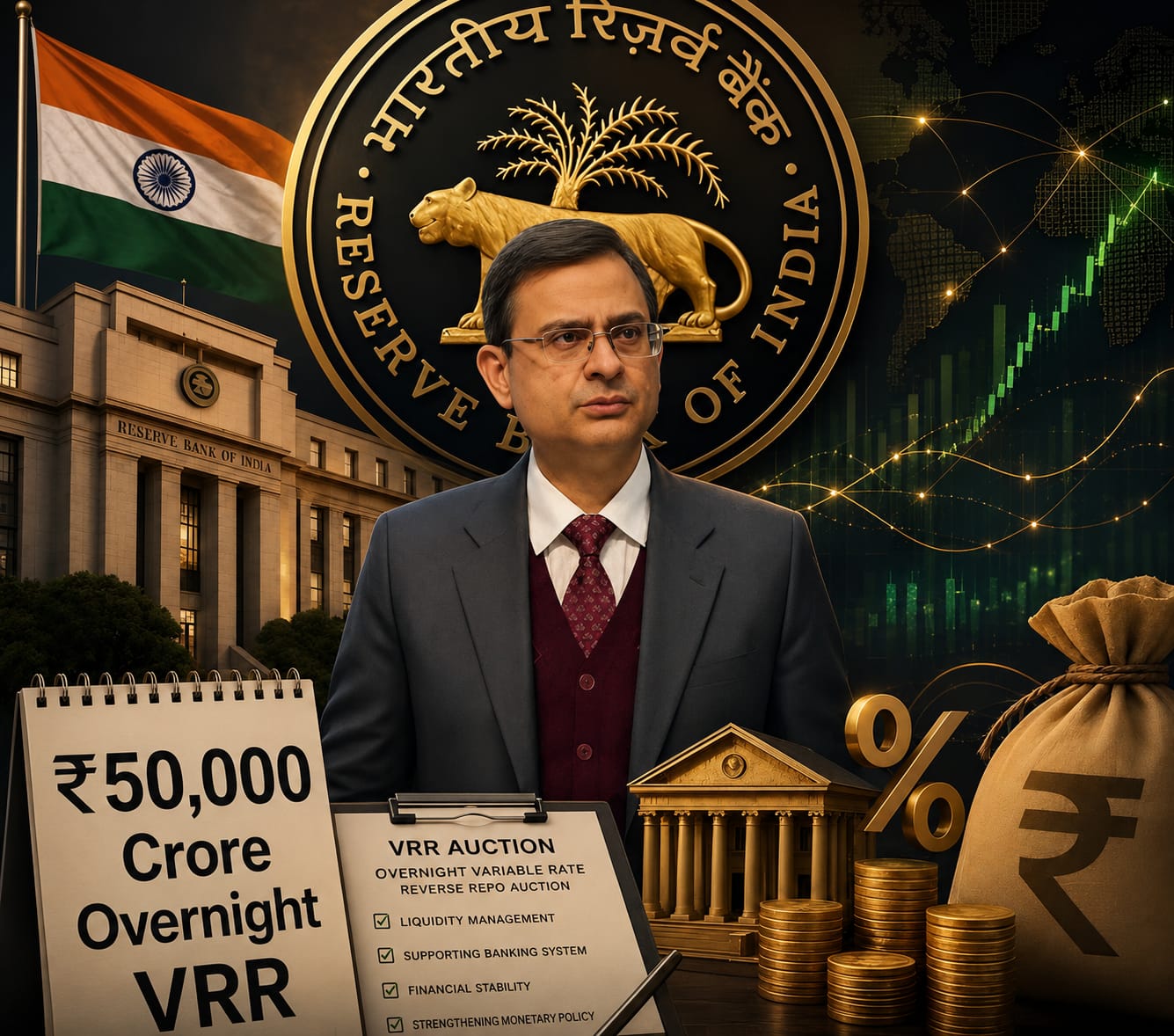
The Reserve Bank of India announced an overnight Variable Rate Repo (VRR) auction for ₹50,000 crore under its LAF framework, scheduled for July 7, 2026. The proactive cash injection aims to counter temporary liquidity deficits in the banking system caused by significant mid-year corporate tax and GST outflows.
MUMBAI, India — The Reserve Bank of India (RBI) announced on Monday, July 6, 2026, that it will conduct an overnight Variable Rate Repo (VRR) auction worth ₹50,000 crore (500 billion rupees). The liquidity injection window, operating under the central bank's Liquidity Adjustment Facility (LAF), is scheduled to open on Tuesday, July 7, 2026, to address localized cash deficits experienced by domestic commercial lenders.
The decision follows regular assessments of institutional funding balances across the domestic banking system. The rapid scheduling of the overnight operation underscores the regulator’s commitment to actively stabilizing the short-term money market.
Easing Short-Term Pressure on Systemic Liquidity
According to the official operational release issued by the Reserve Bank of India (RBI), the overnight Variable Rate Repo auction will feature a total notified amount of ₹50,000 crore. The competitive bidding window for scheduled commercial banks will open on July 7, 2026, from 09:30 AM to 10:00 AM, with the reversal of funds set to take place on Wednesday, July 8, 2026.
Treasury officials and money market analysts attribute the current contraction in systemic cash surpluses to a combination of seasonal factors. Large-scale corporate advance tax distributions alongside routine Goods and Services Tax (GST) remittance cycles have temporarily transferred significant capital out of commercial bank books and into government treasury accounts.
These massive statutory outflows routinely push overnight money market rates above the RBI's benchmark policy repo rate. When institutional cash flows experience tightening, the interbank call money rate trades near or above the upper target corridor, triggering the central bank's pre-emptive intervention threshold to prevent broader funding friction.
Maintaining the Liquidity Framework
The operational guidelines for Tuesday's cash infusion remain identical to the revised liquidity management architecture established by the central bank. Under this framework, participating banks submit electronic bids specifying both the volume of funds required and the premium interest rate they are willing to pay above the benchmark.
The current strategy highlights a proactive approach by the central bank. The RBI continues to utilize both short-term Variable Rate Repo injections and variable rate reverse repo (VRRR) operations to keep interbank call rates aligned with the target policy corridor as changing economic developments require.
Impact on Consumers and Commercial Markets
While the overnight Variable Rate Repo auction is fundamentally a structural, short-term balancing mechanism between the central bank and primary lenders, its stabilization effects ripple directly into the broader economy. By supplying immediate cash reserves to commercial desks, the RBI prevents sudden spikes in short-term borrowing costs.
For businesses seeking working capital loans, corporate bond investors, and retail consumers, this intervention ensures that commercial banks maintain a steady, predictable supply of credit without the need to temporarily adjust lending rates due to artificial, short-term capital deficits.
Official Sources Section
The timing, bidding window parameters, asset volumes, and underlying operational rules of this financial operation are structured entirely in accordance with official press notifications released on July 6, 2026, by the Reserve Bank of India (RBI) under the Department of Communication's monetary guidelines.
Quote Section
"On a review of current and evolving liquidity conditions, it has been decided to conduct a Variable Rate Repo (VRR) auction on Tuesday, July 07, 2026," stated Ajit Prasad, Deputy General Manager (Communications) for the Reserve Bank of India, in the official operational filing.
Why It Matters
This sudden overnight Variable Rate Repo injection bridges the seasonal gap caused by large corporate tax collection schedules. By offering an immediate ₹50,000 crore backstop, the central bank maintains strict control over institutional borrowing baselines, assuring domestic financial markets that short-term treasury volatility will not disrupt standard commercial banking operations or broader macroeconomic credit transmission.
Key Facts at a Glance
Auction Date: Scheduled to take place on Tuesday morning, July 7, 2026, with bidding restricted to a 30-minute window.
Total Value: The Variable Rate Repo auction has a notified maximum liquidity deployment cap of ₹50,000 crore.
Tenor Duration: Formatted as an overnight injection, with full capital reversal mandated on July 8, 2026.
Operational Rules: The guidelines for the auction match established protocols issued by the central bank on January 20, 2022.
Frequently Asked Questions
What is a Variable Rate Repo (VRR) auction?
A Variable Rate Repo auction is an elastic monetary tool utilized by the central bank to inject short-term liquidity into the banking sector. Commercial banks borrow cash from the RBI by pledging government securities as collateral, with the interest rate determined competitively via market-driven bidding.
Why are overnight interbank call money rates trading above the official repo rate?
When statutory tax payments pull large tranches of cash out of commercial bank vaults and deposit them into government accounts, the immediate supply of liquid funds drops. Lenders competing for remaining funds push overnight interbank interest rates upward until the central bank steps in.
Does this ₹50,000 crore auction signal a change in India's long-term interest rates?
No. This overnight operation is strictly a tactical liquidity management exercise designed to handle short-term cash flow volatility in the money market. It does not reflect an adjustment to the RBI's long-term monetary policy stance or structural interest rate projections.
Source: Reserve Bank of India (RBI) Official Communications Desk.