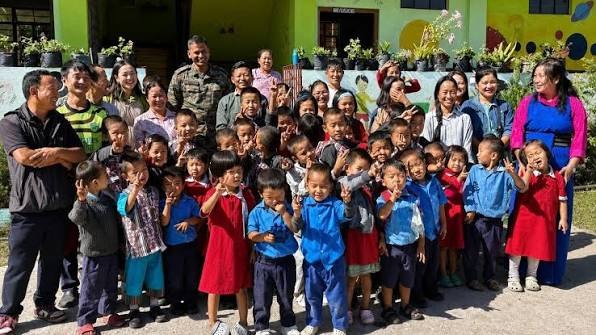
Despite a grueling three-hour off-road journey and zero cellular connectivity, the Government Primary School in Pentong, North Sikkim, provides modern educational facilities for its 18 students. Driven by educator Clock Lepcha, the school utilizes a state-funded residential hostel model to bypass hazardous daily mountain commutes for remote alpine pupils.
MANGAN, SIKKIM — Tucked deep within the Eastern Himalayas, the Government Primary School in Pentong village, North Sikkim, is establishing a vital standard for remote public education in India. Located in a region devoid of mobile network signals and vulnerable to extreme mountain weather, the institution successfully delivers continuous education from Lower Kindergarten (LKG) to Class 5 for just 18 local children. The facility highlights the state's ongoing efforts to counter geographic isolation through robust, state-funded rural infrastructure.
The Logistical Challenge of Pentong
Reaching Pentong village requires navigating some of the most rugged terrain in the North Sikkim district. The journey to the school demands a grueling three-hour off-road drive from the nearest municipal hub, crossing a narrow suspension bridge over a torrential mountain river, and ascending more than 100 concrete stairs built into the hillside.
Because of the steep, rocky landscape, transporting basic food items and educational supplies to the site is a persistent operational challenge. Furthermore, the complete absence of cellular connectivity means the institution operates entirely offline, detached from digital communication networks.
High-Quality Infrastructure in a Wilderness Zone
Despite severe environmental constraints, the school's structural resources mirror those found in urban centers. It features a well-maintained, lush green playground set against the Himalayan peaks. Inside, the classrooms are organized with modern seating arrangements and walls adorned with hand-painted instructional murals, structural diagrams, and creative art pieces designed to stimulate student engagement.
To solve the daily commute hazard for children spread across isolated mountain hamlets, the state administration runs a fully funded, free government hostel on campus. Out of the 18 students currently enrolled, only one child resides in Pentong village proper; the remaining 17 students live full-time at the school hostel.
Grassroots Leadership Drives Enrollment
The institutional success is largely attributed to School In-Charge and educator Clock Lepcha. Facing historic skepticism from agrarian and tribal families regarding school access risks, Lepcha personally visited isolated households across the mountains to counsel parents and secure admissions.
To ensure safety and maintain structural continuity, Lepcha personally escorts the boarding students through the mountain passes back to their respective home villages when the school closes for official summer vacations. A dedicated team of four full-time educators manages the comprehensive development of the 18 pupils.
Official Sources Section
According to data tracked by the Department of Education, Government of Sikkim, systemic intervention programs are active to mitigate transport instabilities across the state’s far-flung districts. The administration has increasingly focused on distributing rugged transport assets and financial support to remote schools to counteract natural geographic barriers.
Quote Section
"According to local administrative officials, structural preservation and supply lines to the Pentong educational campus are monitored systematically to prevent drops in attendance. Staff are trained to implement standard educational frameworks without relying on real-time internet connectivity."
Why It Matters
The survival and high performance of the Pentong facility demonstrate that geographic isolation does not necessitate low educational outcomes. By provisioning a free, fully residential hostel model, the government removes the daily physical risk of mountain commuting for young children. This framework offers a scalable blueprint for administrative bodies managing tribal and alpine borders across India, proving that targeted human capital investment can successfully bridge the deep-seated rural-urban infrastructure divide.
Key Facts at a Glance
Difficult Access: Requires a 3-hour off-road trek, traversing a river bridge, and climbing over 100 stairs.
No Connectivity: The entire village and campus function under zero mobile or internet network coverage.
Hostel Integration: 17 out of the 18 enrolled students are housed in free, government-funded on-site hostels.
High Staffing Ratio: Four dedicated teachers oversee the education of the 18 multi-grade students.
FAQ Section
Q1: Where exactly is this remote primary school located?
The school is situated in Pentong village, a highly isolated settlement in the mountainous terrain of North Sikkim, India.
Q2: How do students from other villages reach the school safely every day?
They do not commute daily. The government operates free residential hostels on the school grounds where 17 of the 18 children live throughout the academic term.
Q3: What grades are taught at the Pentong Government Primary School?
The institution provides early childhood and primary education, covering classes from Lower Kindergarten (LKG) up to Class 5.
Q4: How does the school function without an internet connection or phone networks?
The teaching staff utilizes standalone textbooks, offline teaching aids, and hand-painted instructional murals to fulfill the standardized curriculum without digital dependencies.
Source: Department of Education, Government of Sikkim, National Press Release Archives, The Economic Times Panache Report on Pentong School Infrastructure.