The National High Speed Rail Corporation Limited has initiated excavation on India's first undersea rail tunnel using a second mega Tunnel Boring Machine beneath Thane Creek. The 3,200-tonne machine will clear a critical 7-kilometer undersea segment for the Mumbai–Ahmedabad bullet train corridor, utilizing advanced ground-stabilizing slurry technology.
MUMBAI — The National High Speed Rail Corporation Limited (NHSRCL) officially commenced subterranean excavation for the second phase of India's first undersea rail tunnel on Saturday, July 18, 2026. Deploying one of the largest engineering machines ever utilized in domestic railway history, the second mega Tunnel Boring Machine (TBM) was successfully launched from the Sawli shaft in Ghansoli. Moving toward Vikhroli, the machine will hollow out a critical 10-kilometer underground stretch, of which 7 kilometers will run entirely beneath the seabed of Thane Creek.
This key engineering development is essential to realizing the broader ₹1.08 lakh crore Mumbai–Ahmedabad High Speed Rail (MAHSR) corridor project. The deployment represents an aggressive logistical acceleration in the Maharashtra sector of the network, providing technical infrastructure that will allow future Shinkansen-class bullet trains to traverse heavily urbanized and ecologically sensitive marine environments without disrupting surface populations or natural ecosystems.
Technical Architecture of India's Largest Rail TBM
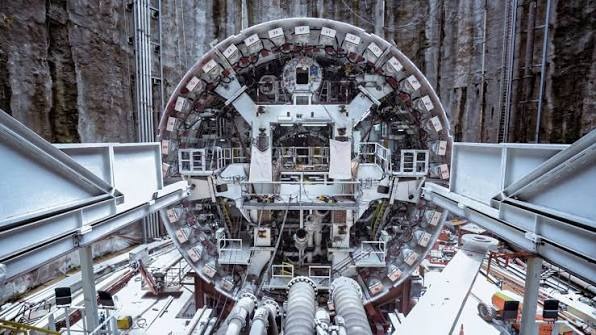
The newly deployed mega-machine features highly advanced technical dimensions engineered explicitly for complex undersea conditions. According to technical specifications released by the project implementing agency, the TBM features a cutterhead diameter of 13.6 meters—equivalent to the height of a four-story building. The entire operational machine weighs approximately 3,200 tonnes and measures 96 meters in total length, replicating the scale of a standard football pitch.
To navigate the unpredictable geological strata beneath Thane Creek, the machine operates as a Mixshield-type, semi-automatic, slurry-based system. The technique utilizes a highly pressurized liquid bentonite slurry circuit to actively stabilize the changing tunnel face during active boring. The chosen structural methodology is designed to minimize surface ground settlement and prevent water ingress in urban and coastal sectors.
Furthermore, the machine integrates a Semi-Continuous Advance (SCA) system. This mechanism permits tunnel face excavation and the installation of heavy concrete segment rings to happen simultaneously, substantially accelerating the project's net monthly progress.
Safety Systems and Real-Time Environmental Defense
Given the severe risks associated with deep sub-sea boring, the NHSRCL has constructed a comprehensive logistical backup ecosystem inside a 39-meter-deep launch shaft at Sawli. The surface environment features dedicated slurry treatment units, water processing plants, and a dedicated electrical substation supported by high-output backup generators.
To protect the structural integrity of overlying suburban neighborhoods and the marine habitat, engineers have deployed a continuous, real-time tracking network across the surface corridor. The sensor arrangement includes:
Surface Settlement Points: To instantly flag any subtle shifts in subterranean soil density.
Optical Displacement Sensors & Tilt Meters: Monitoring structural responses in nearby civilian properties.
Real-Time Gas Sensors: Integrated within the TBM shield to constantly scan for dangerous variations in methane, oxygen, carbon monoxide, and carbon dioxide.
To ensure the tunnel remains entirely waterproof over its century-long operational mandate, the concrete segment linings are being interlocked using double-layer Ethylene Propylene Diene Monomer (EPDM) gaskets reinforced with specialized hydrophilic seals.
Official Sources Section
The current construction metrics and mechanical data have been corroborated via formal public releases issued by the National High Speed Rail Corporation Limited (NHSRCL) and verified announcements broadcast by the centralized Press Information Bureau (PIB) under the Union Ministry of Railways.
Executive Statements
"The second Tunnel Boring Machine has commenced tunnelling today from Sawli (Ghansoli) towards Vikhroli in Maharashtra for the Mumbai–Ahmedabad Bullet Train Project," the Press Information Bureau (PIB) confirmed in an official executive release on Saturday.
According to officials from the NHSRCL, the launch marks the successful execution of one of the most challenging phases of the entire 508-kilometer high-speed corridor. Program directors stated that the first TBM, which began its 6-kilometer drive from Vikhroli to the Bandra Kurla Complex (BKC) terminal on July 5, is also advancing on schedule.
Why It Matters
For daily commuters, regional businesses, and international transport investors, the successful operation of the undersea TBMs represents a critical leap toward ending long-standing project delays. Once operational, the high-speed link will collapse the travel time between the financial center of Mumbai and the industrial hub of Ahmedabad from over six hours down to just under two hours.
The construction approach provides a blueprint for future complex transit corridors across South Asia, showing that mega-scale infrastructure can be built directly under critical marine channels without disrupting vital coastal shipping corridors or fragile coastal ecosystems.
Key Facts at a Glance
Undersea Scope: A 7-kilometer section of the 21-kilometer underground route will run directly under the seabed of Thane Creek, forming India's first undersea rail path.
Scale of Technology: The Mixshield TBM weighs 3,200 tonnes and utilizes a 13.6-meter diameter cutterhead capable of simultaneous excavation and ring assembly.
Deep Launch Site: The giant machine components had to be lowered in segments down a custom-built 39-meter deep shaft at Sawli.
Ecosystem Protection: The project utilizes specialized pressurized bentonite slurry loops to prevent ground cave-ins and surface land settlement in urban Mumbai.
Frequently Asked Questions
Why is the bullet train route being built underground beneath Thane Creek instead of on a bridge?
The underground approach was chosen to completely protect the delicate flamingo sanctuary and coastal mangrove ecosystems at Thane Creek from noise pollution and visual disruption, while also avoiding interference with intense maritime traffic.
What measures are being used to stop water from leaking into the undersea rail tunnel?
The tunnel structure uses high-strength precast concrete segments fitted with advanced double-layer EPDM rubber gaskets and hydrophilic seals that expand upon contact with moisture, ensuring a fully waterproof seal.
When did the first Tunnel Boring Machine begin its excavation work for this project?
The first companion TBM officially began its 6-kilometer boring run from Vikhroli toward the Bandra Kurla Complex (BKC) hub on July 5, 2026.
Source: National High Speed Rail Corporation Limited (NHSRCL), Press Information Bureau (PIB), Ministry of Railways, Government of India.