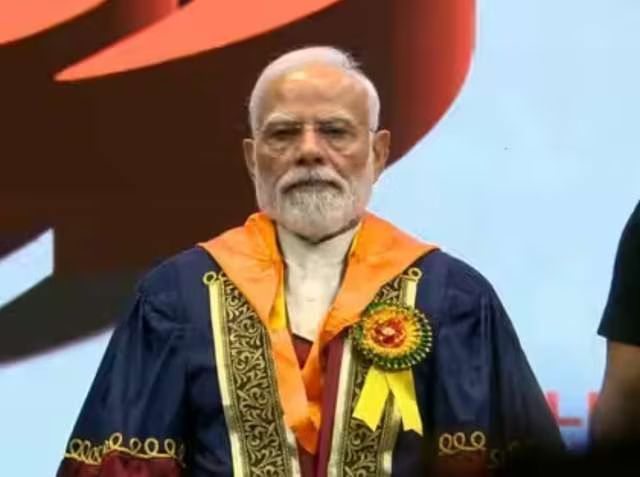
Addressing IIT Delhi's 57th convocation on August 8, 2026, Prime Minister Narendra Modi told Gen Z graduates that their decisions over the next three decades will shape India's journey toward Viksit Bharat. He urged students to stay curious, embrace continuous learning, and leverage emerging technologies to transform national challenges into opportunities.
Addressing the 57th convocation at IIT Delhi, the Prime Minister urged graduating students to harness technological innovation and guide India's long-term development.
Opening Paragraph
Placing the responsibility of national transformation directly onto the shoulders of upcoming technology leaders, Prime Minister Narendra Modi delivered a keynote address at the 57th convocation ceremony of the Indian Institute of Technology (IIT), Delhi, on Saturday, August 8, 2026. Speaking before an audience of over 3,000 graduating students, faculty members, and research scholars, Modi emphasized that the choices made by the nation’s youth over the next three to four decades will directly influence India’s overarching objective of becoming a developed nation, or Viksit Bharat, by 2047. The address underscored the critical intersection of youth innovation, emerging digital economies, and national self-reliance.
Navigating Out-of-Syllabus Challenges and Technological Shifts
Addressing the graduating engineers and scientists, the Prime Minister drew a distinct parallel between academic examinations and real-world problem-solving, noting that life's challenges rarely come with a structured syllabus. He encouraged students to maintain active curiosity and a relentless instinct for learning in an era defined by rapid global shifts.
Key highlights and core takeaways from the convocation address include:
The Power of Lifelong Learning: Reassuring graduates that "those who learn, win," Modi stressed that adaptability and continuous skill acquisition are essential as global industries evolve.
Converting Challenges into Opportunities: Urging students not to shy away from complex obstacles, he highlighted that the courage to find original solutions turns difficult circumstances into stepping stones.
Technological Self-Reliance: Pointing to strides in domestic semiconductor manufacturing and artificial intelligence initiatives—including the newly launched Param Pragya supercomputing facility—Modi stated that India is poised to build everything from microchips to heavy industrial systems locally.
Research and Innovation Funding: Reaffirming institutional backing for research, the government's ongoing push aims to channel substantial capital into scientific exploration and startup ecosystems.
Impact on Young Professionals, National Industry, and Higher Education
The Prime Minister’s message carries deep practical implications for graduating engineers, researchers, and India’s burgeoning startup ecosystem. For Gen Z professionals entering the workforce, the call to action emphasizes indigenous problem-solving over traditional corporate placement tracks, encouraging entrepreneurial ventures in high-tech sectors like AI, green energy, and deep space tech. For educational institutions and investors, the emphasis on robust research infrastructure signals continued policy alignment toward making India a global hub for technological research, manufacturing, and intellectual property development.
Why It Matters
Engaging the younger generation directly during foundational academic milestones reinforces the national roadmap toward technological self-reliance. By aligning individual career trajectories with broader national goals, leadership frameworks help channel intellectual capital toward sustainable economic growth.
Key Facts at a Glance
Event: 57th Convocation Ceremony of IIT Delhi.
Date: Saturday, August 8, 2026.
Graduating Cohort: Over 3,000 students, including 587 PhD scholars.
Core Theme: Youth responsibility in shaping India’s path to Viksit Bharat by 2047.
FAQ Section
What was the central message of PM Modi's address at IIT Delhi?
The Prime Minister urged graduating Gen Z students to recognize that their decisions over the next 30 to 35 years will directly shape India's journey toward becoming a developed nation (Viksit Bharat).
What key advice did the Prime Minister offer regarding modern careers?
He stressed the importance of lifelong learning, maintaining natural curiosity, and having the courage to find innovative solutions to out-of-syllabus challenges.
What specific technological sectors were highlighted during the convocation?
Modi highlighted rapid advancements in domestic semiconductor manufacturing, artificial intelligence research, and high-performance supercomputing initiatives.
Where can readers find the official transcript of the convocation speech?
Full official transcripts and video broadcasts are accessible via the Press Information Bureau (PIB) Portal and the PM India Official Website.
Source: Press Information Bureau (PIB), Prime Minister's Office (PMO), IIT Delhi Official Portal, DD News