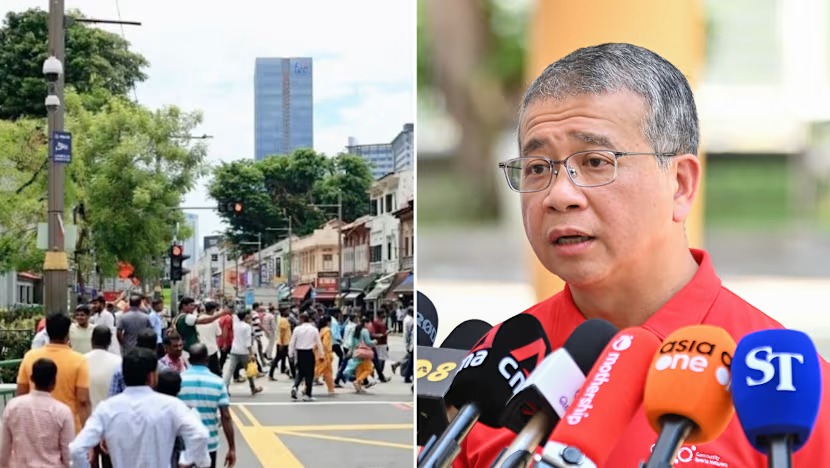
Singapore has issued Disabling Directions under the Online Criminal Harms Act to Facebook, YouTube, and X to block 14 foreign online posts targeting the local Indian community. Law Minister Edwin Tong emphasized that the nation must act firmly against offshore narratives designed to fracture its multicultural stability.
SINGAPORE — The Government of Singapore officially directed global social media conglomerates including Meta, Google, and X (formerly Twitter) to systematically block localized access to 14 digital posts containing inflammatory, anti-Indian narratives. Speaking at the Siglap South Community Centre on June 6, 2026, Edwin Tong, Minister for Law and Second Minister for Home Affairs, declared that the island nation must act firmly against coordinated or organic offshore efforts aimed at dividing its multicultural society. The legal enforcement marks a critical application of Singapore’s recently enacted Online Criminal Harms Act (OCHA) to defend domestic social stability from foreign-sourced digital friction.
Directives Issued Under the Online Criminal Harms Act
The regulatory enforcement actions developed swiftly following an internal monitoring assessment by the Ministry of Home Affairs (MHA). Investigators discovered a cluster of localized, Chinese-language video posts originating in May 2026 within the external digital information ecosystem. According to formal statutory declarations, the targeted material systematically utilized derogatory language to demean the domestic Indian community, broadcasting false assertions that Singapore was being "overrun" and displaying institutional anxiety over its ethnic demographics.
To contain the spread of these narratives, the Singapore Police Force issued formal Disabling Directions under OCHA to the parent companies of YouTube, Facebook, and X. The statutory instruments require the internet intermediaries to take all reasonable steps to ensure the specified content is completely hidden from view for end-users located within Singapore’s borders.
Officials noted that the narratives contained severe mischaracterizations designed to sow internal discord. Among the problematic talking points documented by the ministry were explicit assertions that the ethnic Chinese population holds a superior right to national belonging, that Singapore’s foundational multiracial framework is merely an artificial façade designed to appease Western observers, and that growing numbers of ethnic Indian politicians would act exclusively to favor foreign immigrants.
Investigating the Nature of Foreign Digital Threats
A primary focus for state intelligence and law enforcement was determining whether the inflammatory videos constituted a state-sponsored Hostile Information Campaign (HIC). Under the structural purviews of parallel legislation, such as the Foreign Interference (Countermeasures) Act (FICA), a state-backed digital assault triggers distinct diplomatic and legal countermeasures.
However, during an official press briefing, Second Minister Edwin Tong clarified that current forensic data does not point to a state-orchestrated operation. The Ministry of Home Affairs' technical analysis indicates the videos were likely generated organically by individual foreign netizens operating within international spaces before being cross-posted onto mainstream global applications.
Despite the low view counts on several of the flagged videos, the government rejected arguments that formal takedown orders would inadvertently spotlight obscure content. Security officials emphasized that the threshold for regulatory intervention is determined by the potential damage to national cohesion rather than raw algorithmic traction.
Societal Impact and Legal Penalties for Hate Speech
For everyday citizens and the country’s diverse workforce, the swift application of geo-blocking protections reinforces the state’s absolute zero-tolerance policy regarding xenophobia and nativism. The Indian community comprises Singapore's third-largest ethnic demographic, and individuals of Indian descent have historically held prominent institutional roles, including three of the nation's nine presidents.
The Ministry of Home Affairs stated that the distributed material likely represents a direct breach of Section 298A of the Penal Code of Singapore. This specific statute criminalizes acts that knowingly promote feelings of enmity, hatred, or ill-will between separate groups on grounds of religion or race. Individuals found guilty of orchestrating or distributing content that compromises racial harmony face severe judicial penalties, including maximum prison terms of up to three years, steep financial fines, or a combination of both statutory punishments.
Official Sources Section
The statutory directives, specific legal provisions, and case timelines presented in this journalism report are sourced directly from the official press releases and ministerial doorstop transcripts published online by the Singapore Ministry of Home Affairs (MHA). Legal definitions concerning internet intermediary compliance and hate speech parameters were cross-verified with the codified texts of the Online Criminal Harms Act and the Penal Code via the Singapore Statutes Online portal maintained by the Attorney-General's Chambers.
Quote Section
"These videos attack our multi-racial society and they try to divide people based on race. This, however, is not who we are," stated Minister for Law and Second Minister for Home Affairs Edwin Tong during his address to reporters. "Every community in Singapore here is valued and everyone has an equal place. The content reflects the agenda, unfortunately, of those who intend to divide us as a nation. And that is why we must act firmly and reject attempts from those who wish to do us harm."
Why It Matters
The enforcement action demonstrates how small, digitally open nations utilize targeted geo-blocking laws to protect domestic stability. By forcing major social media conglomerates to immediately restrict access to divisive foreign posts, the state prevents external culture-war narratives from taking root inside its local population.
Key Facts at a Glance
Regulatory Action: The Singapore government ordered Facebook, YouTube, and X to block 14 specific online posts.
Legal Framework: The Disabling Directions were legally executed under the parameters of the Online Criminal Harms Act (OCHA).
Narrative Focus: The targeted videos contained derogatory comments and divisive claims aimed directly at the local Indian community.
Source Profile: Investigations reveal the content originated overseas within the Chinese information space, generated organically by foreign netizens rather than state actors.
Statutory Penalty: Spreading narratives that incite racial enmity violates Section 298A of the Penal Code, carrying a potential three-year jail sentence.
FAQ Section
What is an OCHA Disabling Direction?
An OCHA Disabling Direction is a formal legal order issued by Singapore authorities to online platforms or internet intermediaries. It compels the platform to disable specific pieces of content or accounts so they cannot be viewed by users located within Singapore, usually to prevent criminal harm or threats to social harmony.
Did a foreign government orchestrate these anti-Indian videos?
No. Minister Edwin Tong confirmed that there is currently no evidence suggesting this was a coordinated campaign backed by any foreign government. The uploads appear to have been generated organically by various foreign internet users in external digital spaces.
What are the specific claims made in the blocked videos?
The videos alleged that Singapore was being "overrun" by Indian immigrants and that its multiracial harmony is an artificial concept designed for Western appeal. The posts used derogatory language and imagery of crowded districts during weekends to twist facts about ethnic demographics.
Can individuals in Singapore be punished for sharing these videos?
Yes. Distributing or forwarding content that intentionally promotes enmity or ill-will between different racial or religious groups is a criminal offense under Section 298A of Singapore's Penal Code, punishable by a fine and up to three years in prison.
Source: Official press statements and media doorstop transcripts issued by the Singapore Ministry of Home Affairs (MHA); statutory definitions from the Singapore Statutes Online database.